Words and Witchery: Some References for Slavic Mythology

A tall man in a Mother Christmas t-shirt stands beside a short woman in a Ukrainian embroidered blouse.
Stephen and Valya at Chicon8

Over Labor Day weekend, Stephen and I took the younger two teenagers to their second World Science Fiction Convention: Chicon 8 (San Jose was their first Worldcon in 2019).

Both of us were on panels (usually at the same time), and I was delighted to be on the Slavic Mythology panel with moderator Dr. Jeana Jorgensen, Alex Gurevich, and Alma Alexander. (Unfortunately Alex Shvartsman did not make it to the panel.)

We had a really wonderful and engaged audience, and at the end of our discussion, someone asked for additional references about Slavic Mythology. I agreed to post a list of resources published in English on my blog.

4 masked panelists seated at a table talking with a curtain behind them.
Slavic Mythology panel at Chicon 8.

I’ve done my best to collect them here. I will try to remember to update the post as I acquire new books, or as new media come to my attention.

A small disclaimer: Many books have been published recently about Slavic magic and Baba Yaga. I have not included anything as a nonfiction reference here that I have not personally read and reviewed. Some of the fiction and films, on the other hand, come from other panelists and audience members. I cannot speak to the accuracy of their portrayal or sources.

Nonfiction:

  • Slavic Folklore: A Handbook by Natalie Kononenko
  • Encyclopedia of Russian and Slavic Myth and Legend
    by Mike Dixon-Kennedy
  • The Bathhouse at Midnight: An Historical Survey of Magic and Divination in Russia by W. F. Ryan
  • Mother Russia: The Feminine Myth in Russian Culture by Joanna Hubbs
  • Baba Yaga: The Ambiguous Mother and Witch of the Russian Folktale by Andreas Johns
  • Fairy Tales of the Russians and Other Slavs: Sixty-Eight Stories Edited by Ace G. and Olga A. Pilkington
  • Witchcraft in Russia and Ukraine, 1000–1900: A Sourcebook (NIU Series in Slavic, East European, and Eurasian Studies) by Valerie A. Kivelson and Christine D. Worobec
  • Ukrainian Minstrels: Why the Blind Should Sing: And the Blind Shall Sing (Folklores and Folk Cultures of Eastern Europe)
    by Natalie O. Kononenko
  • The Paths of Folklore: Essays in Honor of Natalie Kononenko
    by Svitlana Kukharenko, Peter Holloway
  • The Gods and Goddesses of Old Europe: 7000 to 3500 BC myths, legends and cult images by Marija Alseikaitė Gimbutas
  • The Magical Universe: Everyday Ritual and Magic in Pre-Modern Europe by Stephen Wilson
  • Baba’s Kitchen Medicines: Folk Remedies of Ukrainian Settlers in Western Canada by Michael Mucz
  • Essential Russian Mythology by Pyotr Simonov

Folklorica: An open-access peer-reviewed journal produced by the Slavic, East European & Eurasian Folklore Association. The Slavic, East European, and Eurasian Folklore Association (SEEFA) is devoted to an exchange of knowledge among scholars interested in Slavic, East European and Eurasian folklore.

Fiction that draws from Slavic mythology:

  • Night Witches by L.J. Adlington
  • The Bear and the Nightingale by Katherine Arden
  • Shadow and Bone series and Grisha trilogy by Leigh Bardugo
  • Rusalka, Chernevog, and Yvgenie by C.J. Cherryh
  • The Age of Witches by Marina & Sergey Dyachenko
  • American Gods by Neil Gaiman
  • “Viy” by Nikolai Gogol (Mykola Hohol)
  • Shadows of Forgotten Ancestors by Mykhailo Kotsiubynsky (translated but difficult to find)
  • The Silence of Trees by Valya Dudycz Lupescu
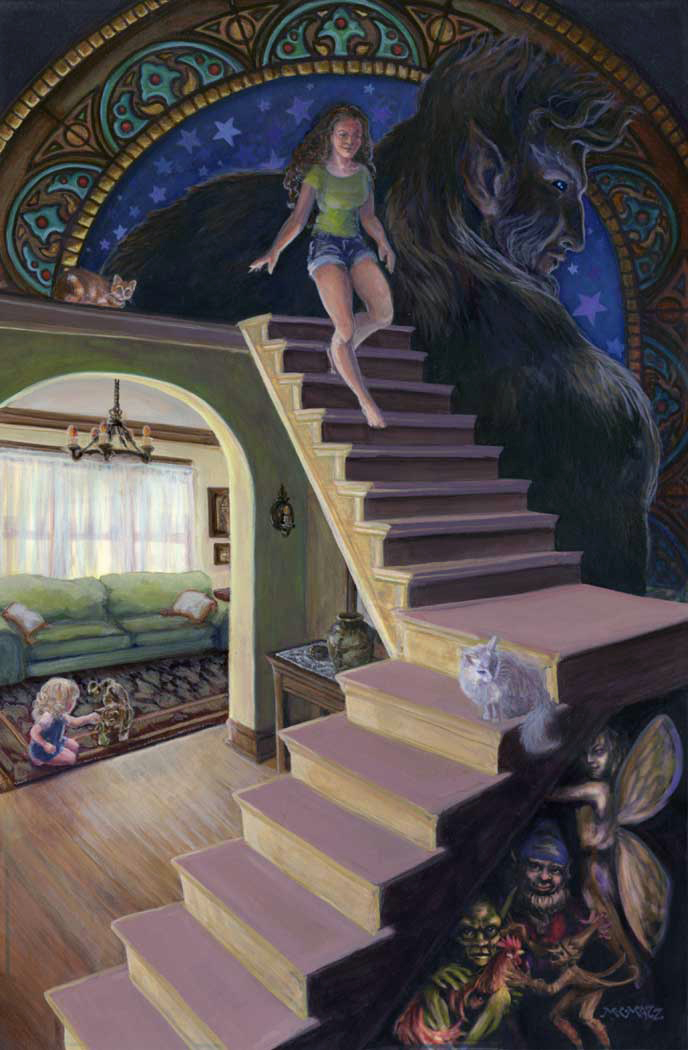
  • Sticks & Bones: Home Is Where the Hearth Is (comic) by Valya Dudycz Lupescu & Madeline Carol Matz
  • Uprooted and Spinning Silver by Naomi Novik
  • The Secret History of Moscow by Ekaterina Sedia
  • Deathless by Catherynne M. Valente
  • The Forest Song by Lesya Ukrainka (play, translated by Percival Cundy)
  • Mesopotamia by Serhiy Zhadan

Television & Film

  • American Gods (Starz)
  • Shadow and Bone (Netflix)
  • Shadows of Forgotten Ancestors (1965 – Ukrainian: Тіні забутих предків, directed by Sergei Parajanov)
  • The Witcher (Netflix)

Articles:

A stack of books topped by a Baba Yaga figurine.

Is Comic a Dirty Word?

I began this post when a Kickstarter backer asked if Sticks and Bones was a comic or a graphic novel. It was a good question, and I set off to discuss the differences between the two.

Both comics and graphic novels are sequential art. In Comics and Sequential Art (1985) Will Eisner describes sequential art as “the arrangement of pictures or images and words to narrate a story or dramatize an idea.”

As a lover of the form, but someone just beginning to dip her toes in the process of creating comics, I turned to books and the internet for definitions of “comic books” and “graphic novels.” Who better to consult than those creators and artists who have shaped and redefined the industry?

While doing research, I discovered an interested phenomenon. The distinction between comics and graphic novels seems to be most often made by those outside the industry. Many comic creators and artists seem comfortable to classify all sequential art under the category of comics.

“It’s a marketing term… that I never had any sympathy with. The term ‘comic’ does just as well for me… The problem is that ‘graphic novel’ just came to mean ‘expensive comic book’ and so what you’d get is people like DC Comics or Marvel Comics—because ‘graphic novels’ were getting some attention, they’d stick six issues of whatever worthless piece of crap they happened to be publishing lately under a glossy cover and call it The She-Hulk Graphic Novel….” (Alan Moore, “The Alan Moore Interview: Northampton / Graphic novel”. Blather.net. October 17, 2000).

If I had to try and explain the difference, I would say that a graphic novel is a longer narrative work (like a novel) revealed by sequential art instead of words alone. It has a beginning, middle, and end crafted with a story arc that is the convention in most novels or plays (exposition, rising action, climax, falling action, and resolution). Its length seems to average between 60 and 120 pages.

A comic is usually smaller in scale, 20-24 pages bound with saddle-stitching. Within those pages, most comics also have that same narrative structure. Serial in nature, the story also continues from comic to comic.  Collections of comics are sometimes grouped together and published as graphic novels.

Again, the distinction is subjective, it seems to be a matter of perspective and preference. I kept thinking of the Robert Graves poem, “The Naked And The Nude,” where the narrator contrasts the two words (naked and nude), coyly commenting on semantics and playing with the connotations of two synonyms.

Is “comic” a dirty word in literary circles?

Comic books and graphic novels are earning more respect and critical academic consideration than ever before, but for decades they were considered “low art,” in contrast to “higher art” forms like literature or the fine arts. Essays and dissertations have been written on this evolution and distinction by scholars (you can google it, there is so much out there). There is also an International Comic Arts Forum, a Comic Book Legal Defense Fund, and some universities have added Comic Arts or Comic Studies to their curriculum.

Attitudes seems to be changing, and yet when I mentioned that I was writing a comic, the response was tepid to negative from some of my more literary associates: Why would I want to do that? How would it reflect on me as a writer? Wouldn’t it be a waste of my time?

I believe that the story dictates the form. As a writer, one of my tasks is to choose the right one: some stories work best as novels, some as flash fiction, some as plays, others as comics.

With Sticks and Bones, Madeline and I hope to create four comics that can someday be collected and published together. In the meantime, the first issue: Home Is Where the Hearth Is, will stand alone. It’s a short story told using sequential arts.  It’s a comic book.

I’m proud of the story, and I’m thrilled by the depth that artist Madeline C. Matz brings to it with her beautiful art. I’m also excited to slip into the back of a continuum of writers whom I respect that tell poignant stories using the comic book form.

I hope that you enjoy Home Is Where the Hearth Is. There are 9 more days to pre-order your copy and spread the word!

Kickstarter Comic: Sticks and Bones (Issue 1 – Home Is Where the Hearth Is)

In graduate school at the School of the Art Institute of Chicago, I took a class called the Shape and Structure of the Book with M. Evelina Galang. It was one of my favorite classes because we broke books apart to see how they worked, looking at the bits: choices of perspective, setting, chapter breaks, syntax.

I love knowing how things are put together, especially stories. Everything is a choice when you’re crafting a story: Where do you start? Who is the protagonist? How many chapters? What do you name the town? How much history do you include? What word best describes the villain? Where do you end? What will be your first sentence? What will be your last? So many choices. Some conscious, some intuitive.
If a writer is successful, readers don’t notice the machinations of the plot, characters, setting. A puppeteer doesn’t want you to think about the strings. A magician doesn’t  want you to focus on the sleight of hand. A writer doesn’t usually want you to notice a clever plot device or stop to admire the way a character’s backstory was carefully developed.

Last year, I had the idea for a story. I wrote it, and I liked it, but it didn’t feel quite right. A few months ago I realized that this was because it wasn’t meant to be a short story, but a comic. So I wrote it and revised it (thanks to some helpful comments and feedback), and I asked artist Madeline C. Matz if she’d be interested in doing the artwork for it, funding it through Kickstarter. She was, and away we went!

Last week we launched our first Kickstarter comic project: Sticks and Bones: Issue 1 – Home Is Where the Hearth Is.  The comic explores issues of home, roots, identity, and sacrifice on 24 fully-painted pages.

Home Is Where the Hearth Is tells the story of Yaroslav, a displaced house spirit in America looking for a new home. At its heart, this is a fairy tale about love and transformation, and the sacrifices we make to find our place in the world.

You can learn more about the comic and the incentives being offered to backers on our Kickstarter page:

http://www.kickstarter.com/projects/valya/sticks-and-bones-issue-1-home-is-where-the-hearth

We’re hoping to raise $3,500 to cover the costs of production, printing, shipping, and promotion. As is the Kickstarter policy, if we do not raise the full amount, no one gets changed and we will be unable to complete the project. If we raise beyond that around, we plan to print more copies and then begin Issue 2.

Available on the kickstarter page, here’s my attempt at an introductory video (encouraged by Kickstarter). The beautiful musical score is “The Domovyk’s Lament,” written by Rob Lambert. The photos are used with permission by 8 Eyes Photography. The shaky camera is my feeble attempt at videography. Forgive me, I usually work with words, not cameras.

Thank you for your support!