Our Kitchen: Cooking Under Construction

Last year we moved into a historic 1920s building in Chicago. The apartment had been empty for nearly a decade and was previously decorated in the popular styles of bygone eras — color and accessory choices from the 80s being the predominant style for the elderly couple who lived there before us.

I have grown to love all the kitchens I have had in my lifetime, from the spartan European kitchen I had in Frankfurt, with its tiny fridge and Ikea table where the kids would color, to my beloved Spanish-style kitchen in Casa del Lobos, with its red clay tiles and beautiful backsplash. (I cried when saying goodbye to that kitchen.)
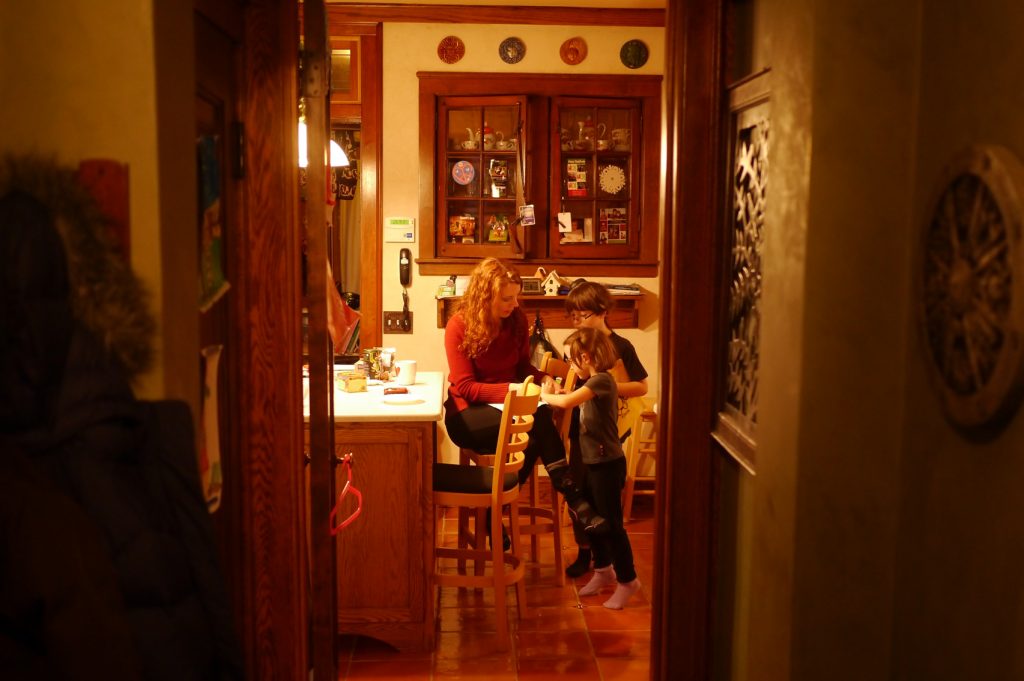
Trillian Stars with the kids in Casa del Lobos. Photo by Kyle Cassidy.

I understand that the kitchen is ultimately a container. It’s what we fill that space with that matters: the joyful celebrations and thoughtful conversations, as well as the architectural details, furniture, photographs, and art. I knew the style of this kitchen needed to be different, to denote a new chapter in our life, to complement the deco sensibility of the apartment, and also to deal with the challenges of a narrow cooking space that had to accommodate the daily maneuvering of two adults, three rapidly growing children, and two cats.

We tried to return the aesthetic of our apartment as close to the Art Deco style of the time when it was built.

However, the kitchen had already been “renovated” before and needed new cabinets and appliances. We kept it simple and clean; and because there was an impending massive building-wide plumbing renovation that was set to start soon after we moved in, we decided we’d wait to do things like backsplash tile.

As soon as the appliances were installed, pots and dishes were in their places, the pantry was full of food, and the ancestral altar was set up, I fell in love with our galley kitchen.

Even working full-time, I spend a lot of time in the kitchen, not just cooking but chatting (in person, on the phone, on the computer) and writing. This is why I made sure to allow for a little counter space where I could sit on a stool and use my laptop; it’s also where Lana often sits to help me or keep me company while I’m cooking.
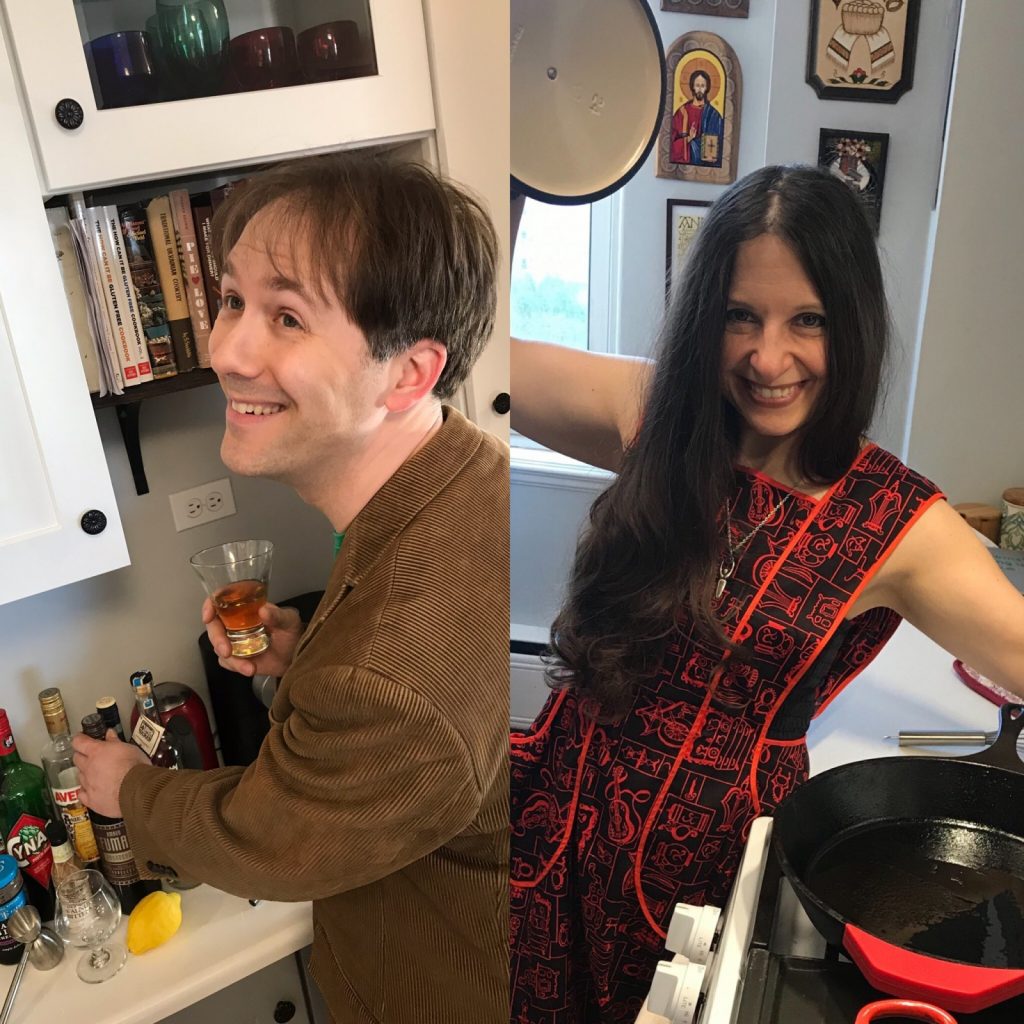
We mounted a radio under the cabinet so that we can play music (in case of spontaneous kitchen dancing), and when I feel stressed or overwhelmed, you can find me sitting on the stool by the window to see the sliver of lake in the distance or sitting on the floor beside the stove, with my back to the dishwasher. It’s usually the warmest spot in the apartment, and sitting there helps me to feel better, to feel grounded.

So as soon as the kitchen was ready, we settled in and started cooking and writing in a philosophical pun-filled frenzy to create the manuscript for Forking Good. 

Testing recipes for Forking Good, 2019.

When that was done and the manuscript sent off to our editor, it was time to pack everything back up into boxes, cover it all with dropcloths, and effectively stop using the kitchen for a few months while the plumbing work got underway. Goodbye to our lovely kitchen and hello to crockpot recipes in the dining room, barbecue in the garden, and the occasional takeaway Thai or pizza. Not to mention dishes washed in the small powder-room sink.

Kitchen plumbing construction, 2019.

Our building is massive, and the carpenters, plumbers, and crew have been working from the top down, riser-by-riser to replace all the pipes (often encased in concrete) in the walls. There have been days when the only disruption has been the thundering  wall-shaking from above or below, and other days when they are in the apartment opening up plaster walls and replacing massive pipes. Most days we come home to a layer of dust that has crept around drop cloths or was shed from the ceilings and walls with all the vibrations.

It has been… a challenge. I have moved enough times to have developed a true dislike of boxes cluttering my home, and I need to feel like there is a certain semblance of order before I can relax. This means the past few months I have been more tightly wound than usual and waiting for the work to be done so that our home can go back to curated creative chaos, not the messy disruption of construction.

Thankfully, it’s summer now, and that means a greater use of outside spaces and brainstorming about picnic ideas and grilling. It’s a little easier to not feel trapped by clutter when you can walk down to the beach in five minutes.

Mid-afternoon clouds over the beach.

The good news is, we are in the final month’s countdown until all the major work should be completed. We have just gotten back into the kitchen, so we should be able to post from there more regularly leading up to the book launch. We’re trying to figure out now which Forking Good recipes everyone might be curious to see behind the scenes, or maybe a few that we chose not to use.  Would you like to see videos, as well as photographs of food and process?


Ukrainian Christmas Blessings

Much like Greeks, Russians, and other Slavic people, many Ukrainians (Orthodox and Catholic alike) celebrate Ukrainian Christmas today, according to the old “Julian” Calendar.
WILLIAM KURELEK, Ukrainian Christmas Eve (1973)

We have always celebrated both Christmases in our family.  “American” Christmas was the festive holiday for Christmas movies, carols, and Santa Claus. We would watch the skies for signs of Santa while driving home from my Uncle Mike and Aunt Sophia’s, and my sister Nadya and I often fell asleep in the car before we even got home.

Ukrainian Christmas was the more sacred winter holiday for us, connecting us to family but also to our ancestors. Sviat Vechir (Holy Night) dinner on Christmas Eve night was at the heart of the holiday, and we would go to Baba Dudycz’s house with all the aunts and uncles and cousins. Baba had her tree decorated, and around the house hung several of Baba’s pavuky (more on the pavuk can be found here). The small house was filled with family, and it always smelled amazing–frying onions, baked bread, borshch, mushroom gravy, the sweet kutia. My cousins and I amused one another with stories and games as we waited,occasionally entertained by adults who took turns interacting with us or watching television with Dido in the front room.

After seeing the first star in the sky, we said a prayer and often sang a Ukrainian carol, then feasted on the traditional dishes. I knew that Baba and my aunts were working in the kitchen, but I never really appreciated how much work it was until I prepared the dishes myself many many, years later. Baba and Dido Dudycz would beam as the meal began, so proud of their big, beautiful family; so happy to be sharing this treasured night.

There would always be a place set for our Beloved Dead, for our ancestors. The night felt like magic to me. I truly felt like our family from Ukraine would come to visit while we sat there, and I wondered which spirits from Baba and Dido’s lives back home made their way across the big ocean to visit with them, and with us.

There was never a doubt that some of them would come, that they could not be deterred by time or distance, because they were family; and where there is love, there is the most powerful of connections. If anyone could make a feast to entice the ancestors from “home,” it would be Baba.

Looking back, I realize that Sviat Vechir, even more than other rituals and holidays, formed my ideas about our relationships with our Beloved Dead; because even though I had not yet experienced a personal loss, I knew that after people died, they were not gone and forgotten. Like any relationship, we would have to work to nourish and maintain it. It was our job to remember and to honor them.

Many of my fondest memories are from the many years of Sviata Vecheria meals squeezed into that dining room around those long tables. This is also where I developed the idea that sharing a meal with loved ones is a sacred experience, and preparing food with intention is one of the greatest ways of showing love–because you could feel the love, taste the love in every bite of Baba’s cooking.

Baba 1987

Today the family has grown larger and spread out across the state, and even if we were able to all gather together (which is rare these days), there would be many faces missing from around that table. We’ve lost too many of our loved ones, and there is a hole in our hearts that is full of memories but still aches for them. But when my sister and I gather at my parents’ house, and my cousins gather with my aunts and uncles–the same traditional dishes are made with love, the prayers are said and carols may be sung, memories are shared, and our family who have died are with us. I have no doubt that Baba and Dido make every stop to see all of their family.

So when I put portions of every dish on the ancestor plate, I serve them before myself, and I whisper the names of the loved ones we have lost. The room, although not as full as Baba’s house, gets a little cozier, a little more full, and I know that they have come. Because we do get small miracles and moments of grace in this lifetime. I can feel them still beaming and loving us–because love is the most powerful of connections, and what is remembered, lives.

Veselyh Sviat. Христос народився! Merry Christmas.

Writers and Nebulas

If you’re involved with publishing or books in some way or another, you likely know that BEA (BookExpo America) is in Chicago this year (May 11-13). What you may not know is that there’s another literary event overlapping as well. The Nebula Conference is in Chicago on May 12-15 and will feature seminars and panel discussions on the craft and business of writing.

NebulasPostcardFront20161-680x486

There is no one path to being a writer (except for the work of writing and revising). Some of us have gone through MFA or PhD programs. Some of us come from backgrounds in journalism or advertising. We are lawyers, teachers, therapists, burlesque dancers, parents, doctors, baristas, puppeteers. We have varied experiences, perspectives, and skill sets. Conventions and conferences give us the opportunity to learn from one another, and the Nebula Conference has assembled an impressive array of topics that are timely and relevant.

Here’s a sampling of the programming options for writers who register for the Nebula Conference Weekend:

Best Practices for an Author Website

Commissioning, Working With, and Compensating Expert Readers

Understanding Translation

Fighting the Harassment Game

Patreon

Podcasting for Writers

Language as Rebellion

Historical Research from the Margins

The Moral Responsibility of the Storyteller

Day Jobs for Writers

What Teens Are Looking for in YA Literature

The Future of Racism

Promotional Bootcamp

BarCon and other Secret Handshakes

So you want an assistant…

Western Narratives, There is No Single Voice in The West, So Why Do Only Hear From One?

Defense Against The Dark Arts: Protecting Yourself and Others From Harassment Online

Literary EstatesPart I and II (pre-reg required)

How to Give an Effective Reading

hodgman1Celebrating its 50th anniversary, the annual SFWA Nebula Conference will be held at the Palmer House and will include professional programming, receptions, and an awards banquet and ceremony with Toastmaster John Hodgman.

On May 13, a mass autographing session will also take place at the Palmer House that is FREE and open to the public. You can view the list of participants here.  (I’ll be there with Stephen signing copies of Geek Parenting! Stop by and say hello!)

While the organization sponsoring the weekend, SFWA, is a professional organization for authors of science fiction, fantasy and related genres, the programming and speakers participating in the conference are pertinent to all manner of professional writers. From freelancing to social media, digital assets to agents—these topics transcend genre and will be presented by professional writers, editors, lawyers, and social media specialists.   

More information about the SFWA Nebula Conference can be found at: http://www.sfwa.org/nebula-awards/2016-nebula-conference/

 Autographing