Budapest and Ideas Brewing

As part of our time in Frankfurt, Germany, we’re trying to travel as much as possible. This was easier during our first stay here, when we had but one child. Now, with three children under six, it’s more complicated. Not impossible, but difficult.

Last month, we went to Budapest, and it was lovely but cold. The kids had a great time (we stayed at a hotel with an indoor water park), and it was a nice holiday away. We saw the Buda and Pest sides in winter, and each has a beautiful character quite unlike the other. Overall, the city reminded me a bit of Vienna.

The most memorable part of the holiday was our visit to the New York Café, where I had the best dessert that I have ever had in Europe. We’ve had memorable desserts in Paris, Barcelona, Malaga, Vienna, and other places; but truly this was the best. I’m sure that the setting and history contributed a bit, but the quality and presentation of the desserts were excellent.

The New York Café has an interesting history, and for me, it was love at first sight. The café actually gets its name from the New York Insurance Company, who commissioned the Art Nouveau building in 1894. The New York Café held its grand opening on October 23, 1894, and soon took its place as one of the most famous of nearly 400 literary cafés in Budapest at the end of the 19th century.

From the early 1910s until the 1930s, Budapest boasted of a thriving coffee culture, where writers and artists spent much of their day creating and chatting at their “regular” tables. They enjoyed free ink and paper, and they ate from a discounted “writer’s menu.”

The New York Café was frequented by famous literati of the time: Michael Curtiz (born Manó Kertész Kaminer), director of Casablanca, dined there with Sir Alexander Korda (Sándor László Kellner), director of The Thief of Baghdad.

Legend has it Ferenc Molnár, a famous Hungarian writer, and his friends threw a key to the café in the Danube, so that the café should never be closed. It seems that his “magic” may have worked, and I hope that it continues to exist until the next century.

Unfortunately, it was ravished by two world wars, turned into a shoe shop, then a tourist restaurant, and finally restored to its original splendor in the Rococo style by Boscolo Hotels, who reopened the café and hotel in 2007.

The interior is amazing; the New York Café is a café with personality. Photos do not do it justice.

This from the Budapest Guide:

“The majestic building was built in eclectic style relying on Italian renaissance and baroque; its lavishly furnished interiors were designed in the spirit of historical eclecticism. Everything being made of marble, bronze, silk and velvet many people compared the building to the palace of the Bavarian King Louis II.”

My husband had the best apple strudel ever (and we live in Germany, so that’s saying something), and my chocolate souffle was divine.

I now have a not-so-secret dream of coming back to the New York Café someday to do a reading for one of my books. Dream big, I say. Maybe during that visit back to Budapest, I’ll also throw a key from the New York Café into the Danube.

Childhood memories

I’m making my way through an advance reading copy of Philip Smith’s Walking Through Walls, a memoir about growing up in the 1960’s with a famous interior decorator father who discovers that he has psychic powers. I haven’t gotten very far into it, but what I’ve read is interesting. In the beginning of the book, Smith details his life in Miami in the 50’s , when his father was an interior designer for the rich and famous around the world. He mentions several of the more unusual aspects of his childhood, and how he often wished he could be part of a “normal” family.

This book got me thinking a little about my own childhood, which certainly had its share of unusual moments (although not nearly as exotic as some that Smith describes).

For me, growing up Ukrainian American was probably the one thing that set me apart when I was really young. I was the daughter of a Chicago cop, but so were many of the kids in the neighborhood. I grew up in a tight-knit neighborhood on the Northwest side of Chicago, and many of the parents were firemen or policemen, city workers who had to live in the city.

We were the only ones in our neighborhood that I knew who spoke a second language at home. A few kids had Polish grandparents who tried to teach them phrases here and there, but that was about it. I was also the only kid in my grammar school class who went to Saturday school (Ukrainian school), Ukrainian folk dancing, and because our church followed the “Old Calendar,” we had different holidays for Christmas and Easter (as well as wildly different ways of celebrating both).

When I was 10, my father was elected into the Illinois Senate, and so began a new chapter of unusual childhood experiences. My mother, sister and I would accompany our father to fundraisers where we met local and state politicians and their families. We spent afternoons during election time canvasing neighborhoods, where my sister and I would run from door to door dropping newsletters or fliers into mailboxes, or sometimes slipping them into screen doors. We learned that we were not allowed to leave fliers in exterior mailboxes, only inside those that went directly into the house.

I enjoyed the chance to see other neighborhoods, other houses and backyards. I remember wondering what was going on inside those houses as we walked by, peeking into the large front windows characteristic of Chicago bungalows. I was already a bookworm and a daydreamer, so it was all fuel for my imagination.


Here’s our family at the Governor’s Mansion, 1984.

When my father was first elected, several buses filled with family, friends, and supporters made the trek down to Springfield for the inauguration. Our campaign had been truly grassroots, and almost all of our friends and family helped out, volunteering to stuff envelopes, make calls, go door-to-door, help at fundraisers, march in parades, etc. Over the years, the campaigns continued to be family-affairs. My Uncle Bob was my father’s campaign manager, my cousins nearly spent as much time in the campaign offices as we did. We often saw my aunts or uncles around the office.

My father decided to hold a sock-hop every Halloween for the first decade he was in office. The first few had a 50’s theme, and then they evolved into true Halloween parties with costume contests and parades. Again, hordes of family and friends filled our different venues to parade their inner monster and dance to Oldies. By the time I was in high school, all of my friends had been to at least one Sock Hop, and many had gone to several.

For a few years, our annual family roadtrip was determined by where the conference for state legislators was being held (which is how I was able to visit Baltimore, Washington D.C., New Orleans, Nashville, and other places). They often had events set up for the families while the politicians were in meetings. I remember being so excited to meet these kids from other states and then being disappointed when so many of them turned out to be snobby and pretentious.

Unlike my sister and I, a lot of the kids grew up in wealthy households of political dynasty families, where government “ran in their veins.” We found them exotic, like rare birds with their designer labels. My father (and mother’s) parents came over from Ukraine after WWII and worked in factories. My Baba Dudycz was so proud of “her Son the Senator.”  When I think about their road to America, everything it took to get to Chicago, how hard they worked once they got here to support their six children, I can imagine her marvel–that a child of hers would help to make the laws in her state, meet Presidents of this and other countries, travel around the world on diplomatic missions. It’s no wonder we grew up believing that almost anything was possible.

Ukrainian Folk Arts in The Silence of Trees

The folk arts of the Ukrainian people are an intrinsic expression of their spirit and heritage. Ukrainian folk arts are diverse and include wood carving, beading, folk dancing, vyshyvka (embroidery), pysanky, cooking, music, costumes, oral tradition, and more.

It would be impossible for me to tell an authentic story without including a few aspects of the rich Ukrainian traditions, so folk arts are certainly a part of my ABNA entry, The Silence of Trees.In my novel, Nadya connects to her homeland with her vyshyvka (the sewing of embroidery). Her eldest daughter, Katya (named after Nadya’s aunt who drowned) is a pysanka artist.

The Silence of Trees is a novel about stories–their power to heal, to connect, to transform. In Chapter Three, Katya teaches her niece how to make Ukrainian pysanky. As the two woman apply wax to the eggs, Nadya works on her embroidery.

Katya's Pysanka

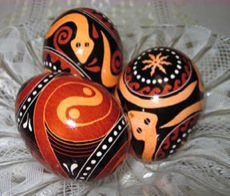
This is the pysanka that Katya describes making in the chapter. In the interest of providing readers with bonus materials and supplemental goodies, my Web site, www.thesilenceoftrees.com features an essay by the fictional Katya, which provides a little background about the art of crafting pysanky.

In the coming weeks I will be uploading more information about Ukrainian folklore and folk arts to my Web site, so be sure to check back often.

(The actual creator of this pysanka is Adriana Wrzesniewski, pysanka artist and teacher. You can visit her site at www.pysanka.com)