Not Yet

For the record, I am not an 80-year-old woman. Not yet.

The Silence of Trees is not an autobiography. It is fiction set in a historical context.

Last night I paid my first visit to a couples bookclub for The Silence of Trees. I am most often invited to speak at bookclubs comprised predominently of women. If there are men present, it’s for a mixed-gender bookclub, but they do not usually attend as couples.

This group met when they had been seated together for the wedding of one of their children. They hit it off so well that they decided to continue to start this bookclub.

The hosts and guests were gracious and enthusiastic, their discussion lively and a lot of fun, but the hostess was slightly disappointed that I was not an 80-year-old woman.
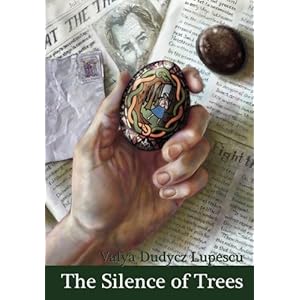
She was sure that the novel was actually an autobiography, and she was prepared to welcome Nadya to her home. She had decorated the dining room table with a tablecloth and china that she thought would befit an elderly Eastern European guest.

When I walked in the door, she was completely thrown off. She couldn’t shake the image she had constructed in her mind of the author and narrator as the same person. What followed was an interesting conversation about how I could put myself into the mindset and create the voice of an older woman.

I’m thrilled that the character of Nadya was believable, that’s so important, but I couldn’t stop thinking about our discussion all the way home. I wonder if other writers get asked variations of that question, “How did you write this character (who is unlike you in some way: be it gender, race, age, etc.) with such authenticity?”

Clearly, when writing science fiction, horror, or fantasy, the author is creating characters who are magicians, clones, werewolves, monsters, and aliens. There’s an inherent suspension of disbelief when you open a genre book. I wonder if the genre audience is better prepared to accept a character who is unlike the writer in some way?

Can I explain the magic that happens when I sit down and slip into a character to write his or her story? Not really. It’s like trying to explain the terrain of the imagination.

When I sit down to to write, sometimes five hours will pass by in a flash. When I look up from my writing, it will be some ungodly hour in the morning, and I’ll have written thousands of words and feel as if I’ve been out of ordinary time and space for a while.

That’s the magic of writing.

After that comes the hard work of craft: shaping and revising to make sure I’ve told the story in the best way possible.

That’s the work of writing.

I love what I do. I’m so grateful that people want to read my words.

I thank you for reading–wholeheartedly.

Now back to the work.

Imagination Grows by Exercise

A quick post, while working on others. I really enjoyed this conversation between Connie Willis and Neil Gaiman filmed at World Fantasy Con 2011.

Charming and inspiring, it’s a great one for writers and aspiring writers to watch.

Is Comic a Dirty Word?

I began this post when a Kickstarter backer asked if Sticks and Bones was a comic or a graphic novel. It was a good question, and I set off to discuss the differences between the two.

Both comics and graphic novels are sequential art. In Comics and Sequential Art (1985) Will Eisner describes sequential art as “the arrangement of pictures or images and words to narrate a story or dramatize an idea.”

As a lover of the form, but someone just beginning to dip her toes in the process of creating comics, I turned to books and the internet for definitions of “comic books” and “graphic novels.” Who better to consult than those creators and artists who have shaped and redefined the industry?

While doing research, I discovered an interested phenomenon. The distinction between comics and graphic novels seems to be most often made by those outside the industry. Many comic creators and artists seem comfortable to classify all sequential art under the category of comics.

“It’s a marketing term… that I never had any sympathy with. The term ‘comic’ does just as well for me… The problem is that ‘graphic novel’ just came to mean ‘expensive comic book’ and so what you’d get is people like DC Comics or Marvel Comics—because ‘graphic novels’ were getting some attention, they’d stick six issues of whatever worthless piece of crap they happened to be publishing lately under a glossy cover and call it The She-Hulk Graphic Novel….” (Alan Moore, “The Alan Moore Interview: Northampton / Graphic novel”. Blather.net. October 17, 2000).

If I had to try and explain the difference, I would say that a graphic novel is a longer narrative work (like a novel) revealed by sequential art instead of words alone. It has a beginning, middle, and end crafted with a story arc that is the convention in most novels or plays (exposition, rising action, climax, falling action, and resolution). Its length seems to average between 60 and 120 pages.

A comic is usually smaller in scale, 20-24 pages bound with saddle-stitching. Within those pages, most comics also have that same narrative structure. Serial in nature, the story also continues from comic to comic.  Collections of comics are sometimes grouped together and published as graphic novels.

Again, the distinction is subjective, it seems to be a matter of perspective and preference. I kept thinking of the Robert Graves poem, “The Naked And The Nude,” where the narrator contrasts the two words (naked and nude), coyly commenting on semantics and playing with the connotations of two synonyms.

Is “comic” a dirty word in literary circles?

Comic books and graphic novels are earning more respect and critical academic consideration than ever before, but for decades they were considered “low art,” in contrast to “higher art” forms like literature or the fine arts. Essays and dissertations have been written on this evolution and distinction by scholars (you can google it, there is so much out there). There is also an International Comic Arts Forum, a Comic Book Legal Defense Fund, and some universities have added Comic Arts or Comic Studies to their curriculum.

Attitudes seems to be changing, and yet when I mentioned that I was writing a comic, the response was tepid to negative from some of my more literary associates: Why would I want to do that? How would it reflect on me as a writer? Wouldn’t it be a waste of my time?

I believe that the story dictates the form. As a writer, one of my tasks is to choose the right one: some stories work best as novels, some as flash fiction, some as plays, others as comics.

With Sticks and Bones, Madeline and I hope to create four comics that can someday be collected and published together. In the meantime, the first issue: Home Is Where the Hearth Is, will stand alone. It’s a short story told using sequential arts.  It’s a comic book.

I’m proud of the story, and I’m thrilled by the depth that artist Madeline C. Matz brings to it with her beautiful art. I’m also excited to slip into the back of a continuum of writers whom I respect that tell poignant stories using the comic book form.

I hope that you enjoy Home Is Where the Hearth Is. There are 9 more days to pre-order your copy and spread the word!