The Magic of Music

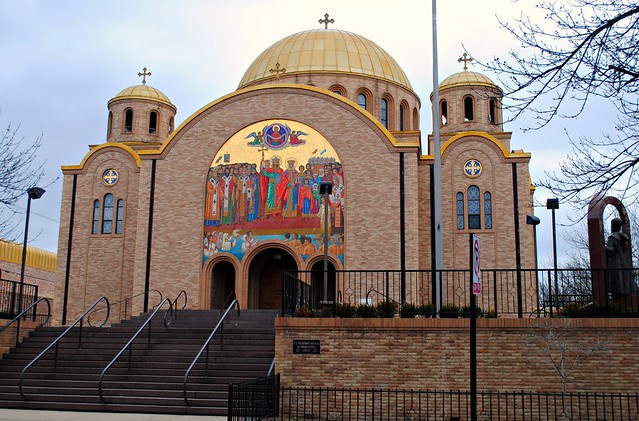
As a child, my favorite part of going to Mass at Sts. Volodymyr and Olha Ukrainian Catholic Church was the music. The walls, covered with their beautiful icons, were a feast for the eyes and my  young imagination, but it was the music that transported me into another world.

Mass was usually sung in Ukrainian and accompanied by a choir of voices in the balcony. Standing with my parents and little sister, I remember closing my eyes and feeling like I had stumbled into another world. I was absolutely certain that those voices and music got God’s attention. It was my first experience with the very real way that music could transform a space into something sacred.

The first time I remember hearing Gregorian chants, I was in high school, and it was a similar experience. I recall sitting in my religion classroom blown away by the power of those voices. Later, it made perfect sense to me that ethereal bands like Enigma or Dead Can Dance would incorporate the chanting into their music. There was power there.

As I got older, I became interested in comparative religions and learned that the ancient Greeks were among the first to document the ways that music shifted the collective consciousness of a group of people. I became especially interested in shamanic music and the ways that indigenous holy men and women used drumming and their voices to heal, to protect, and to communicate.

My first drumming circle, hearing the heartbeat of those many drums working together, was another of those pivotal moments that touched something deep inside of me. Although maybe not as elegant, drumming was raw, honest, and primal. The drum beat is so much like the first sound we all hear–the heartbeat of our mother in the womb. It is the sound of our own heart as we learn to sit quietly and meditate. It is a sound that stretches across time and space.

After following more breadcrumbs of myth and music, I encountered ritual theatre. Theatre emerged from ritual and mythology as a way to recreate sacred stories and repeat certain actions for a desired end. From the ancient Greeks to contemporary Balinese, ritual drama engages the community and allows participants to surrender themselves to the ritual process.

Last weekend, Mark and I had the pleasure of watching my favorite ritual theatre ensemble, Terra Mysterium, perform the Snow Queen version of Betwixt & Between, A Journey into Faery for their Winter Gala.

Held at the Chicago College of Healing Arts on Devon, the performers masterfully wove the web of their story about the Snow Queen, two human children, and the Fae.

All the members are talented, and I’ve had the pleasure of seeing them perform in several other venues. Each performance has been wonderful and wonder-filled, but this time I was struck by how polished they have become, how cohesive as a group.

When Terra Mysterium sang their beautiful songs, I recalled those days in church as a child, when all the world faded away and I felt a part of this magnificent music that filled the space. Their music was magic. Terra Mysterium took my breath away, transported me to another world, and inspired my imagination.

Plato believed that music was a form of medicine that brought order to our souls. In this day and age, when there is so much disorder and dissonance, we could all use a little more music in our lives.

So I leave you with two songs from Terra Mysterium:

Walk To My River (music and text by Shannah Lessa Wojtyska; arranged by Matthew Ellenwood)

07 Walk To My River

Athrabeth (music by Matthew Ellenwood, text by Keith Green):
09 Athrabeth

Cocktails and Coffee Cups

I began this entry a week ago and am only now finishing it. This Autumn has been like that, full of bumps and detours.

A few weeks ago, Mark was in NY for business, and I met him in Manhattan so that we could have a belated tenth anniversary getaway that coincided (not coincidentally) with Cynthia von Buhler‘s Speakeasy Dollhouse performance.

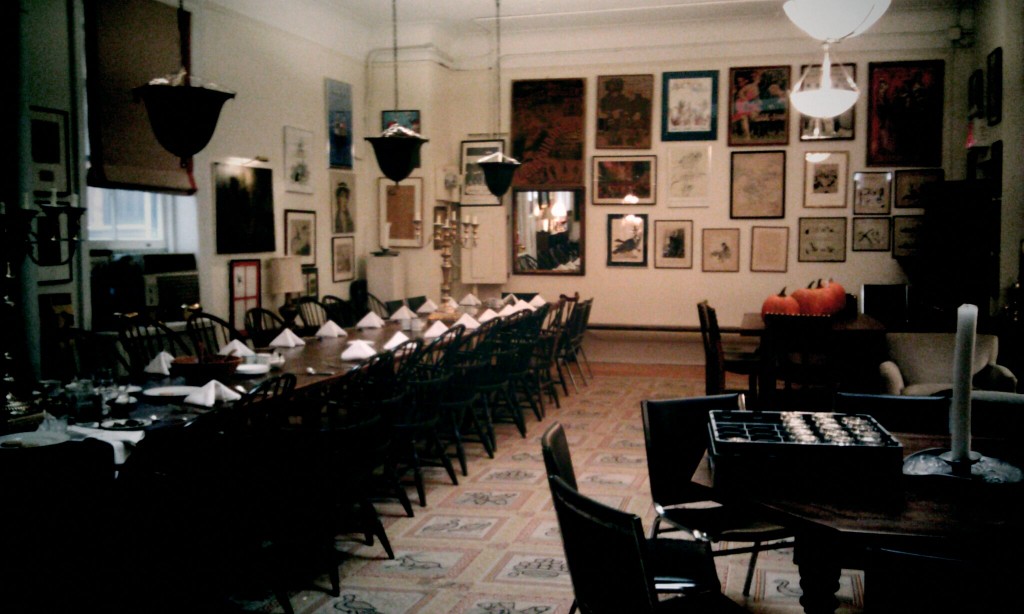
The luxury of 48-hours together was wonderful, and Mark and I had a lovely dinner at a local bistro and then walked around Times Square. The next day we had the luxury of a lazy morning, followed by lunch at the historic Coffee House Club. Now that I’m a member of the Cliff Dwellers (as Artist-in-Residence), I have privileges at reciprocal clubs all over the country (and a few overseas). Each club has its own unique history and character.

Inspired by other Arts-related clubs founded around that time (like The Cliff Dwellers) in cities across America, a group of friends who called themselves The Foes of Finance Dinner Club held their first meeting in the old Brevoort House on February 5, 1914. After a few more members and a few different locations later, the Coffee House was born and resided in the Hotel Seymour for the next sixty-seven years.  In 1982, the hotel was demolished and the Club moved  a few doors to the west at No. 70 and then again to its current location in the 2000s.

The club has rules, but one of the rules is that there are no rules:

No officers

No charge accounts

No liveries

No tips

No Set Speeches

NO RULES

Upon quietly slipping into the club, we were welcomed by one of the members and invited to sit at the round table in the parlor. We were served drinks from the bar and waited to dine together at the one large table in the dining hall. Over drinks, we chatted with two members about the history and membership of the club. We then joined the other eight people who were seated around the communal table. Our orders were taken, and we enjoyed a delicious, hearty lunch care of chef Irene. The conversation was lively and varied, and only after he left did I find out that Mark had been sitting beside E.B. White’s stepson, writer and New Yorker editor Roger Angell!

I don’t know the names of other members who were seated at our table that day. Formal introductions are not allowed at the table. You sit down at the next available seats and like the lottery, it’s a matter of chance to whom who you end up talking to over your meal. On any given day, you can show up for lunch and meet artists and writers who have helped to shape the creative history of our times: New Yorker editors, artists, journalists who reported on the latter half of the last century.

The sad reality is that many of these social clubs are not drawing new, young members. With so much networking happening online, the Arts clubs of the past are being replaced by the online clubs of the present. While this may allow for a greater breadth and diversity of membership, I can’t help but ponder what is being lost in the process.

Later that evening, Mark and I dressed in out 1920s finery and stopped by Spano’s Bakery for “cannoli” (the codeword that allowed us to enter the speakeasy) where we were joined by the stylish Madeline C. Matz and her friend Annalisa from Connecticut. Together we slipped into 1920s New York City, and it was such fun!

The immersive theater experience was set in a beautiful former speakeasy. The setting was lush, and the actors were convincing and playful as they interacted with the audience. Artist Cynthia von Buhler created a vivid world and a provocative piece of theater in response to the unsolved mystery of her grandfather’s murder. You can read about her process here. The evening was also recorded by director Susan Marks  (of  the documentary “Of Dolls and Murder“) who is creating a sequel documentary on the Speakeasy Dollhouse.

While attending a theatrical performance (much like when I read), I easily and eagerly suspend disbelief. I love Art that engulfs me in an alternative world. Sitting on a velvet couch sipping a cocktail from a coffee cup while intrigue unfolded around me, I was delighted.  Cynthia and her actors swept us up in their mystery, and I was happy to be a part of it.

Then, just like that, it was over. The next morning, we returned to Chicago, to the kids, and the everyday.

But that’s another post.

How to Appease Your House Spirit for Halloween

You’ve heard it haven’t you? The sigh under your bed just as you lie down. The scratching on the window that stirs you from sleep?

Come closer to the computer. Lower your voice and look over your shoulder.

You know those bumps in the night? Those creaks on the stairs when you’re in bed with the dog and no one else is home? Those misplaced keys and glasses, or randomly spilled milk on the counter? The flash in the shadows that looks like cat eyes, but you don’t have a cat? Something brushes against your foot when you step down onto the rug to get a drink of water in the middle of the night. Something tugs at your sweater when you sit down to watch the television.

You wonder for a moment, then shake it off to dreams that linger, or spicy food before bed, or dust in your eyes, or maybe the wind.

But that’s not it, and you secretly know that there’s more to life and to your home than what you see.

You have a house spirit, and he or she wants your attention.

You can choose to ignore the signs, but they seldom stop. In fact, they get louder, stronger, and more persistent.

So, what can you do?

The house spirit, like a neglected friend, wants a little communication, a little whimsy, a little sacrifice.

Of course, there are traditional ways: leaving out a small offering of milk, meade, or vodka (depending on your ancestry), singing folksongs, keeping a clean kitchen, leaving a special broom beside the hearth, sharing books for All Hallow’s Read. But be forewarned, modern house spirits can be more demanding.

Lucky for you, the kind folks at the Night Garden have provided you with a way to do all three!

They have created the October Challenge to encourage you to create Art inspired by a house spirit. This can be a drawing, a doll, a story, a poem, a recipe, a blanket, any creative response that you can imagine! (Need more ideas, see this blog entry.)

And the sacrifice? Well, you can definitely submit Art without making any donation, but perhaps you can spare a little money to help the Bengals? This special breed is often adopted by overzealous owners, then given up when they realize that you get a lot of cat and quite a bit of tiger-attitude in these darlings. Have I mentioned that house spirits LOVE Bengals? They do.

Complete details about the challenge are here: http://www.thenightgarden.net/?q=node/114

To recap, participate in the Night Garden challenge and you:

1. VERY LIKELY APPEASE YOUR HOUSE SPIRIT

2.) Become a part of an online community of awesome artists

3.) Get published online, on thenightgarden.net site,  alongside professional writers and artists like Christopher Lincoln and Nathalie Boisard-Beudin! That’s some mighty fine company.

4.) Help Bengals: a breed of cat formed by the cross of a domestic feline and an Asian Leopard Cat. These cats are often adopted by overzealous owners, then given up when they realize that you get a lot of cat and quite a bit of tiger-attitude in these darlings.

5.) Maybe get published in a limited edition hardcover version of a new comic about a house spirit! That’s right, some lucky submissions will be included in a special section at the end of Sticks and Bones: Home Is Where the Hearth Is (due out Summer 2012)

6.) Have a chance to win a cameo inside the comic!

6.) Have a chance to win a signed, limited edition poster of the Night Garden Challenge created by Madeline and me!

No one really needs a reason to make Art, but those are some pretty great reasons. Only a few days left!

On October 31st, when the veil between the worlds thins and entities seeking to make contact have more power than before, do you want your house spirits to be happy or discontent?

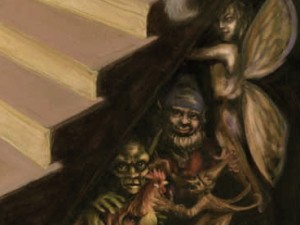
"The Spirit of the Secrets Closet" by Christopher Lincoln for the October Night Garden Challenge