Embroidered Worlds — A New Anthology of Ukrainian Fantastic Fiction

I am excited to share with you the news that I am editing an anthology of Ukrainian speculative fiction, including fantasy, science fiction, horror, magic realism, and alternate history!

The title of the anthology is Embroidered Worlds: Fantastic Fiction from Ukraine and the Diaspora, and it will be published by Detroit publisher Atthis Arts. Thank you to E.D.E. Bell and Chris Bell of Atthis Arts for believing in this project.

The majority of stories included in the anthology will be from writers in Ukraine, and for most of them it will be the first time their work will be translated into English. Writers of the Ukrainian diaspora have contributed stories as well, drawing from varying degrees of connection to their heritage and ancestral homeland, illustrating the complex and diverse ways we celebrate and re-imagine culture.

Most of the work soliciting stories from writers in Ukraine can be credited to the perseverance of my Ukrainian co-editors, Olha Brylova and Iryna Pasko. This anthology would not exist without them. Also instrumental were members of the science fiction community who began exploring this idea after Russia attacked Ukraine on February 24, 2022. They shepherded this project through many stages until it came into my hands. I am so grateful to them for all their hard work. 

This anthology is important to me because it represents a collection of possibilities. It is an expansive experience of the Ukrainian imagination, which dares to remember history and dares to dream of freedom, justice, and peace.

Largely due to Russian colonial imperialism and russification policies,  a few decades ago it was nearly impossible to find Ukrainian literature in the United States, especially translated into English.

Kazky was my favorite of the children’s readers and workbooks (Tut I Tam series) published by Alberta Education in Canada in 1977.

Growing up in Chicago in the 1970s and 80s, my sources for Ukrainian stories were either my grandparents or the stories I read for Ukrainian School on Saturday mornings. Some were Xerox-copied from books that our teachers owned, others were smuggled overseas or purchased from Canada.

Nowhere outside of the Ukrainian spaces we inhabited (church, school, folk dancing, scouts), nowhere in the American spaces of my life, did I hear about anyone like me or my family. I have no doubt that my love of world mythology came from my scouring books of myths from around the world trying to find any that came from Ukraine.

In my “American life,” I was instead asked if a teacher or a new acquaintance could shorten my name to Val, because it was “easier to pronounce” or “sounded more American.”  I was told that Ukraine “isn’t a real country” or it’s “a part of Russia” or I’m “practically Polish.”

So we clung to any mention of Ukraine or Ukrainians on the news, in the Olympics, in popular culture. From a very young age, I loved the Beatles for giving a lyrical shout out to “Ukraine girls” in “Back in the USSR.” Even though they included the problematic “the” before Ukraine, still, here was proof. We existed! Someone thought we were real and beautiful.

A Ukrainian man and women in their 60s wearing Ukrainian folk costumes and holding a Ukrainian flad in their Chicago backyard. When the Soviet Union collapsed in 1991, Ukraine declared its independence, and there was so much celebration and hope. My grandparents, Baba and Dido, had feared they would not live to see an independent Ukraine but they did. Ukraine and her people were free!

In the thirty years since, there have been many stories and books written in Ukrainian, and some have been translated into English. For anyone who is interested in reading more about modern Ukrainian speculative fiction, I recommend reading “SciFi in Ukraine” by Michael Burianyk, in Locus magazine.

This week I was talking with my parents about the ongoing atrocities in Ukraine, and my father repeated something he has said many times since the war began: “I’m just glad Baba and Dido are not here to see this.” I cannot even fathom how much it would hurt their hearts to see the land that they loved so much, that they raised their children and grandchildren to love and cherish and celebrate, being ravaged in such a horrible way. Again.

How many stories will never be written? How many voices have been lost forever, both in battle and in Russia’s senseless attacks on civilians?

Members of the Ukrainian diaspora have been trying to help in any way we can: financially, emotionally, and politically, in public and private spaces. More than ever, it is important for us to amplify the voices of the Ukrainian people, to share their stories and art and poems and songs.

Culture is the container for everything that the diverse populations of Ukraine hold dear. It contains the ideas and ideals, the history and future that the Ukrainian people are fighting and dying for.

“Often ignored, or relegated to marginal status, the cultural front is nonetheless foundational. The wars of this century are wars over meaning. As American forces learned in Iraq and Afghanistan, if you lose on the cultural front, military and economic dominance swiftly erode. The terrible battles for Kyiv and Kharkiv, the destruction of Ukraine’s civilian infrastructure, Europe’s struggle to heat and feed itself this winter, spiralling inflation, the brutal material horrors of the struggle, might make any cultural reading of the conflict seem fantastical or glib. But at its core, and from its origin, this Ukrainian conflict has been a war over language and identity.” 

Stephen Marche, Our mission is crucial’: meet the warrior librarians of Ukraine” in The Guardian

Today, there is more Ukrainian writing translated into English than ever before. I’m proud that our new anthology, Embroidered Worlds, will be adding to that canon. These writers and their stories are wildly diverse: there are ghosts and monsters, there are space ships and ancient gods, there are battles — real and imagined — as well as time travel adventures, post-apocalyptic settings, magic and folk motifs. 
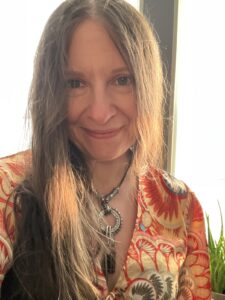
Smiling brown-haired woman with gray in her hair standing in front of a window in an orange paisley dress.

Over the next few months, I’m going to share updates about our progress here and on social media. At this time, we have 26 stories in our table of contents. Nineteen of those are from Ukrainian writers, seven are confirmed from the diaspora with a few still under consideration. We have enlisted the services of translators, and soon we’ll announce our Kickstarter pre-order campaign!

Anyone who would like to lend support to the project in any capacity, please email me: [email protected] or the publisher: [email protected]

Thank you. Дуже дякую.

“Many stories matter. Stories have been used to dispossess and to malign. But stories can also be used to empower, and to humanize. Stories can break the dignity of a people. But stories can also repair that broken dignity.”

Chimamanda Ngozi Adichie

A Little Goncharov For Thanksgiving

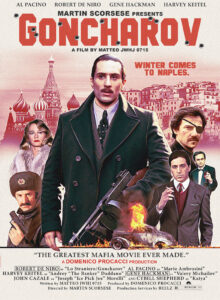
Movie poster for the fictitious film, Goncharov.
Movie poster by Alex Korotchuk, (beelzeebub.tumblr.com)

If you have not heard of the recent Tumblr phenomenon of Goncharov, you have only to google it to read a breakdown by The Guardian, Variety, and NBCnews.

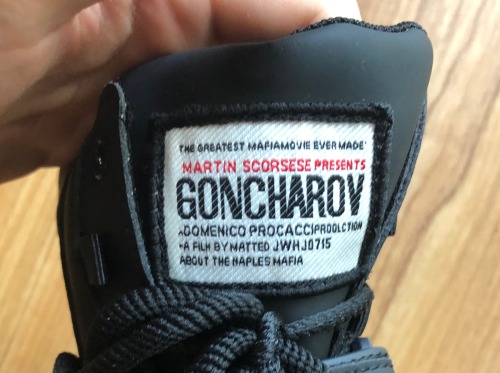
What began a few years ago on Tumblr with a photograph of a pair of boots with a label that read “The greatest mafia movie ever made. Martin Scorsese presents GONCHAROV,” evolved into an online collaborative fan community that is still working to world-build an entire film franchise that never existed. 

I learned about it the way I learn about most memes and pop culture, from my teenagers. In the days leading up to Thanksgiving, we had a group chat spring up on Discord that included two family friends who were going to be joining us for the holiday from out of town. One of the topics of conversation turned to Goncharov, the imaginary film around which an active Tumblr fan community had sprung up, as if it had been a real, little-known cult classic from 1973 made by Martin Scorsese. 

It became a fun creative exercisein the middle of the day, one of the kids would send a question about Goncharov: “What do you think about the relationship between Katya and Sofia?” or “What did you make of the clock tower imagery?” or “Goncharov… iphone or android guy?” To which someone else would playfully answer. 

This same kind of thing was happening on a massive scale on Tumblr, where artists created movie posters and promotional materials, composers posted songs and soundtracks, people posted deleted scenes and script fragments. There are reviews and academic papers, fictitious Wikipedia and IMDb listings, and A LOT of fan art.

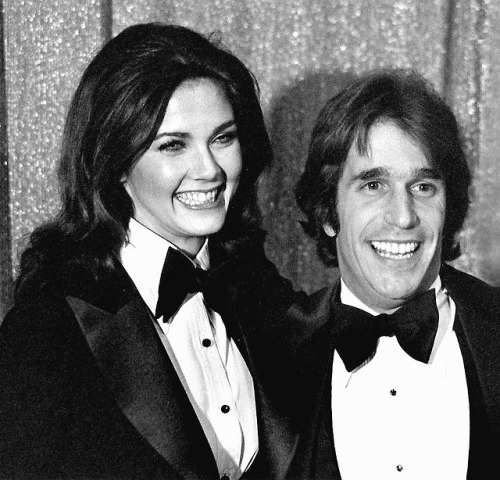
Lynda Carter posted a photo on her Tumblr with Henry Winkler that she captioned, “Me and ‘The Fonz’ at the premiere of Goncharov (1973) at Grauman’s Chinese Theatre.”

Discussions popped up about the characters and who would play them in the reboot. Posts were shared hundreds, then thousands of times. A Goncharov (1973) Lore Google Doc and Discord server were created to help keep the content organized.

Ice-Pick Joe’s Demise.

Our family’s fan-favorite character was Ice-Pick Joe, so I wrote “Musings on Ice-Pick Joe” in between chopping veggies for stuffing and waiting for the sweet potatoes to roast, complete with some AI-generated art. That was four days ago, and the post has been liked and shared more than I anticipated, and I keep thinking about why that is.

Conversations around Goncharov have continued, and I find myself wondering what it is about this moment in time and this type of activity that continues to capture so many people’s imagination and engagement? Tumblr is a hub for public fandom culture and community in a way that the other social media platforms are not. It’s where you can find discourse and fanfiction/fanart for almost anything.

Still, this is a little different and on a much larger scale. At a time when people are looking for Twitter alternatives, with the stress and joy of holidays approaching, what is drawing so many people in?

We talked about this over Thanksgiving: the way Goncharov allowed people low-stakes permission to create, to play to their particular strengths, to connect with other people, to escape reality for a moment, to build a new community. We talked about the shortcomings and challenges we saw: power dynamics, issues of race, etc.

It’s an evolving experiment, and as such, it has been shaped by the many variables involved and course-corrected each time someone notices a gap or opportunity: What would a musical look like? What if some of the actors had gone on Sesame Street or the Muppet Show? What if Gonzo played Goncharov and Miss Piggy played Katya? What would the remake look like set in 1980s NYC? What recipes might be created for the Goncharov cookbook? (I remember how much fun we had making the Forking Good cookbook.) There really is no end to what people can come up with. I’m waiting to see if Goncharov gets a Tom Gauld comic or a mention on Saturday Night Live. 

It seems relevant that role-playing games, both online and tabletop, have recently increased in popularity. Dungeons and Dragons was the cornerstone of Stranger Things, and 50,000 people attended Gen Con (tabletop game convention) in 2022. It’s not my world, although I’ve watched the joy my kids take in it. My energy goes into writing, but I can absolutely appreciate the fun of playing together. 

As a writer, I walk around with worlds in my head, but I don’t get to share them until they get published. Something like Goncharov, which was not an intellectual property “owned” by anyone, gives people permission to imagine and play.

I think it speaks to a need we have an human beings to experience connection, joy, wonder, and hope. We’ve always had those needs. People have been gathering around fires or tables, telling stories, for thousands of years.

Today, the hearth may be a computer or a phone, but the desire is not that different. My November began with the publication of Mother Christmas, my graphic novel, the secret origin of the Santa Claus story which is rooted in the ancient Muses, whose gifts inspire humanity. One of the questions my story attempts to answer is: Where does inspiration come from?

If we look at Goncharov we can see that inspiration comes from so many places. So much is possible when people given themselves permission to play, to shrug off the inner critics and outer trolls, and to imagine for a moment a different world that they have a part in creating. That is such a powerful and compelling idea.

Stories remind us that we are not alone, that we share struggles, and that we can overcome obstacles. There are so many challenges in the world right now. Maybe Goncharov is a lens through which people are seeing themselves and each other, reminding us how much fun it is to make-believe and how powerful it can be to have a shared image of the world.

The first step in creation is imagining. Exercising that muscle, allowing ourselves to play and tell stories and make art is a worthwhile one, and I think it’s one that we need to survive.  The Goncharov phenomenon gives me hope, because if we can have this many people put their energy into creating a whole world around Goncharov, just imagine what else is possible?


Why Mother Christmas?

In September/October of 2022, my new graphic novel, Mother Christmas, Volume 1: The Muse, will be released by Rosarium Publishing. It is a love letter to the winter holidays and the hope that they celebrate and inspire. Light in the darkness. Hope in times of uncertainty.

Now, more than ever, I wanted to write a story that celebrates hope. We live in difficult times, and fear is ever-present in many people’s lives all around the world: fear of the pandemic, violence, war, loss of basic rights and freedoms, fear of global warning and a collapse of so many things we have grown accustomed to. Fear of change, fear of difference, fear of being passed by, fear of being misunderstood, fear of being judged, fear of being forgotten. There’s a lot of fear.

The story of Mother Christmas is largely a story about fear and hope. In Volume 1, you meet the Kobaloi who literally feed off fear. You also meet the Muses, whose job it is to inspire.

How does this all come together for Christmas? Set around the Winter Solstice, so many of the holidays of this season recognize the primal fear of darkness and the unknown. Our ancestors worried that as days got shorter, the sun may never come back. Now, we have so much science and technology on our side, and yet we still do not know what the future holds or if we can survive what is happening all around us.

So we look around for the hope. We listen to stories that comfort and inspire us, that challenge us to do better and show us ways to try. What better way to look at hope than by looking at some of the archetypes that we hold dear, like Santa Claus?

Mother Christmas attempts to answer a question that first occurred to me back in 2003: “What is Mrs. Claus’s story?”

Most of my story ideas begin with a question. This question led to more: Where did she come from? When and why did she come on the scene? What exactly is their relationship?

Which led to still more questions: Why are they living such a long life? What’s the deal with the presents? Where does the magic come from?

I began digging into the biography and lore of St. Nicholas. We were living in Frankfurt, Germany at the time, so we were able to plan a trip to Turkey. With my baby strapped to me, we explored the cities of what had been Lycia the land where the historical Nicholas lived: Patara, Myra, and the surrounding areas.

That trip is a story all on its own (for another blog post). It allowed me to visit for myself the wonderful places that have come to feature prominently in the story of Mother Christmas.

When Nicholas was alive, the Roman Empire was populated by people practicing many different faiths. It’s at the intersection of those spiritual practices where our story begins.

I started writing that story 17 years ago but didn’t finish it until last year, when I began to work on it as a graphic novel, illustrated by Victória Terra, for Rosarium Publishing.

This month I wrapped up the script for our first volume, and Victória is finishing up the art. We are so excited to share this world with you, and what a world it is! All the images in this blog post are from the first of the three volumes story.

Volume 1: The Muse introduces us to Amara, and she’s probably not what you expect Santa’s eventual partner to be.

Amara is one of the Muses, from the House of Polyhymnia. She is assigned to Nicholas’s sister, Flavia, to inspire her in her life’s purpose.

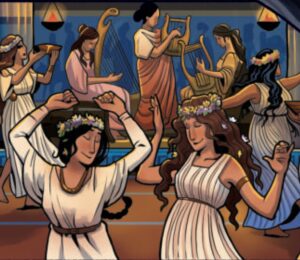
In Volume 1, you get to meet some of the other Muses.

You also get introduced to the Kobaloi, creatures that feed on fear.

A glimpse from a children’s book for Muses:

This is just Volume 1. In the remaining two volumes will follow Nicholas and Amara all over this world and through other realms, from Turkey to Iceland to Germany to the UK to America and more. Eventually you’ll learn more about some of those longstanding questions about St. Nick: Elves? Flying Reindeer? Presents? Krampus? You’ll also meet some of the other historical and mythic figures who have played a part in shaping up the winter holidays we have today.

In Volume 1, we watch the relationship develop between Amara and Flavia and Nicholas, as well as Amara’s struggles as she tried to figure out what being a Muse means to her and how she can best use her abilities to help humanity.

By her side (most of the time) is the Guardian assigned to watch over and help protect Flavia from birth until death.

Then there are the others who seem to be helping the Kobaloi to cultivate fear and sabotage the work that Muses and Guardians and other are doing to help humanity.

I’m excited to share these glimpses of what’s to come. Mother Christmas is already available for pre-order online, and I’ll post more information as it becomes available.

There will be a launch party or two, and signings around the country (hopefully just in time for the Winter Holidays).

We’re going to try and do some fun promotions around this, so stay tuned, and please get in touch if you have ideas or questions about bringing Mother Christmas to your town.