When I was growing up, the Chicago Public Library on Narragansett, the West Belmont Branch, was my library. It wasn’t a large branch; I quickly graduated to adult books in my early teens, and then devoured the reference section for anything I had questions about, from ghosts to WWII, mythology to cooking.
As a curious kid, I had a lot of questions, and the librarians were kind and patient, pointing me to the right sections, giving me the space to explore or helping me when I was short on time. They recognized a love of words and a desire for knowledge in a bespectacled, geeky little girl, and they didn’t dismiss it, they helped to nurture it. That is something that people, not the internet or search engines, can do. They can meet our gaze and point us in the right direction.
I’m so grateful. Next to teachers, librarians were my favorite grown-ups because they held the keys to the worlds I wanted to explore, AND they took me and my questions seriously.
That is one of the many reasons I love the Alexandria Still Burns kickstarter project by Kyle Cassidy. Kyle is a brilliant photographer, and he has a way of finding and telling stories about transformational people and moments, stories that may go unnoticed or discounted. Kyle notices.
I’ve been thinking a lot about authenticity, about what is genuine.
It’s something I look for and love about the people in my life: give me honest grumpiness over false pleasantries. I think that’s why I sometimes have a hard time with sarcasm–if I can’t tell what’s true, it makes me uneasy.
I’ve recently had a few conversations with friends about the internet and authenticity–the ways we portray ourselves and the quality of our online relationships.
Just last weekend, I was at a baby shower for a dear childhood friend, sitting at a table with my sister, my oldest friend, and others from the neighborhood. The conversation turned to the love-hate relationship many of us have with Facebook.
My sister refuses to join Facebook, while the rest of us use it to varying degrees. She teased me about some of my posts, brought to her attention by my cousin, who asked if I really do the things I post about (especially with three young kids).
The things I post about really do happen.
But it got me thinking.
When I post a photo or an anecdote about some small instance of joy, like dancing in the kitchen or enjoying coffee under canopy of trees or laughing with friends by a campfire, it’s not to point to them as examples of my everyday life.
My everyday is filled with a rather unexciting routine of kids, coffee, writing, kids, cooking, coffee, housework, relationships, writing, wine, frustration, bickering, procrastination, overcommitment, deadlines, and so on. The everyday is pretty typical. It’s messy, and I’m generally ok with that.
My dining room at this very moment–a mess of homework, Halloween, and the ever-moving piles of paperwork.
Sometimes I will post about the everyday, usually if I think it’s funny because I think it helps to know that other people are dealing with ridiculous moments of child stubbornness or homeowner frustration, but nobody wants to read about the everyday everyday.
So most of my everyday posts are about coffee or wine. Because the sharing of those seems to be a recognizable symbol for “the routine”–a shout out to everyone else, as if to say “Cheers! We’re in this together, this grind of everyday”–without having to specify the details. It’s like a nod of recognition.
Those other moments: the ones that are silly or playful or creative–they are exceptions and exceptional. They are the moments that make me stop and feel gratitude, they remind me to keep perspective, they show me what the everyday is for.
When I share them, it’s because they are outside my norm, because they are not everyday or typical. I feel like they’re a gift, so I share them.
I’ve been reflecting about why I post the things I post: on Twitter, on Facebook, on Tumblr, on the blog. Each one is different, a different tool.
This past year I’ve been trying to write as much as possible: fiction, short fiction, poetry, comic book script. Making a commitment to writing means that I spend a lot more time at home alone on my computer. When I take a break, I pop online. I read a post or some tweets. Then I go back to work.
Twitter? It’s about community for me, the larger writing/arts community, many of whom are not in Chicago. That’s where I can wave to friends who are also writing at 2am, learn about a new poem someone published, or give congratulations for an award or good review. It’s also where I get most of my news.
Tumblr? I post photos and stories that I find interesting and quotes that strike me as compelling. Much of what I post there if for myself, a sort of bookmark for the future. (I tend to use Google+ in a similar fashion).
Blog? I process the world by writing. When something is really important and I’ve been giving it a lot of thought, I often write a blog post. It’s my way of working things out and also inviting a conversation from people I don’t get to see in person.
Facebook? This one is trickier.
Facebook is good for long distance friends and family, for birthday greetings and other milestones. I periodically check-in on people, pick a few folks I’m thinking about and read their posts, skim their photos.
But what about the things I choose to post?
There are the interesting articles and links. I try to only post things I think are compelling or important.
The rest?
I think it comes down to connection.
In her TED talk on vulnerability (and also in her book), Brené Brown says, “Connection is why we’re here. It’s what gives purpose and meaning in our lives.”
I think she’s right. Of course, connection means different things for different people. For some people it’s the close friendship of a handful of trusted friends, for others it’s crowds of fans and followers. Most of us are somewhere in between.
I think at its best, Facebook can be about those little nods that tell us we’re not alone. Especially when we are alone so much of the time.
That’s how I see “likes,” as nods, not in agreement necessarily, but in acknowledgment: I see you, I hear you. In this moment, you are not alone.
Of course, we are. Alone. That’s not necessarily a bad thing. It’s what I loved so much about Louis CK’s talk on Conan.
Louis CK said:
“You need to build an ability to just be yourself and not be doing something. That’s what the phones are taking away, is the ability to just sit there. That’s being a person. Because underneath everything in your life there is that thing, that empty—forever empty. That knowledge that it’s all for nothing and that you’re alone. It’s down there.
And sometimes when things clear away, you’re not watching anything, you’re in your car, and you start going, ‘oh no, here it comes. That I’m alone.’ It’s starts to visit on you. Just this sadness. Life is tremendously sad, just by being in it…And I go, ‘oh, I’m getting sad, gotta get the phone and write “hi” to like 50 people’…then I said, ‘you know what, don’t. Just be sad. Just let the sadness, stand in the way of it, and let it hit you like a truck.’
And I let it come, and I just started to feel ‘oh my God,’and I pulled over and I just cried like a bitch. I cried so much. And it was beautiful. Sadness is poetic. You’re lucky to live sad moments. And then I had happy feelings. Because when you let yourself feel sad, your body has antibodies, it has happiness that comes rushing in to meet the sadness. So I was grateful to feel sad, and then I met it with true, profound happiness. It was such a trip.”
I think Louis CK is right. We need to be able to just stand in the way of moments without the distraction of the phone or the filter of the camera. We need to be able to feel them fully, to be present.
But after? After those moments?
After that profoundly sad moment happened, Louis CK shared it on live television, and it has been archived and passed all over the internet.
Maybe somewhere in there lies the balance?
We need to experience genuine moments–moments of joy or sadness or revelation. But after? Afterwards we can share them.
Facebook can never be a substitute for a face-to-face talk, a hug, the energy of a lively dinner conversation, but the internet does give us a starting point from which we can further connect.
I think it’s always important to remember that the virtual is only part of the whole.
When I raise my mug of coffee in the morning, know that I’m probably setting it down on a large pile of papers to be sorted. Just because I don’t mention them, doesn’t mean they’re not there.
When I’m singing to the Beatles in the kitchen, it may to be to drown out the sound of the kids complaining about homework or fighting over who gets to use the cool, sparkly pencil.
And when we’re dancing in the living room–I often close my eyes not to see the clutter –because sometimes it’s better to just be present in the moment. The rest of it can wait.
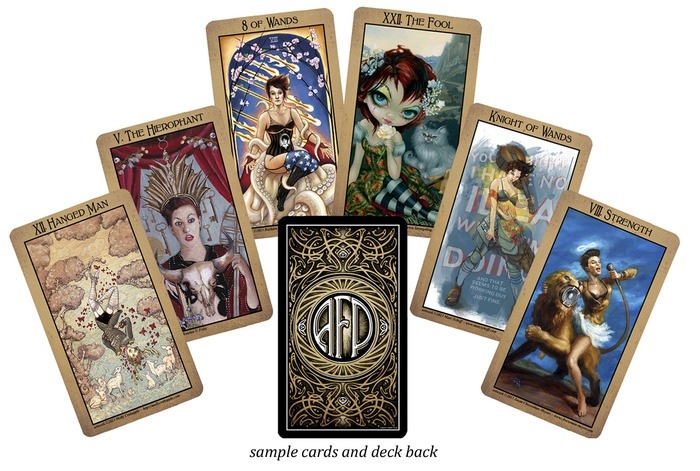
For hundreds of years, the Tarot has been used as a system of divination, reflection, storytelling, and inspiration. There are decks inspired by gods and goddesses, decks of cats, decks inspired by fictional worlds like Harry Potter or Star Wars, fairy tale decks and complex metaphysical ones. People are drawn to certain decks because they identify with the imagery or connect with the artwork or theme.
It comes as no surprise that fans of singer Amanda Palmer decided to draw upon the iconography of Amanda’s work, both as a solo artist and member of the Dresden Dolls, to create a Tarot deck.
For those unfamiliar with her work, Amanda’s songs, while fiercely intimate, are also iconic. She sings about abuse, addiction, abortion, heartache, love, abandon, regret, and hope; and her songs give voice to the dreams and fears of fans around the world. That would be enough to endear Amanda to her fans, but she takes it further to connect with them on a personal level at shows, ninja gigs, and online. Amanda opens herself up, and people often walk away saying that the experiences were intimate, inspirational, and transformative.
That is what the Amanda Palmer Tarot is about: Intimacy. Inspiration. Transformation.
When Madeline C. Matz, told me she was going to take the collaborative deck to Kickstarter, to use the crowd funding tool for preorder and distribution of the tarot deck and to pay the 78 artists involved, it made perfect sense. Collaboration brought the deck into existence; collaboration would get it produced.
***UPDATE: The Tarot was fully funded within 24-hours of launching the Kickstarter Campaign, but you can still order a deck until September 3, 2013!***
At its heart, the Amanda Palmer Tarot is a one-of-kind creative collaboration, a tribute deck featuring the work of 78 different artists, including Molly Crabapple, Kyle Cassidy, Walter Sickert, Kristina Carroll, Zelda Devon, Katelan V. Foisy, and more. Even fans unfamiliar with Tarot as a system of divination can enjoy the beauty of the unique cards inspired by all-things-Amanda.
Tarot is like a mosaic or patchwork of our lives at any given moment. People look at the cards to gain insight, to glean something new, to be challenged, to connect with a larger picture. (Interesting that those are some of the same reasons we encounter art.)
It will be interesting to find out what Tarot readers will think of the Amanda Palmer Tarot, because of course, the cards are sexy, symbolic, and provocative.
But then again, Art should provoke, and Tarot should provoke. Any deck inspired by Amanda would have to be provocative, and I think that translates into a beautiful and powerful collection of cards.
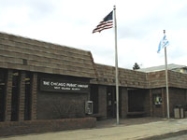 When I was growing up, the Chicago Public Library on Narragansett, the West Belmont Branch, was my library. It wasn’t a large branch; I quickly graduated to adult books in my early teens, and then devoured the reference section for anything I had questions about, from ghosts to WWII, mythology to cooking.