When I do interviews or visit with book clubs, people often ask how I could write about an elderly woman in The Silence of Trees with such authenticity.
Sometimes I answer with a variation of, “She’s certainly inspired by people I’ve known.” This is true, but…
Other times I give the more esoteric (but slightly more honest in my opinion) answer of , “I don’t know. She came to life in my imagination and is as real as a memory.”
There are fragments of me in Nadya’s character, although most are subtle.The biggest connection that we share is our nostalgia. Nadya revisits the Past like a heartbroken lover. She holds onto people, stories, scents, songs. She’s sensual and her memories are triggered by the most simple cues, like the smell of the tomato plant.
I understand this. For me the past is a definite touchstone.
Yesterday I went with my parents to visit my grandparents—my father’s parents in Chicago’s Ukrainian Village. My Baba is 88, my Dido is 93. They still live together in the small house where they have lived for as long as I’ve been alive.
When I walked in my grandfather was sitting in his recliner, by the window. The seat goes up and down to help him when he needs to stand. He is frail, but solid. He has always seemed grounded to me, substantive. Even as he grows more thin and withdraws into himself, he still seems sturdy.
“Hi, Dido!” I said loudly (He’s nearly deaf.) I gave him a big hug and kiss, then kissed the top of his bald head for good measure.
“Chih taw, Valya?” he asked in Ukrainian. (“Is that Valya?”)
I shouted in his ear, “Tak!” (“Yes.”)
He smiled, and it was the same smile he has given me since I was a little girl. I didn’t notice that he didn’t have his teeth in. All I saw was the way his face lit up, his eyes brightened, and the wrinkles faded for a moment. Everything shifted except those eyes and that smile. It was easy to see him the way he exists in my mind’s eyes, the way his will always be in my memory.
His eyesight is not failing, but his memory is beginning to fray a bit. Luckily my round face still resembles the face of my youth.
“Oh, Valya! Deh deetih?” he asked me. (“Where are the children?”)
I explained loudly that they were at school, and we were only staying for a short visit.
My father was dropping off a new walker for my Baba, my grandmother. It matches the one my grandfather has. She was pleased.
“It’s very good,” she said to my father in Ukrainian. “I promise to use it. Even in the grocery store.”
Twice while we were there she walked off without it, leaving the new walker in the kitchen. My father scolded her, reminding her that it’s there to be used. My Baba has fallen too many times, her bones are fragile now, her curves faded into the hanging folds of skin beneath her clothes.

There was a time when my Baba was the epitome of a robust, curvy grandmother. Always cooking and baking, she welcomed guests into her home with an abundance of food set before them. Yesterday she looked thin, and it was unlike her. Again the reality did not match up to the memory, and while my grandfather’s health is worse than hers, he seemed more solid than she. She seemed more fragile.
Although we all live in Chicago, I haven’t seen my grandparents in weeks. I’m ashamed to admit it. It hasn’t been often enough. There has been so much else going on with the holidays, my projects, my sister’s challenges, and general life happenings. It hasn’t been enough.
“I miss my family,” my Baba said in Ukrainian. “It gets lonely all alone here. Your Dido,” she motioned with her hand in his direction, then shrugged, “he doesn’t hear me. His life is eating and sleeping now. I miss my children, and their children.”
My aunts and uncles and cousin visit. Several work and live nearby, but it must be such a contrast to their lives before, when the house was filled with 6 children, then with even more grandchildren often stopping by after Ukrainian school or dancing practice or church.
They are still at the roots, my grandparents, but how much further away are the branches of our family tree as our lives veer off and grow in new directions?
We only stayed for a short visit this time, long enough to hear about the latest funerals, my grandparents’ health, the state of their pantry and icebox.
“Just a few more minutes,” my Baba asked as we moved to leave.
“If you had your way, we’d stay here until 6 in the evening,” said my father.
“No!” said my Baba, “If I had my way, I would keep you here until midnight. When the devils come out.” She grinned.
“Do you have any devils?” my father teased back.
“Just that one,” she said, and motioned to my grandfather in his recliner, gazing out the window.
Earlier that day, my father had asked me how many copies my novel had sold last year. I couldn’t tell him the numbers for paperbacks and hardcovers, but I know that my kindle sales were over 45,000 ebooks sold in 2011.
I knew he wanted to share this with my grandmother.
“Mama,” he said, “Guess how many books Valya has sold?”
“Maybe 150?” she offered.
“45,000!” he said.
Her eyes got wide, and then she said to me, “You know, you get that from me. From my family. Not from him,” she gestured toward my grandfather.
She then went into the story of how her grandfather was mayor of their town back in Ukraine, and her father a musician who taught her how to read by copying poetry in her notebook.
I had heard the history before, of course. When my father was a State Senator, my Baba used to tell me that he got it from her, from her family. It was nice to see that same pride in my Baba’s eyes, to see that spark I remembered. My Baba was always a force to be reckoned with.
“Can you believe it, Mama?” my father asked. “45,000 people have read about a Ukrainian woman who came to America after WWII. They read about our traditions, out stories. Can you believe it?”
She smiled. “Is it translated yet? Into Ukrainian?”
My heart sank a little. I had always hoped my grandparents would be able to read my writing. I told her not yet, but I hoped it would be soon.
After a few more minutes, we said our goodbyes. We had limited time and planned to visit the Displaced Persons exhibit at the Ukrainian National Museum before I had to get home to pick up the kids from school.
“Come back,” my Baba said with a hug, “and bring my great-grandchildren.”
My Baba waved in the doorway, the same way she has waved for decades, and I wished that we had more time.
My parents and I next stopped at the museum to see “From DP to DC, Displaced Persons: A story of Ukrainian Refugees in Europe 1945 – 1952.” Many people had donated items from their time in the DP Camps, or things they had inherited from their parents or grandparents. It was eerie, to see physical manifestations of things I had written about, to see so many photographs and letters, sketches and legal papers from WWII and the time after.
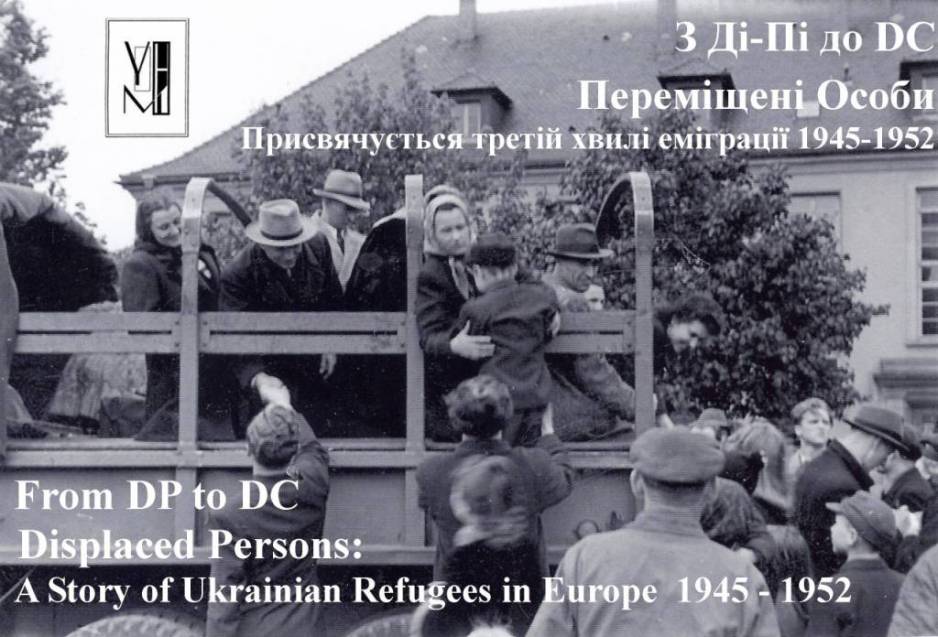
When I began to research The Silence of Trees in the 90s, I didn’t have access to this much information, to this level of detail. Some came from oral and written communication with former DPs, some came from books. This was the real thing.
My parents walked through pretty quickly, but I felt like I had slipped back into the world of my novel, except instead of inside my head, here it was in fragments under glass.
The items were mostly in display cabinets, but oh how I wanted to touch them! They seemed so familiar, as if they were the very items handled by my fictional characters in their fictional experience of a real war and a real immigration. What an odd feeling, as if suddenly I stood before the Mad Hatter’s hat or the magical wardrobe or Pooh’s honeypot. Only these were characters out of my own imagination.
Eerie and sacred and strange.
I had woken up that morning with a lump in my throat and had gone through the day in the oddest mood, emotional and near tears for no apparent reason. It was one of those days when I just felt raw. Perhaps for that reason, the visit with my grandparents and the visit to the museum were so provocative, so emotional.
I had lunch with my parents at Shokolad, a really wonderful Ukrainian restaurant in Chicago. The meal was excellent, but I didn’t feel like small talk. I was already taking notes in my head—for this blog entry— to try and hold onto the day, to hold onto the experience of a glimpse into my own fictional world, to hold onto something precious even as it was slipping further away.
I believe in the inscription I sign into copies of The Silence of Trees: What is remembered—lives.
It applies for places, people, ideas, and characters. So I write this, as a reminder.


 On Friday night, I made my way up the stairs to the Everleigh Social Club with a friend, to attend the