You just might find, you get what you need

Last night I had the pleasure of listening to Neil Gaiman read a story he had begun in 2004 and finished last year, “The Return of the Thin White Duke.” Neil was originally asked by artist Yoshitaka Amano to write a story to accompany Amano’s sketches for a fashion spread featuring David Bowie and Iman, but only the first half was published in 2004. Neil completed the piece for his upcoming short story collection TRIGGER WARNING (to be released in February 2015).

David Bowie, by Yoshitaka Amano

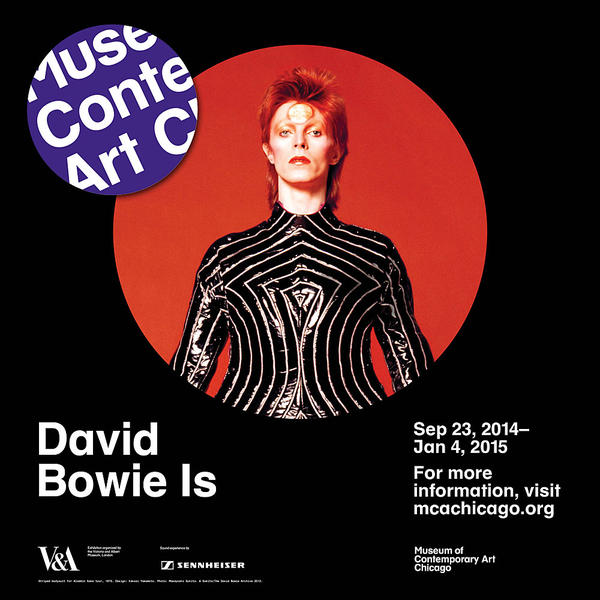
The inaugural reading coincided with the closing of the David Bowie exhibit at the Museum of Contemporary Art in Chicago. I had the opportunity to view the “David Bowie Is” exhibit a few weeks earlier when Brooke Bolander was in town, and it was wonderful–provocative and inspiring.

David Bowie Is at MCA, Photos by Evan Hanover for MPR

While I have always enjoyed Bowie’s work, I had not previously encountered the full scope of his creative vision. Taken from his personal collection and accompanied by corresponding Bowie songs, the exhibit included storyboards and relics, books and sheet music, videos and photographs, and so many exquisite clothes.

David Bowie Is at MCA, Photos by Evan Hanover for MPR

All of them came together to create a portrait of a man who seems to delight in creating new experiences for his audience–reinventing himself, challenging expectations and norms, using his persona and music to affect change.
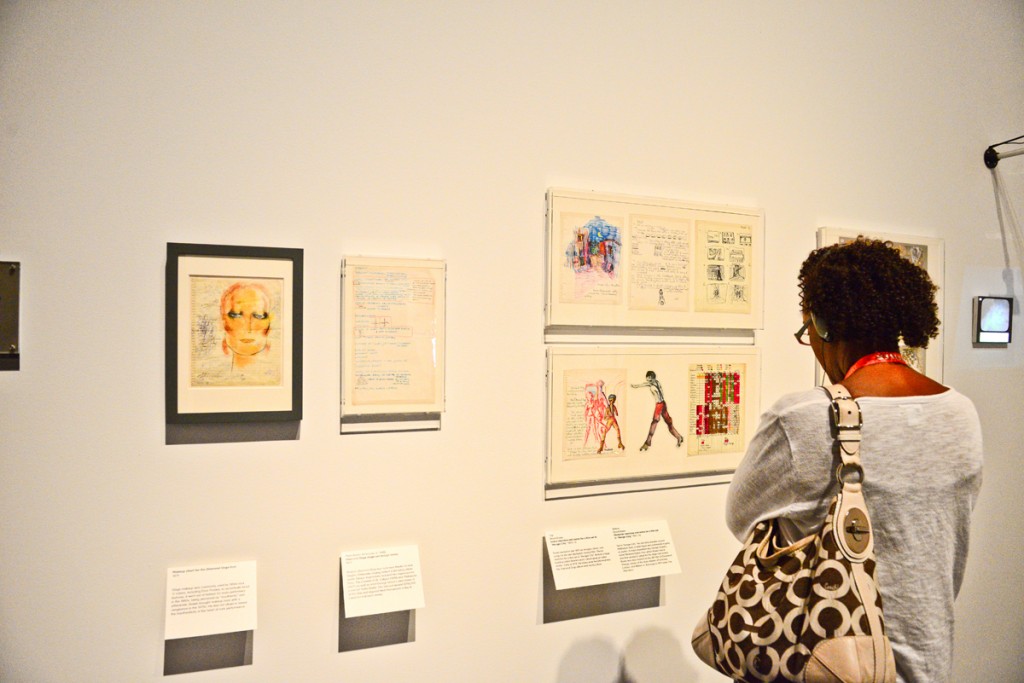
David Bowie Is at MCA, Photos by Evan Hanover for MPR

Neil’s reading closed out a steady stream of Bowie admirers and cultural icons who have graced the MCA stage over the last four months to celebrate Bowie and his influence.

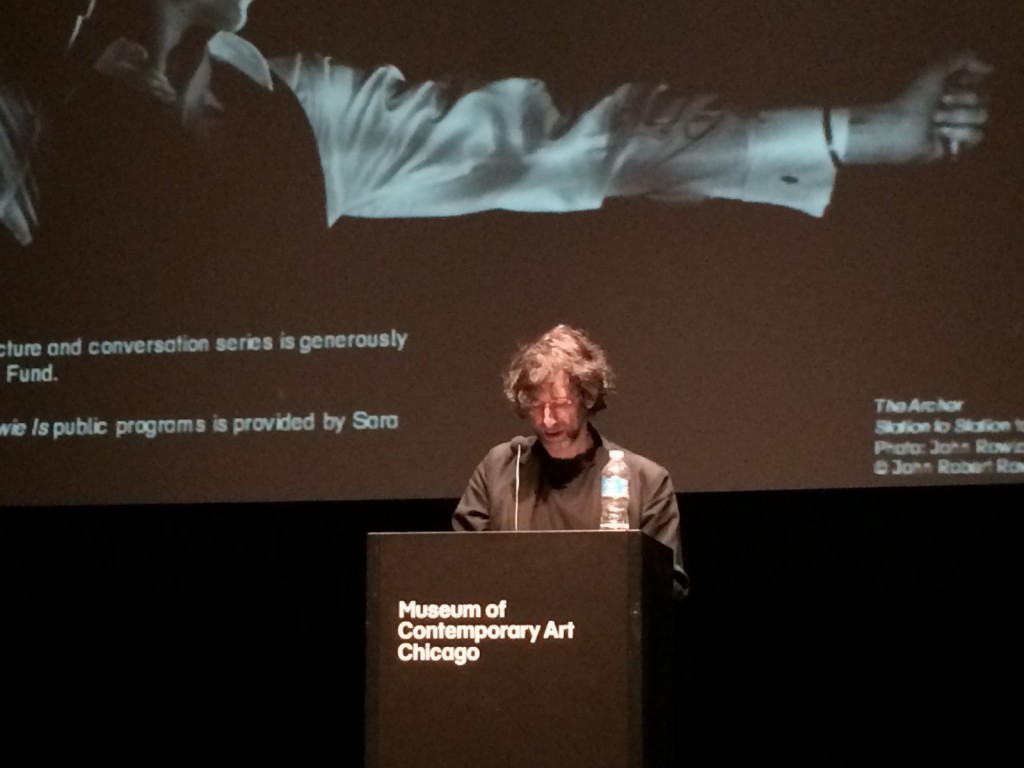
Neil Gaiman reading from "The Thin White Duke" at the Museum of Contemporary Art in Chicago, on the closing of the David Bowie Is exhibit.
Neil Gaiman reading from “The Thin White Duke” at the Museum of Contemporary Art in Chicago, on the closing of the David Bowie Is exhibit.

I adore Neil’s writing, and his short fiction in particular. He is a master storyteller. Whether set in primeval oceans, Elizabethan pubs, wolf-infested walls, or alternate dimensions, the worlds Neil creates are vivid and populated with characters who feel authentic. When Neil reads his work aloud, it all comes crashing into life, words like waves washing over an audience who will raptly follow him anywhere.

During the Q&A, Neil talked about the challenges of writing historical characters that remain “true” to the reality of the person, in particular those who are still alive. In “The Return of the Thin White Duke,” Neil has captured something of the enigmatic yet almost archetypical essence of David Bowie. Rich with the “fantastic,” yet grounded with carefully selected real-world details, “Thin White Duke” feels like something that could easily exist in one of the multiverses of Bowie’s mind, snaking its way into his songs and sketches.
2015-01-04 18.51.45

Neil talked about how when he was young, Bowie’s songs presented him with doorways that in turn, led Neil to new information and ideas, things that inspired him. Interesting that while standing in line and waiting in the auditorium, I heard the same thing said of Neil and his work. So many people talking about the influence that Neil’s fiction and tweets and blog entries and comics have had on their work, their art, their lives. Neil, like Bowie, presents us with doors. It’s a creative continuum: ripples from artist to audience, and artist to artist, and so on.

Sometimes a story provides us with a welcome escape; sometimes it opens the door to a new world; and sometimes a story gives us exactly what we need to hear.

“The Return of the Thin White Duke” is a beautifully crafted Neil Gaiman story inspired by another risk-taking artist who continues to challenge us to “turn and face the strange.”

I won’t spoil the ending for you, but I will say it is a story about transformation and sacrifice, a story about the ways we reinvent ourselves when we try to get back in touch with our heart–and these things at this moment in time resonated with me in a way I did not expect. It was a gift of serendipity, and another kind of door opened.

“You can’t always get what you want
But if you try sometimes you just might find
You get what you need.”

Rolling Stones, You Can’t Always Get What You Want

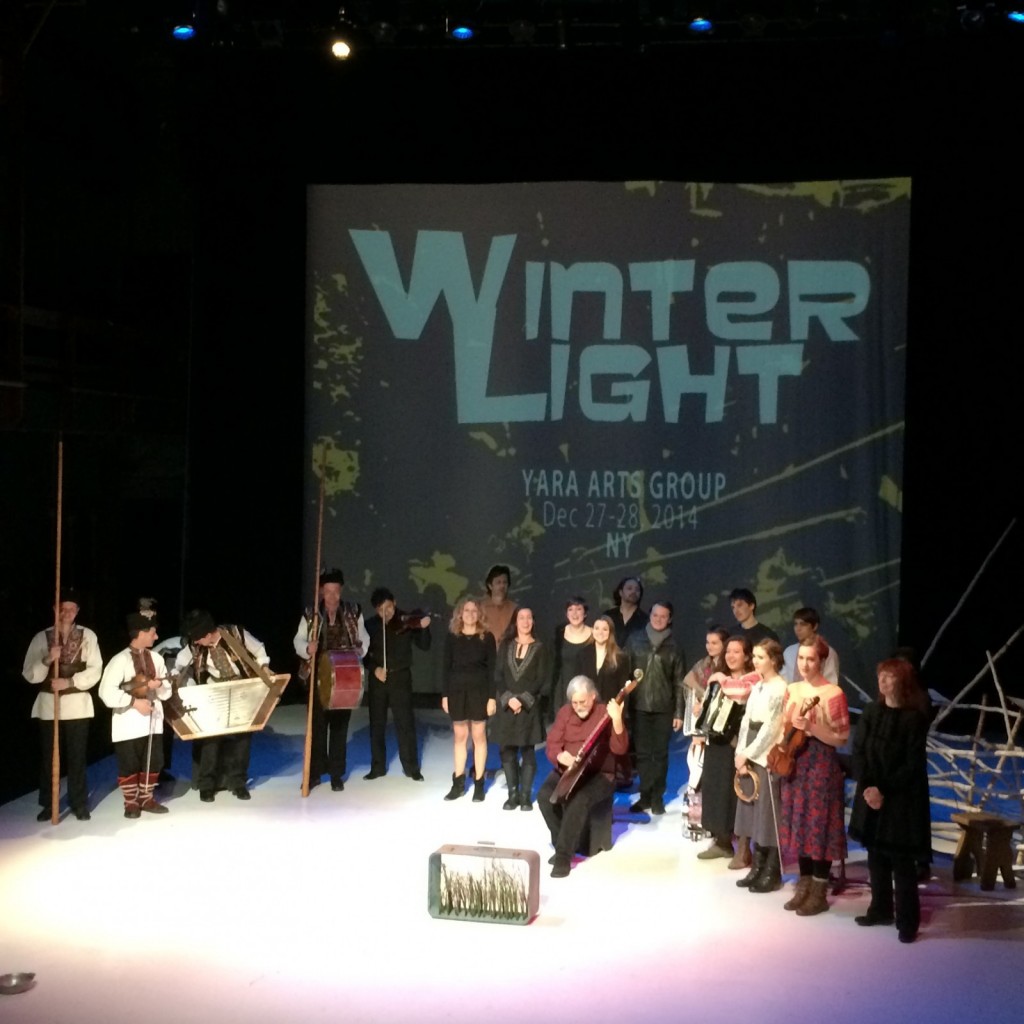
Winter Light in New York City

Photo by Waldemart Klyuzko.

WinterLight

I first heard about Yara Arts Group over a decade ago, when I read about its founding director, Virlana Tkacz, traveling to villages deep in the Carpathian mountains to record ancient pre-Christian winter solstice rituals and songs. In an essay about her experiences, Virlana writes:

“That day I heard a beautiful epic story about a dashing young man who rides a raven black horse around Kryvorivnia turning down gold and silver, but accepting the hand of a fine young lady. I also heard one about how the sun, moon and fine rain come to visit the mistress of the house. I was enchanted, but puzzled. What did any of this have to do with the story of Bethlehem? Eventually, I learnt that the koliadas are part of a winter ritual that now coincides with Christmas, but is much older in its origin, traditions and symbolism.”

The weaving together of past and present, the magic of songs and stories passed down from generation to generation, the ways that myth and folklore resonate with current events…these are ideas I am passionate about and themes I explore in my writing, so I was fascinated with Virlana’s research:

“I was struck by how many of the rituals we witnessed were attempts to bring together the present with the past and to create a greater community that would include all the living (both human and animal), the spirits of the ancestors and forces of nature. All would have to come together to create the next harvest and a bountiful future.”

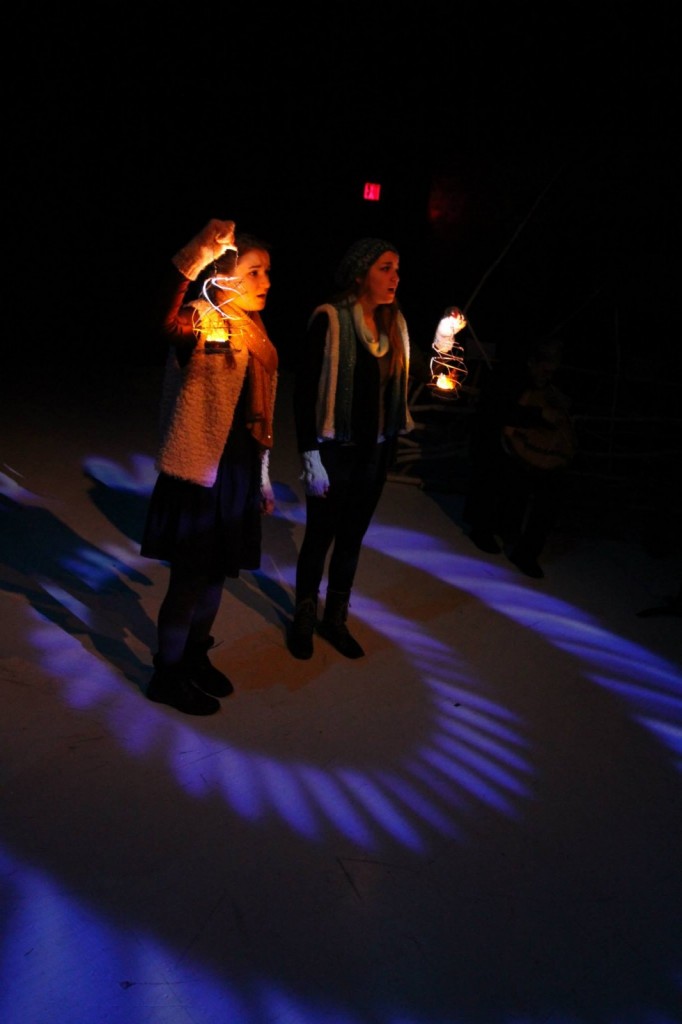
I have been wanting to see one of Yara’s Koliada winter performances ever since. I was so excited when my trip to NYC last weekend coincided with Yara’s “Winter Light” piece, which wove together Koliadnyky (winter song singers from Kryvorivnia, Ukraine), an 18th century Baroque Nativity folk opera, and scenes from the current crisis in Ukraine.

Photo by Waldemart Klyuzko

Created and directed by Virlana and performed by an excellent ensemble, the hauntingly beautiful vignettes blended the magic of the ancient winter rituals with the drama of recents events in Ukraine.

This montage (taken from different performances) will give you a taste of the music and songs from the Carpathians: 

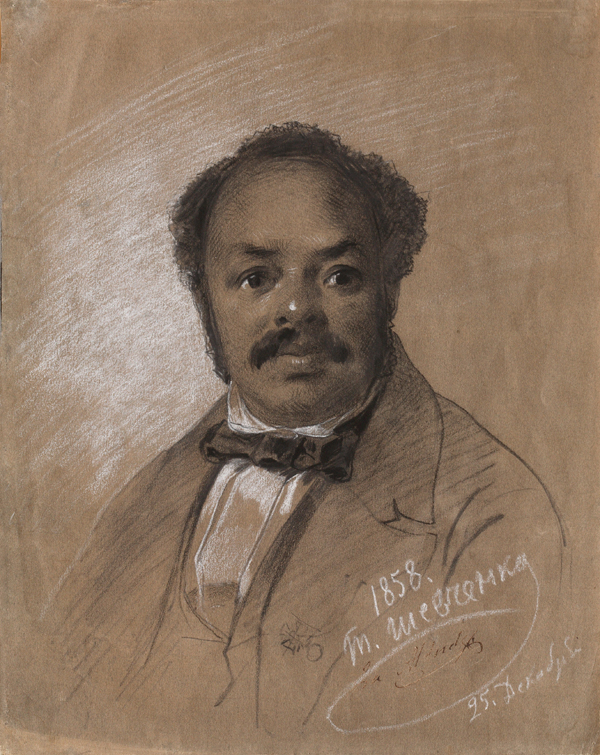
In 2015, Yara Arts is staging “Dark Night Bright Stars” at La MaMa based on the meeting of beloved Ukrainian poet/artist Taras Shevchenko and African American actor Ira Aldridge. In 1858, Shevchenko had been released after a 10-year imprisonment (his poetry was critical of the Russian Tsar) when he met Aldridge, who had left the United States to perform Shakespeare in Europe and Russia. The two men became close friends, and Shevchenko drew Aldridge’s portrait:

The piece is described as “multilingual and is about communication beyond language.” I love to see the ways that Virlana and Yara Arts breathe life into Ukrainian stories and traditions, and I hope to make it back to see the “Dark Night Bright Stars.”

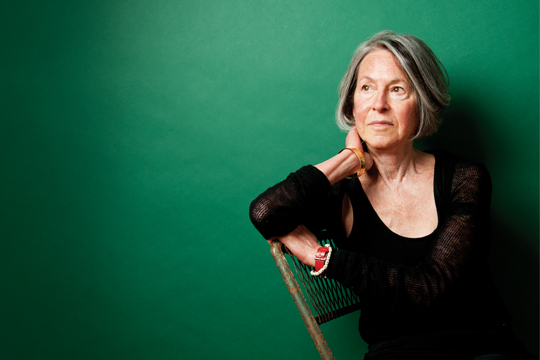
Congratulations to Louise Glück

One of my favorite living poets, Louise Glück once called me on my cell phone to discuss permission for using a few lines from one of her poems in my novel, The Silence of Trees. I got the call from her as I was walking to the car after grocery shopping, and I got genuinely weak in the knees hearing her say, “Is this Valya Lupescu? This is Louise Glück.”

Credit: Webb Chappell

I had never before nor since had that kind of a reaction to communicating in any fashion with another writer or artist, but her poetry had been so important to me, and her words had taken root in my heart and imagination so deeply since I first read her work back in college in the early 90s. I managed to sit down in the car and have a conversation, my hands only slightly shaking from excitement.

I’m delighted to hear that she was honored last night. Congratulations to Louise Glück for winning the National Book Award for Poetry! In honor of her award, I’m sharing William Giraldi’s wonderful interview with her in Poets & Writershttp://www.pw.org/content/internal_tapestries

“I believe that. I used to be approached in classes by women who felt they shouldn’t have children because children were too distracting, or would eat up the vital energies from which art comes. But you have to live your life if you’re going to do original work. Your work will come out of an authentic life, and if you suppress all of your most passionate impulses in the service of an art that has not yet declared itself, you’re making a terrible mistake. When I was young I led the life I thought writers were supposed to lead, in which you repudiate the world, ostentatiously consecrating all of your energies to the task of making art. I just sat in Provincetown at a desk and it was ghastly—the more I sat there not writing the more I thought that I just hadn’t given up the world enough. After two years of that, I came to the conclusion that I wasn’t going to be a writer. So I took a teaching job in Vermont, though I had spent my life till that point thinking that real poets don’t teach. But I took this job, and the minute I started teaching—the minute I had obligations in the world—I started to write again.” ~Louise Glück, from “Internal Tapestries: A Q&A With Louise Glück” by William Giraldi, Poets & Writers