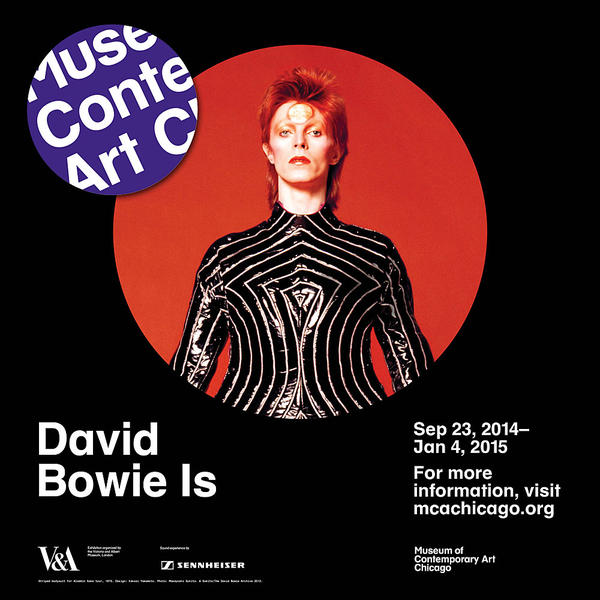
You just might find, you get what you need

Last night I had the pleasure of listening to Neil Gaiman read a story he had begun in 2004 and finished last year, “The Return of the Thin White Duke.” Neil was originally asked by artist Yoshitaka Amano to write a story to accompany Amano’s sketches for a fashion spread featuring David Bowie and Iman, but only the first half was published in 2004. Neil completed the piece for his upcoming short story collection TRIGGER WARNING (to be released in February 2015).

David Bowie, by Yoshitaka Amano

The inaugural reading coincided with the closing of the David Bowie exhibit at the Museum of Contemporary Art in Chicago. I had the opportunity to view the “David Bowie Is” exhibit a few weeks earlier when Brooke Bolander was in town, and it was wonderful–provocative and inspiring.

David Bowie Is at MCA, Photos by Evan Hanover for MPR

While I have always enjoyed Bowie’s work, I had not previously encountered the full scope of his creative vision. Taken from his personal collection and accompanied by corresponding Bowie songs, the exhibit included storyboards and relics, books and sheet music, videos and photographs, and so many exquisite clothes.

David Bowie Is at MCA, Photos by Evan Hanover for MPR

All of them came together to create a portrait of a man who seems to delight in creating new experiences for his audience–reinventing himself, challenging expectations and norms, using his persona and music to affect change.
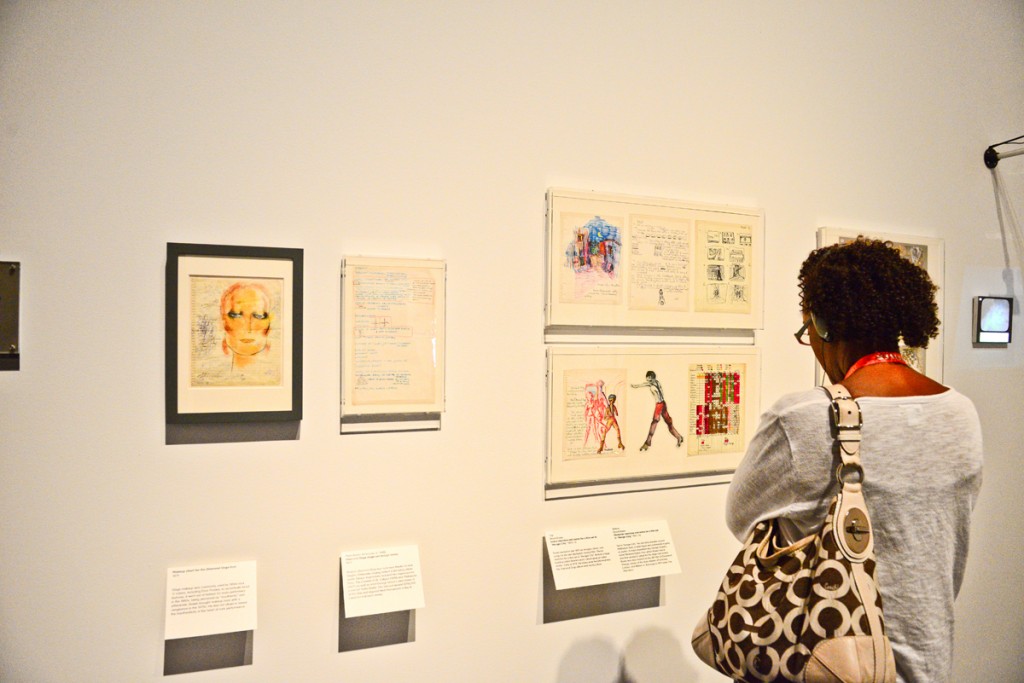
David Bowie Is at MCA, Photos by Evan Hanover for MPR

Neil’s reading closed out a steady stream of Bowie admirers and cultural icons who have graced the MCA stage over the last four months to celebrate Bowie and his influence.

Neil Gaiman reading from "The Thin White Duke" at the Museum of Contemporary Art in Chicago, on the closing of the David Bowie Is exhibit.
Neil Gaiman reading from “The Thin White Duke” at the Museum of Contemporary Art in Chicago, on the closing of the David Bowie Is exhibit.

I adore Neil’s writing, and his short fiction in particular. He is a master storyteller. Whether set in primeval oceans, Elizabethan pubs, wolf-infested walls, or alternate dimensions, the worlds Neil creates are vivid and populated with characters who feel authentic. When Neil reads his work aloud, it all comes crashing into life, words like waves washing over an audience who will raptly follow him anywhere.

During the Q&A, Neil talked about the challenges of writing historical characters that remain “true” to the reality of the person, in particular those who are still alive. In “The Return of the Thin White Duke,” Neil has captured something of the enigmatic yet almost archetypical essence of David Bowie. Rich with the “fantastic,” yet grounded with carefully selected real-world details, “Thin White Duke” feels like something that could easily exist in one of the multiverses of Bowie’s mind, snaking its way into his songs and sketches.
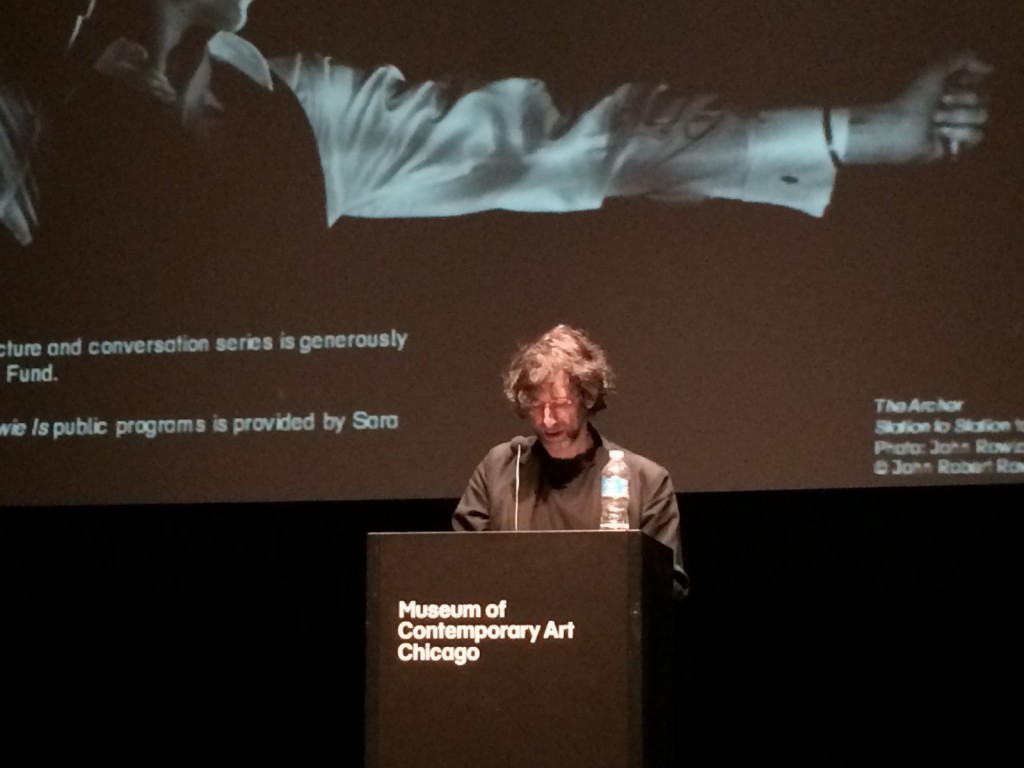
2015-01-04 18.51.45

Neil talked about how when he was young, Bowie’s songs presented him with doorways that in turn, led Neil to new information and ideas, things that inspired him. Interesting that while standing in line and waiting in the auditorium, I heard the same thing said of Neil and his work. So many people talking about the influence that Neil’s fiction and tweets and blog entries and comics have had on their work, their art, their lives. Neil, like Bowie, presents us with doors. It’s a creative continuum: ripples from artist to audience, and artist to artist, and so on.

Sometimes a story provides us with a welcome escape; sometimes it opens the door to a new world; and sometimes a story gives us exactly what we need to hear.

“The Return of the Thin White Duke” is a beautifully crafted Neil Gaiman story inspired by another risk-taking artist who continues to challenge us to “turn and face the strange.”

I won’t spoil the ending for you, but I will say it is a story about transformation and sacrifice, a story about the ways we reinvent ourselves when we try to get back in touch with our heart–and these things at this moment in time resonated with me in a way I did not expect. It was a gift of serendipity, and another kind of door opened.

“You can’t always get what you want
But if you try sometimes you just might find
You get what you need.”

Rolling Stones, You Can’t Always Get What You Want

The Power of Books: Helping to Rebuild Ukrainian Libraries

“But you can’t make people listen. They have to come round in their own time, wondering what happened and why the world blew up around them. It can’t last.” 
― Ray BradburyFahrenheit 451

Burning books–it’s a powerful metaphor for tyranny, censorship, and ignorance. From the burning of “heretical” books during the Spanish Inquisition to the burning of rare Sub-Saharan African medieval documents by Islamist insurgents in Mali last year, our history is full of examples of libraries and precious volumes being destroyed as one group conquers another or seeks to control the ideas and culture of a people.

In March of this year, Pro-Russian activists forced their way into public buildings in Kharkiv and Donetsk, Ukraine, and destroyed volumes of Ukrainian history, literature, and archival books, including some devoted to the Holodomor (the man-made famine imposed by Stalin’s regime in 1932-1933 that killed 7-10 million people).

Why burn them? Destroying books is an attempt to silence people and erase their past and their influence. Books hold stories and histories; they preserve language and traditions; they document people and places; and some of them are archival treasures. It hurts my heart to think of all that’s been lost in the destruction of libraries and archives around the world over time.

Referencing the destruction during WWII, in his  ‘Message to the Booksellers of America,” President Franklin D. Roosevelt wrote:

“Books can not be killed by fire. People die, but books never die. No man and no force can abolish memory … In this war, we know, books are weapons. And it is a part of your dedication always to make them weapons for man’s freedom.”

Books can touch people’s hearts, challenge their assumptions, sometimes change their lives. For me, the incredible potential of words is one of the main reasons I became a writer. Books are powerful. The right books can make ripples that change the world.

When I was growing up, like many Ukrainian American children of first and second generation immigrants, I was taught that it was my responsibility to learn the language and history of Ukraine, to do my part in the preservation of Ukrainian culture and traditions.

Most of us growing up in the Ukrainian Diaspora knew that so much was suppressed and destroyed in Soviet Ukraine, and we watched the efforts of our elders to safeguard all they could of Ukraine’s history and culture. This is why the Ukrainian National Museum (UNM) was created back in 1952 in Chicago.

The Ukrainian Diaspora has been closely watching events unfolding in Ukraine. As soon as word spread about the books being burned in Kharkiv and Donetsk, the UNM began to immediately collect Ukrainian language books to replace all that was lost.

Photo courtesy of the Ukrainian National Museum.

“People have been very generous and donated family collections of books. We have 50 filled boxes,” explains Anna Chychula, UNM Administrator. “Now we need help to fund the cost of shipping.”

The UNM  has launched a crowd-funding project to cover the cost of sending the books to Ukraine and hopes to raise $5000. They’ve chosen Razoo.com, a fundraising platform for registered nonprofits. The beauty of crowd-funding is that every contribution helps. For those interested in participating, the campaign is explained on their Razoo site: http://www.razoo.com/story/Books-Matter-Replace-The-Burned-Books-In-The-Kharkiv-Library (or click on the widget below):

Lights and Dreaming

2013-12-01 02.26.49

It’s 2am, and I’m putting lights and garland on the tree.

Earlier this evening, it was a mostly joyful and noisy team effort of uncovering boxes and assembling, and tomorrow, after breakfast, we’ll put on the bulk of the ornaments.

But right now, it’s blissfully quiet.

Everyone else is in bed. Loreena McKennitt is softly playing, I’m drinking eggnog, and I’m reminded of decorating the tree in my first Chicago apartment on Janssen Street in 1995.

That was the year I started my tradition of putting up the tree the weekend after Thanksgiving.  I usually did it alone, with a glass of wine and Loreena’s To Drive the Cold Winter Away. My parents had given me their old Christmas tree, and I bought white lights and a few ornaments (most of which I still have and will put on the tree tonight). I decorated with red apples and cherries, pine cones, and faux crystal snowflakes and icicles.

I loved that tree.

I loved the moment of sitting on the couch in the dark when it was done, the room transformed. I dreamed big by the light of that tree.

It’s hard to believe that was almost 20 years ago.

I still love the ritual of decorating the house for the holidays, of creating a space for celebration. Including the kids has its own delight, and I especially enjoy having the house full of family and friends on the holidays.

But I cherish moments like this one–quiet, solitary times that allow me to reflect and remember. It’s good to be reminded of the young woman I was back then, to be reconnected with that romantic dreamer.

In the morning, I’ll put on my other hats; but for now, it’s just me and Loreena and the tree, a meditation on nostalgia and dreams.