From Awkward to Awesome

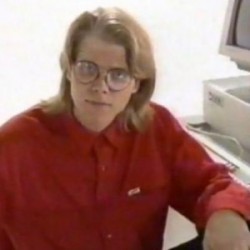
For those of us who grew up in the 80s and early 90s, the brainy Encyclopædia Britannica kid from the tv commercial was an iconic image of what a nerdy kid looked and sounded like. For those of us who *were* nerdy kids in the 80s, it was an extremely familiar image. (I certainly had the big glasses.)

It’s likely no surprise that my Geek Parenting coauthor, Stephen H. Segal, was also a nerd; and when he was young, he shared enough of a physical resemblance to the Encyclopædia Britannica kid (played by Donavan Freberg), that he was quite often mistaken for the awkward commercial know-it-all.

Much later, Stephen met and befriended his adolescent doppelgänger, and Donavan turned out to be a kindred spirit. We hear enough about how people fall from great heights and notoriety, but sometimes the story is better than that. Sometimes people take the gifts they have been given and work to make this world better and more beautiful.

Click here to read Stephen’s blog post about how “This iconic geek kid “had a report due on space.” Spoiler alert: He grew up to be awesome.

(Be sure to also follow the link in the story to read the entire interview with Donavan about his legendary comedian/ advertising creative director father, Stan Freberg.)

I love the way that Donavan’s story shows how creating a space for your kids to figure out who they are can help them to eventually embrace their authentic selves. It’s a valuable reminder, and it’s a really good story.

donavan

Meaning

When I’m writing with a looming deadline, I tend to get hermitty, only leaving the house when I absolutely have to. I drop the kids off at school, make a pot of coffee, and start writing until I have to pick them up again. Then after I put them to bed, I’m back to writing again. I’m an introvert at heart, albeit a social one, so I can sustain this for quite a while before getting antsy.

That said, I find that scheduling one coffee or breakfast during the week, or at least a conversation via skype, helps to reinvigorate me, nourishes my spirit. The time spent away from my manuscript also often helps me to process things I have been turning around and around in my head.

So yesterday, before delving into the work, I had a coffee chat with my friend, Scott​. A fellow writer, we met while teaching at DePaul (over 15 years ago now!) Our conversation turned to a psychiatrist/neurologist whose name I recognized, but whose work I did not know well, Viktor E. Frankl. A Holocaust survivor, Frankl wrote about man’s search for meaning (which is how his name came up in the first place), and I was intrigued enough to do a little digging this afternoon.

Several snippets of his work resonated with me on several levels, and I wanted to share a few here from his book, Man’s Search for Meaning.

Here he writes about his love for his first wife, Tilly, who died at Bergen-Belsen concentration camp:

“I knew only one thing–which I have learned well by now: Love goes very far beyond the physical person of the beloved. It finds its deepest meaning in his spiritual being, his inner self. Whether or not he is actually present, whether or not he is still alive at all, ceases somehow to be of importance.

I did not know whether my wife was alive, and I had no means of finding out (during all my prison life there was no outgoing or incoming mail); but at that moment it ceased to matter. There was no need for me to know; nothing could touch the strength of my love, my thoughts, and the image of my beloved. Had I known then that my wife was dead, I think that I would still have given myself, undisturbed by that knowledge, to the contemplation of her image, and that my mental conversation with her would have been just as vivid and just as satisfying. ‘Set me like a seal upon thy heart, love is as strong as death.'”

And this from the same book:

‘But what about human liberty? Is there no spiritual freedom in regard to behavior and reaction to any given surroundings? … Most important, do the prisoners’ reactions to the singular world of the concentration camp prove that man cannot escape the influences of his surroundings? Does man have no choice of action in the face of such circumstances?

We can answer these questions from experience as well as on principle. The experiences of camp life show that man does have a choice of action. … Man can preserve a vestige of spiritual freedom, of independence of mind, even in such terrible conditions of psychic and physical stress.

[…]

[E]verything can be taken from a man but one thing: the last of the human freedoms — to choose one’s attitude in any given set of circumstances, to choose one’s own way.”

One more:

“A man who becomes conscious of the responsibility he bears toward a human being who affectionately waits for him, or to an unfinished work, will never be able to throw away his life. He knows the ‘why’ for his existence, and will be able to bear almost any ‘how’.”

And a link to a video, because it’s so interesting to see the Frankl speaking:

http://www.ted.com/talks/viktor_frankl_youth_in_search_of_meaning

May we all find our why’s.

Back to writing.

xxo
Blood and Bone and Magic

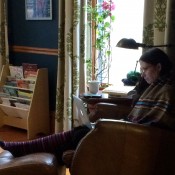
Writing at Mary Anne's house, November 2014. (photo by Mary Anne Mohanraj)

Music is important to my writing process, and I usually end up with a collection of songs for most of my stories, long and short. When I’m starting to write, especially a novel, I like to have a song that sets the emotional atmosphere. It’s exciting when I find it—that perfect collection of words and melody and rhythm to capture the energy. I add to the soundtrack as I go, finding a song for a character or a particular place, but that first one remains important, a touchstone. I will go back to it again and again.

This is all to say that I’ve found that song for my next work-in-progress. I’m in love with it—playing it over and over, trying out the words when I’m alone in the car, rereading the lyrics when I take break from writing. The song, Blood and Bone,” is a by Alt-folk musician Hayley Jane, who currently has a kickstarter campaign to produce her next album. It’s the only song I’ve heard so far, but I was intrigued enough to become a backer. Her campaign is nearly funded after only the first few days, and no matter what else the album holds, I’m grateful for this gem.

I listened to Blood and Bone all morning and on the way to a writing day at Mary Anne Mohanraj’s beautiful Victorian home. Quietly typing away on our laptops atop bellies full of Mary Anne’s always amazing cooking, Mary Robinette Kowal, Kat Tanaka Okopnik, Julie Chyna, Mary Anne, and I spent a few hours writing.

To my delight, “Blood and Bone” had made its way into my imagination, into my creative DNA. When I sat down to work on my opening scene, there it was—a musical-emotional undertow pulling me along, plunging me deeper. I wrote the scene quickly before having to leave to pick the kids up from school, the character and setting still fresh in my mind on the drive home.

I love those moments, when the Muse is in control, when the story washes over me and onto the page in waves. It’s not always like that, but when it is, oh it’s magic! And any day with magic is a very good day, especially on a snowy November Monday in Chicago.

[bandcamp width=100% height=42 track=980009751 size=small bgcol=333333 linkcol=e32c14]