In the Company of Wolves

I became involved with the Chicago Literary Hall of Fame because I believe that Chicago has an important literary legacy deserving of attention. After two induction ceremonies where we celebrated historical writers, it was time to look at the contribution of writers living and working in Chicago.

The Fuller Award (Photo by 8 Eyes Photography)

After some discussion, it was unanimous, and we moved forward to create a new award, the Fuller, to honor a lifetime contribution to Chicago literature. (You can read more about the significance and symbolism of the award here.)

Poster & sculpture design by M.C. Matz (www.mcmatz.com)

There was no question in my mind that Gene Wolfe should be the person to receive the first Fuller Award.

His work is rich, innovative fiction worthy to stand beside many of the literary giants that have shaped not only Chicago’s literature, but modern literature as a whole.

There was briefly a question of “genre writing,” but if we take a look at the literary landscape, the fantastic is an important part of it. Homer, the greatest epic poet of Ancient Greece wrote about Odysseus’ adventures among gods and men. Dante’s La Divina Commedia drew upon medieval Christian mythology in a journey through Hell, Purgatory, and Heaven. Shakespeare incorporated folklore and fairies into his plays. Edgar Allen Poe, Nathaniel Hawthorne, and Oscar Wilde all introduced elements of the supernatural in their works.

Considered to be some of literature’s greatest writers, many of their stories would likely be considered Fantasy and Science Fiction by today’s genre classification. Somewhere along the way, mainstream literature became aligned with realism, but if we look back on the literary spectrum, we see that much of it is saturated with the unknown, the mysterious—the fantastic.

Gene’s work is like that—fantastic and significant.

After talking with Gene and receiving his gracious acceptance, I corresponded with Neil Gaiman. A long-time champion of Gene’s writing, he was my touchstone. After Neil, I contacted others: writers, editors, family, friends; and they responded with overwhelming enthusiasm.

Again and again they confirmed what I believed, that people love Gene Wolfe.  Upon meeting Gene, a respect for the writer and his words evolves into a genuine affection for the man.

March 17, 2012 brought us a day of unseasonably warm weather and sunshine. We headed toward Barrington Hills, stopping for a delicious lunch at the Happy Buddha; and as I looked around the table during our meal, I was once again reminded how blessed I am to have these dear friends in my life. Many of them had been up late the night before, helping me to fold, cut, paste, and package. Even friends who couldn’t attend the event had pitched in to help in during the months before the event. (Thank you!)

A few quick errands, and we arrived at the Sanfilippo Estate for final touches and setup.
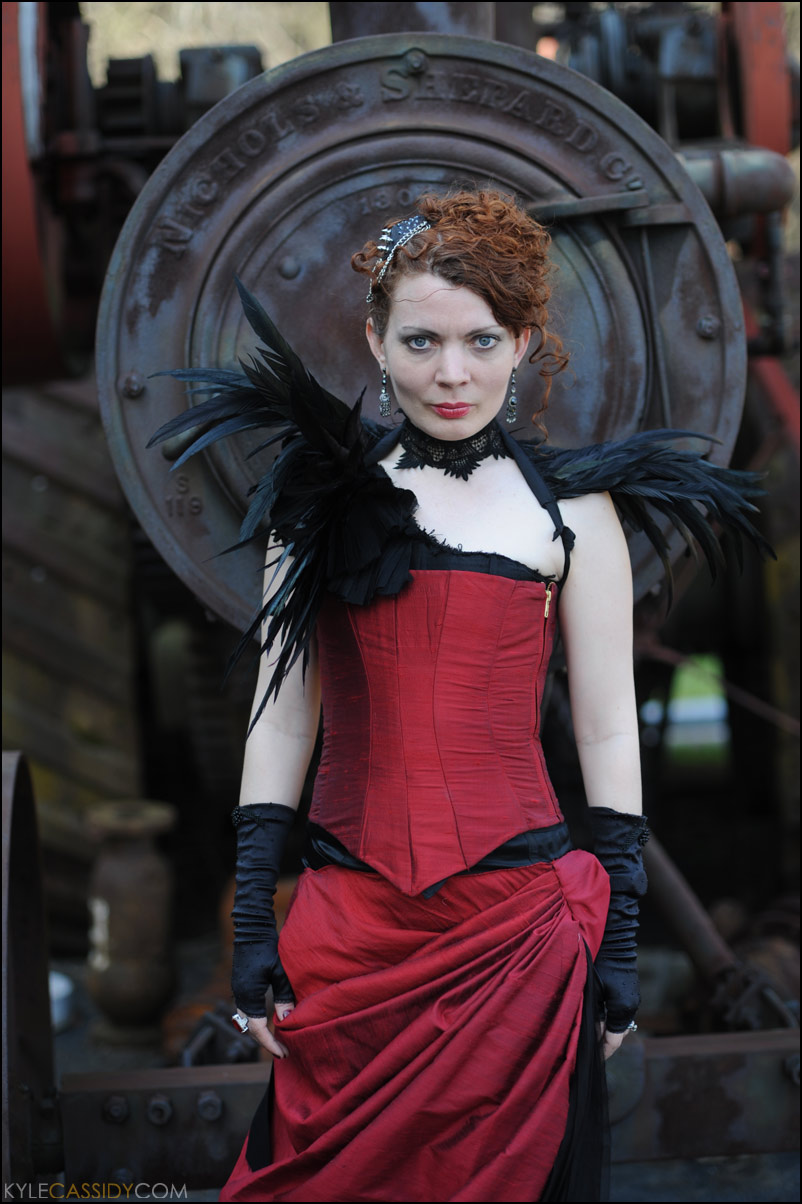
I love this photo of Trillian Stars in front of one of the many steam engines on the Sanfilippo grounds. (Photo by Kyle Cassidy.)

Soon after the guests arrived, and while I waited for Neil and Maria Dahvana Headley in the Carousel Pavilion, I received texts from the folks at the house with updates on guests’ arrivals and the progress of signings and check-in.

Teri Goulding pins the boutonnière on her father, Gene Wolfe. (Photo by Carl Hertz)

Bill Shunn Michael Swanwick, and James Wynn have already posted their accounts of the evening, accompanied by photos and videos.

Lawrence Santoro signs the beautiful commemorative posters created by M.C. Matz. (Photo by 8 Eyes Photography)

Others will surely do the same, and in many ways their perspective is better than mine because they entered into the evening as participants, stepping into the “container” that I helped to create with the assistance of talented friends. It’s like a magic trick, best enjoyed by the audience (but savored in a different way by those who know the trick).

Terra Mysterium (photo by 8 Eyes Photography)

The afternoon was a whirlwind of rehearsals, tours, photos, and the eventual start of the ceremony.

Gary K. Wolfe (Photo by 8 Eyes Photography)

After Gary K. Wolfe’s inspired introduction, Neil’s reading of “A Solar Labyrinth,” and his heartfelt presentation of the Fuller, Gene took the stage.

Neil Gaiman and Gene Wolfe (Photo by 8 Eyes Photography)

His speech was so gracious and genuine, so smart and witty—so very Gene.

Gene Wolfe (Photo by 8 Eyes Photography)

After Gene’s speech, I knew I could relax. I never doubted that Terra Mysterium’s performance of Gene Wolfe’s “The Toy Theater” (adapted by Lawrence Santoro) would be wonderful, and it was.

The Toy Theater, performed by Terra Mysterium (Photo by 8 Eyes Photography)

Once the organist R. Jelani Eddington took the stage, I slipped into the foyer where I could still hear the music.

Maria Dahvana Headley and Valya Dudycz Lupescu (Photo by Carl Hertz)

A small group of us had gathered there: Neil, Peter Straub, Carl and Mark, Audrey, Kyle, and Maria, and 8 Eyes Photography.

Neil and Valya (Photo by Carl Hertz)

Neil told me that Amanda had called at precisely the moment when one of the marionettes was singing “Coin-Operated Boy” during the audio-play. It made me smile. Neil had been such an invaluable ally, and I liked being able to slip in a little echo of Amanda into the evening; the song was a perfect addition to the story and the setting.

Neil Gaiman and Audrey Niffenegger (Photo by Carl Hertz)

So much followed, from fun photos on the grand staircase to the Great Coat Closet Party of ’12, while in the adjoining music salon Jelani played Star Wars on the 8,000-pipe Wurlitzer.

Great Coat Closet Party of ’12, (Photo by Carl Hertz)

I love this incredible circle of creative people in my life. They don’t all appear in the photos here, but I remember their contribution. I couldn’t have done it without them. The evening was proof that together we can make magic.

Kyle Cassidy, Valya Dudycz Lupescu, Trillian Stars, Peter and Beth Sagal, Neil Gaiman, Maria Dahvana Headley (Photo by 8 Eyes Photography)

After the performance and more photos, we moved to the magnificent Carousel Pavilion which looked so lovely lit up in antique lights. Chef Jeramie Campana of Wild Asparagus and his team treated us to a delicious meal.
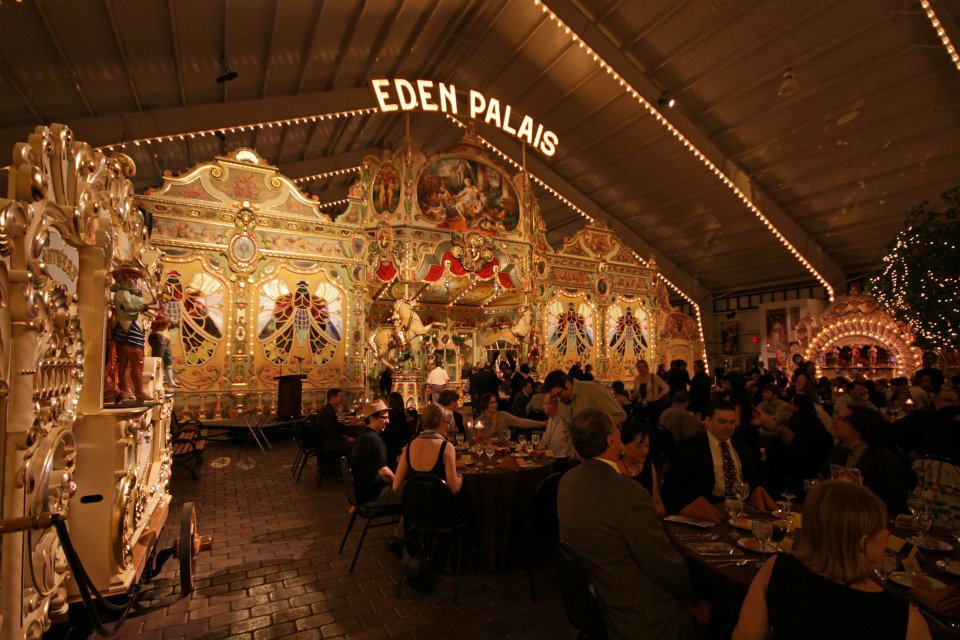
(Photo by 8 Eyes Photography)

Peter Sagal was the perfect toastmaster, fabricating quirky biographical anecdotes for each speaker as he introduced them.

Peter Sagal (Photo by 8 Eyes Photography)

Each of the Special Guests who took to the podium offered his or her own perspective on Gene and his work, beginning with Gene’s daughter, Teri Goulding, who talked about how proud her mother, Rosemary, would have been.

Therese Goulding (Photo by 8 Eyes Photography)

Rosemary was not well enough to attend, and her absence was felt by all who loved Gene. In my own small way I had had tried to include her by attaching a few small sprigs of rosemary to Gene’s boutonniere.

Luis Urrea (Photo by 8 Eyes Photography)
Dr. Elizabeth A. Hull (Photo by 8 Eyes Photography)
Jody Lynn Nye (Photo by 8 Eyes Photography)

Following the speeches, dinner, dessert, and cordials, Greg Leifel, the Foundation Director at Sanfilippo announced that guests could ride the antique carousel. The crowd cheered, loudly, then ran to stand in line. What followed is best expressed in a few photos:

Michael Dirda (Photo by 8 Eyes Photography)
Terra Mysterium (Photo by 8 Eyes Photography)
Jill Thompson, Neil Gaiman, and Kyle Cassidy (Photo by 8 Eyes Photography)

Joy. Wonder. You can see it reflected on their faces in photos and in this video by Bill Shunn:

That carousel evoked such a joyful response. I could think of no better way to end an evening that honored a man whose stories delight so many people. To see his face lit up, to see him so happy—it was the perfect way to close the night.

Gene Wolfe and Rebecca Bushong-Taylor (Photo by 8 Eyes Photography)

Maura Henn, and Kyle and Trillian, were staying with us, and some of the guests met us back at our home. Joined by Peter Straub, Gary K. Wolfe and Stacie Hanes, Jennifer Stevenson, and others, we had cocktails, wine, and cheese, and sat around the living room relaxing in various stages of exhaustion and inspiration.

Then it was over.

When the house was quiet, Kyle, Maura, and Mark chatted while I fell asleep on the couch. In the morning it was like a fantastic dream.

I’ve been eagerly awaiting photos from the evening. Slowly they have begun to appear online.

(Photo by 8 Eyes Photography)
Maura Henn, Maria Dahvana Headley, Valya Dudycz Lupescu, Trillian Stars (Photo by 8 Eyes Photography)

The photos help to make it more concrete, just as writing this blog entry helps to tether it to reality, as if written words can keep An Evening to Honor Gene Wolfe from drifting off into that nebulous realm of dreams and memories.

In life, we are lucky to meet people who inspire us. Sometimes we encounter them through their work—stories and images that strike a chord. Sometimes we are lucky enough to have them for friends. This weekend was filled with both.

Valya Dudycz Lupescu, Gene Wolfe, Walter Dudycz (Photo by 8 Eyes Photography)

Thank you to everyone who helped to make it happen.

More pictures from the evening can be found at: 8 Eyes Photography

And more accounts of the evening by:

William Shunn

Michael Swanwick

Magic and Mischief

Trillian Stars

Win Two Dinner Tickets For An Evening to Honor Gene Wolfe

Wolfsword Press and the Chicago Literary Hall of Fame are sponsoring a contest to win 2 dinner tickets for An Evening to Honor Gene Wolfe held on March 17, 2012, at the Sanfilippo Estate in Barrington Hills, IL.

The evening celebrates the lifetime literary achievement of writer Gene Wolfe as he receives the first Fuller Award. The steampunk scifi literary extravaganza features performances by Terra Mysterium and R. Jelani Eddington. Special guests for the evening include: Gene Wolfe (of course!), Peter Sagal, Gary K. Wolfe, Neil Gaiman, Peter Straub, Michael Dirda Audrey Niffenegger, Luis Urrea, Kyle Cassidy, and so many more! (For more information on the event click here.)

GENE WOLFE WILL SELECT THE WINNER FROM THE FINALISTS!

The winner will be announced on our website by March 1. This will give everyone else time to purchase their tickets (Ticket sales end on March 5, 2012!)

THE CONTEST: Write a flash fiction story that features a wolf (or a Wolfe). This “theme” can be interpreted as broadly as you wish. The story must be at least 100 words but no more than 250 words (that includes the title). The story can be of any genre. It must be previously unpublished (that means in print or online).

The deadline is Friday, February 24, 2012 at 11:59pm CST. Any email submissions sent after that time will be deleted without consideration.

Send your submission in the body of the email (EMAILS WITH ATTACHMENTS WILL NOT BE ACCEPTED!) along with your name, address, telephone number, and email address to [email protected]

A FEW FLASH FICTION TIPS 

Sometimes called sudden fiction, microfiction, or short shorts, the length of flashes can vary. For our purposes, the flash cannot exceed 250 words. Flashes should still contain classic story elements: protagonist, conflict, and resolution. The limited word length, however, dictates that some elements will remain unwritten or implied in the written story.

DISCLAIMER AND OFFICIAL INFORMATION:

      • Winner must provide his/her own transportation: airfare, bus fare, train fare, llama, airship.
      • If you are unable to attend, there is no substitution prize. You may, however, gift your tickets to someone else.

Good luck to you! We look forward to reading your stories and hope to see you on March 17th!

Teen fiction accused of being ‘rife with depravity’

Today my friend in Paris sent me a link to Guardian editor Alison Flood’s response to the Wall Street Jounral commentary on YA Literature. I’d recommend reading Flood’s article: Teen fiction accused of being ‘rife with depravity.’ It discusses the reactions of YA writers to the WSJ piece.

I’d also recommend this well-written response from Kyle Cassidy. I found myself nodding in agreement to all he wrote, so I’ve re-posted it here:

***Originally posted by [info]kylecassidy at The Wall Street Journal Nonsense about YA Literature***

It’s kind of like robbing a bank that keeps its cash in an unguarded shoebox in a public park to say “I’m going to take on the Wall Street Journal’s commentary on YA Literature, “Darkness Too Visible” penned by Meghan Cox Gurdon” whose inbox, no doubt, like the illustrious Journal’s is probably filling up with incredulous and angry comments from people more eloquent and informed than I. But Gurdon provides extremely low hanging fruit that it’s really hard not to swat at, beginning with the proposion that Young Adult Literature is: “all vampires and suicide and self-mutilation … dark, dark stuff” 

Which is sort of like standing in a mall parking lot and shouting “ALL CARS ARE RED!” One hardly need point out that Julie of the Wolves, Island of the Blue Dolphins, the Phantom Tollbooth, The House With the Clock in its Walls, the Chronicles of Narnia, and hundreds of other classics of yesterday are still YA literature, and are still on shelves. It also ignores modern classics like Ysabeau Wilce’s Flora Segunda which has neither vampires nor suicides, but a daring young heroine who would be excellent role model material for any daughter I had. On top of that, it ignores the fact that some of the greatest works of YA literature, like Harper Lee’s To Kill a Mockingbird are … well, dark at times.

Gurdon goes on to make the bizarre claim that “…40 years ago, no one had to contend with young-adult literature because there was no such thing”, claiming, somewhat incredulously, that it began in 1967 with the publication of The Outsiders, this of course discounts not just Tom Sawyer and Huckleberry Finn, perhaps the two most widely known books written for a young adult audience in the English Language, but also books like Kidnapped and Treasure Island which adolescents were reading for generations before Outsiders author S.E. Hinton was born. On my shelf right now I have a book called Six Girls by Fanny Belle Irving published in 1882 — I haven’t read it, but I can assure you it’s audience is teenage girls who might also be reading Little Women or Jane Austen. (In fact, the article’s own sidebar recommends the 1943 novel A Tree Grows In Brooklyn for kids.) All this serves to suggest that Gurdon doesn’t have a clue what she’s talking about — that she hasn’t even taken the time to read the Wikipedia page about the topic she’s writing on, and that carelessness suggests that we should take everything else she has to say with a grain of salt.

Gurdon then goes on to criticize a series of books individually, she takes time to specifically complain about Jackie Morse Kessler’s book “Rage” which involves a girl who turns to self injury after being the victim of “a sadistic sexual prank”. When we live in a world where teenage girls cut themselves at prodigious rates (and this is nothing new, it’s been happening for hundreds of years) The Wall Street Journal thinks that we shouldn’t have books for teens that discuss it. Gurdon takes to task an editor who laments having to cut language from a book in order to get it in schools as though it was a conversation never held between Mark Twain and his editor.

But this is simply the history of books and literature, it is the way things progress and regress and progress again. In the late 1800’s Arthur Winfield began an extremely popular series of books for young readers called The Rover Boys. [info]trillian_stars and I scored a complete collection of these a couple of years ago and found them so offensive, so sexist, so racist, so classist, as to be nearly unreadable — the best-selling morality tales of the late 1800’s and early 1900’s were all about making fun of the poor & underprivileged, those with accents, or dark skin, or those not able to get into the same prep school. The Rover Boys play vicious pranks on their school mates who are fat or who speak with a lisp, and they succeed and persevere because they’re rich and they’re entitled to and, hey, it’s all in good fun.

I realized while trying to read these that YA literature reflects the times as they are and that they will also, occasionally, attempt to grasp the times that Aren’t Yet and pull them closer. If there’s a glut of vampire books on the market now there may not be in fifteen years. Of these, many will fade into obscurity and some, the ones that strive, will remain — Darwin will police the stacks — and in the meantime, the literature will evolve. Things people look at as taboo in one era (women wearing pants) don’t warrant a second glance in another. YA literature is one of the mechanisms by which children learn what types of adults they will become. They likely won’t learn to become vampires, but they may learn that they’re not the only teenage girls who have a compulsion to cut themselves, or that they’re not the only boys who are attracted to other boys, or they may learn how to build a house in a tree if they ever get stranded on an island.

There are many YA books out there — some of them good, and some of them bad. Some of them I’d be happy to let my (theoretical) children read, and some that I think would be a waste of their time.

I feel compelled to quote Heavy Metal Rocker Dee Snider who, when called before the PMRC (Parents Music Resource Comission) in 1985 by a very clueless Al Gore to testify about the harm rock music caused teens, schooled the Senator in parenting in one of the most one sided smackdowns since Lloyd Benson told Dan Quayle that he was, in fact, “No Jack Kennedy”.

Senatore GORE: [Should a parent have] To sit down and listen to every song on the album?

Mr. SNIDER. Well, if they are really concerned about it I think that they have to.

Senator GORE. Do you think it is reasonable to expect parents to do that?

Mr. SNIDER. Being a parent is not a reasonable thing. It is a very hard thing. I am a parent and I know.

I don’t know what’s more embarrassing, that Congress would waste tax dollars on such a farce, or that the senior Senator from Tennessee got his ass handed to him in a debate by a guy who appeared on his album cover wearing shoulder pads, spandex pants, and pink lace-up boots waving a bloody soup bone.

I’m not sure why the Wall Street Journal would bother to print such nonsense, I can only hope it is a result of laying off so much of the editorial staff over the past few years rather than policy.

In summary:

  • Being a parent is not supposed to be easy.
  • It’s not the publishing industry’s job to decide what to print based on what you like to read.
  • Not all books are good books.
  • Every single book that you liked as a child you can still get for your own kids, if not from your local bookstore, then from ebay.
  • Good literature stays around, the bad stuff is transient.
  • At some point your child will probably read a book that you don’t think is good that will change their lives in a good way.
  • Ranting to the Wall Street Journal that YA literature sucks when you apparently know nothing about YA literature is a sad attempt at making a shortcut to responsible parenting.
  • Ask a librarian, they’re there to help.