This post is part of a blog post relay on craft, which the wonderful Nancy Hightower invited me to join. Nancy is the author of Elementari Rising. She has a poetry collection, The Acolyte, forthcoming with Port Yonder Press, and her short story collection, Kinds of Leaving, was shortlisted for the Flann O’Brien Award for Innovative Fiction.
My take on craft:
1) What am I working on?
While my second novel, The Supper Club, is out on submission, I’m working on my third novel, Mother Christmas, a historical fantasy set in Ancient Turkey. I’m also writing the script for a graphic novel, Sticks & Bones, with artwork by the incredible Madeline C. Matz. The story follows displaced house spirits/household gods (brownies, domovyky, the tomte, etc.) who are being hunted in America.
2) How does my work differ from others of its genre?
My writing falls under the category of speculative fiction, more specifically magic realism, but I draw from an Eastern European folkloric tradition rather than a Latin American one. I enjoy looking at the mundane world through the lens of myth and fairy tale, bringing those magical stories into a contemporary context. In my work, I explore moments of revelation—epiphanies that come to light when two seemingly contradictory elements (like the magical/realistic) intersect. Those liminal spaces are my creative obsession—the places where ideas meet, where personalities collide, the crossroad moments in history.
3) Why do I write what I do?
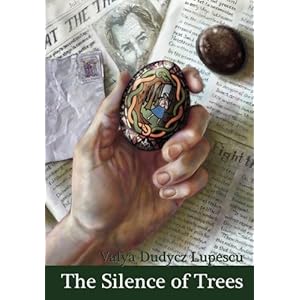
What I write has been called “diaspora literature,” especially my first novel, The Silence of Trees. Diaspora literature is primarily concerned with the individual’s or community’s attachment to homeland. It is born from their sense of yearning for that homeland, an attachment to its traditions, religions, and languages. The diaspora writer creates from the threshold, from the border.
My grandparents came to America from Ukraine after WWII. Like many Ukrainian Americans, my sister and I were raised with one foot in each world: speaking Ukrainian at home, going to Ukrainian school, church, and dancing on the weekends; but also participating in modern American culture. The Ukrainian language and traditions of our ancestors were being wiped out in the Soviet Union. We were taught that it was our responsibility to keep those traditions alive in America. Typical of the Diaspora experience, we were raised to retain a collective memory/vision about our ancestral homeland. I have no doubt that this is where my fascination with “the threshold” was born.
This directly ties into magical realism—with its crossing of borders that allow the writer to celebrate the myths and folklore of home, while creating tension in the story that echoes the experience of being ex-centric, out of the mainstream.
Ultimately, I think I write what I do to explore the paradox of the union of opposites.
4) How does your writing process work?
Most of what I write begins with a question, and those questions come from so many places: reading books or articles, people-watching, going for a walk. I usually write to explore the possible answers: What makes some people bury the past, while others celebrate it? When faced with cruelty, how can two people have such a dramatically different response? What happens to all those teeth? How might the ancient gods of the ocean respond to a devastating oil spill? How might house spirits communicate with one another? For me, the act of writing is the joy and magic of exploration.
As far as process, I most often write at night. I put the kids to bed, wrap up mundane tasks, and brew a pot of coffee. The nighttime has a natural air of magic and mystery, which makes it easier to leave the “real” world behind and slip into the world I am creating. The “writing witching hours” are usually 10pm to 2am. In the morning, after getting up and dropping the kids off at school, I tend to the business of writing. That’s when I do most of my editing and revision, emails, etc. Then I try to get in another four hours of writing in the late morning/early afternoon. Generally, the more I write, the happier I am. I feel like there are so many stories to tell, and I’m trying to find the time to get them all down.
* * *
Next up on the Writing Process blog tour are two fabulous writers: Brooke Bolander and Amelia Beamer! Look for their blog posts on May 19th!
Brooke Bolander‘s work has been featured in Lightspeed, Strange Horizons, and Nightmare, among other venues. She writes stories of indeterminate genre that some might classify as slipstream, although simply calling them weird would probably do just as well.
Look for Brooke’s post at: http://brookebolander.com/
Amelia Beamer is the author of The Loving Dead, the number two zombie novel of the past decade according to Barnes & Noble. She works as an independent editor and proofreader with major publishers including Shueisha English Edition, a new general imprint of popular Japanese titles translated into English. She built her publishing career working as an editor at Locus for seven years, and for three years before that as a student assistant at the Clarion Writers’ Workshop. She publishes short fiction, book reviews, poetry, and cultural criticism. Her most recent short fiction appears in Psychos: Serial Killers, Depraved Madmen, and the Criminally Insane, and Zombies vs Robots: Women on War!
You’ll find Amelia’s post at: http://www.ameliabeamer.com/