Springtime Blessings

Both Ukrainian Christmas and Easter are rich with ancient traditions woven into the fabric of the holiday. I love the connections; these ways we remember those who came before us. When I mentioned blessings baskets on Twitter and Facebook, several people asked me to explain, so I’m adapting/updating this description from an older blog post (April 7, 2007):

I have always admired the way my maternal grandmother dyes her eggs with onion skins, so this year collected the yellow onion skins for several months. We boiled the eggs with the skins, and voila!
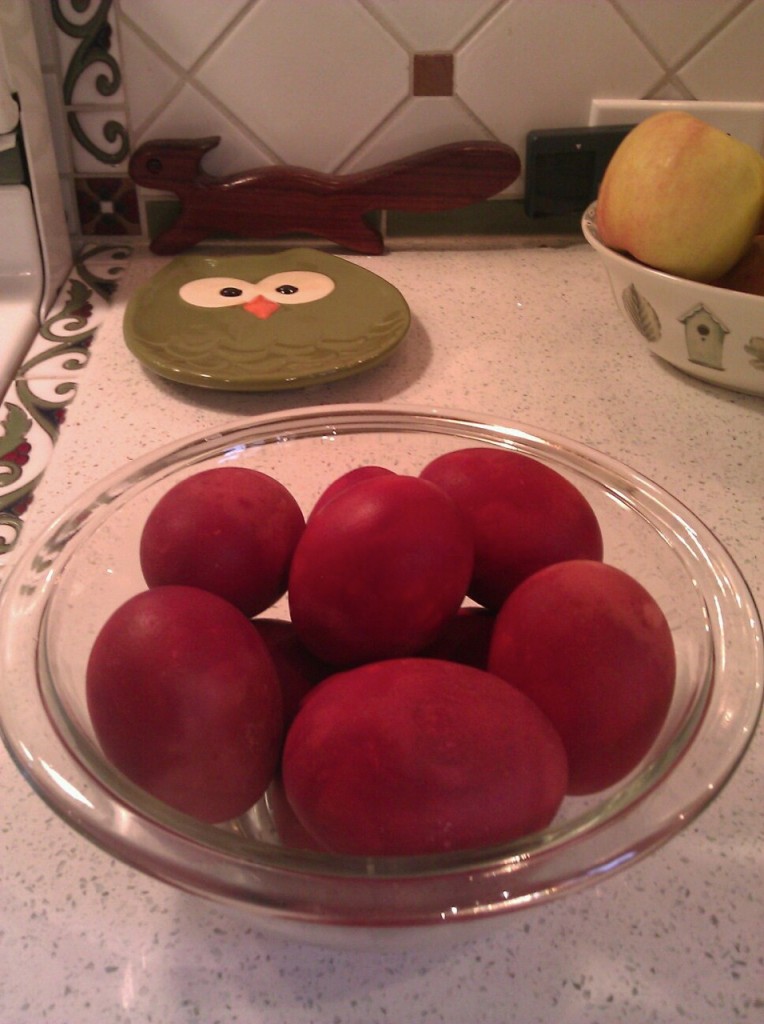
 

On Saturday, we had the blessing of baskets, one of my favorite Ukrainian Springtime traditions. In Ukraine, Christianity came late (988 CE). The peasants still clung to their Old Ways, and as a result, Christianity became infused with them.


Woodcut by Ukrainian artist Jacques Hnizdovsky, illustrating traditional Easter festivities.

The traditional Spring celebrations: dances, baking special breads, painting pysanky, burning fires, dousing with water…these were directly adapted into the Easter holiday. The Saturday before Easter, Ukrainians take their baskets filled with the traditional foods to an area outside of the Church…the blessing usually takes place outside, unless there is rain. The foods are blessed by holy waters and then enjoyed the next morning as breakfast.

The basket usually contains hardboiled and colored eggs, smoked sausages, ham, cheese, butter, horseradish mixed with beets, some salt, and of course the sacred bread, called “paska” or “babka.” Sometimes seeds are added, to be blessed for the garden. We always add some cat food for the cats, and some chocolate…well, because it’s chocolate!

The preparation and baking of paska was considered one of the most important tasks of the year. (I like to bake my own but didn’t get the chance this year.) People believed that the future could be predicted depending on how this holiday bread turned out. Every homemaker wanted her paska to be the best and the biggest, therefore while baking it she performed various magical gestures and used incantations. The dough for the paska was kneaded in a trough which rested on a pillow so that the bread would be light.

During the preparation, the baker had to maintain positive thoughts. While the paska was in the oven, no one was allowed to make a loud noise for fear it would collapse in the oven. In some regions of Ukraine the man of the house stood guard in his front door lest someone enter and cast an evil spell while the paska was baking.

The top of the paska is often covered with symbolic signs made of dough such as a cross, solar signs, rosettes, leaves, pine cones, birds and bees. They refer back to the Goddess of Spring, and the rebirth of the Sun.

Wrapped in a rushnyk (ritual cloth) and placed in the basket, the paska was carried to be blessed in the outdoor ceremony. Once these were offered to the Goddess of Spring and the Sun, now they are offered to the Mother and her reborn Son. Still a ritual of rebirth. The archetypes survive in a slightly different form.

We had a large basket for our family, filled with foods that we shared for breakfast on Easter Sunday.
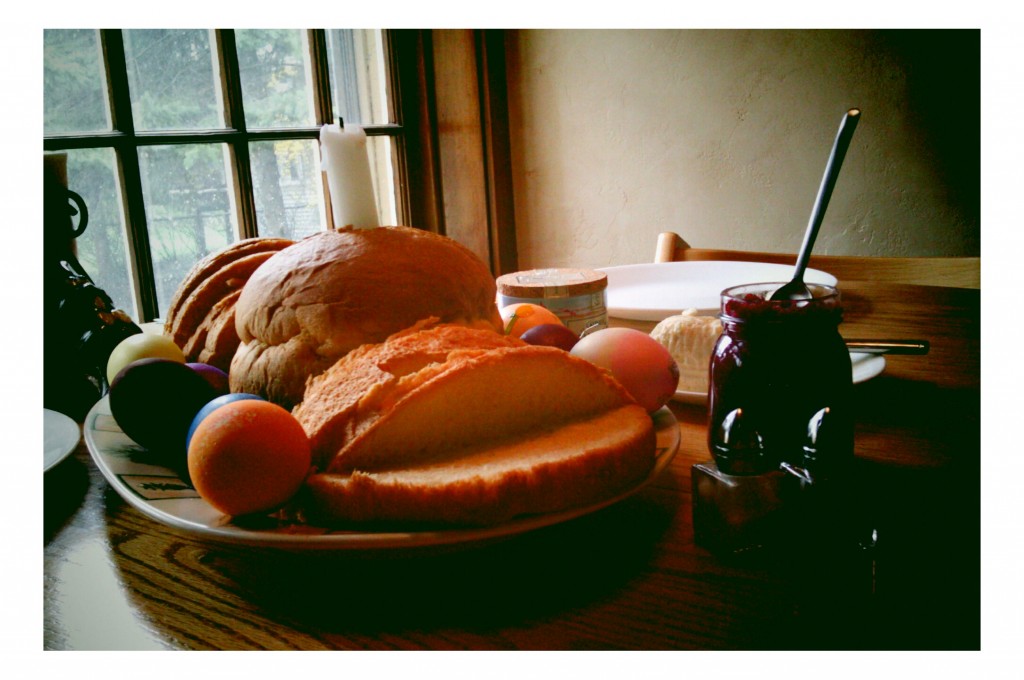
In the spirit of my ancestors, I wish you all the blessings of Spring and the prosperity of a Summer and Fall filled with abundance. May the Sun shine with favor on your path, and the ground grow fertile beneath your feet.

The Sticky Subject of Kutia a.k.a. Ukrainian “Porridge”

This morning Neil Gaiman was in a NY cab and tweeted about his Ukrainian cab driver, who picked up Neil because he was a man and “if 1st fare is a woman is bad luck all day.”

I replied by explaining that this tradition is likely related to the Ukrainian superstition that a man should be the first one to enter a house (or even call a house) on New Year’s Day. I also shared the tradition of throwing kutia (porridge) onto the ceiling on Christmas Eve. If it sticks, it means good luck for the household, and the more kernels that stick, the greater the luck.

After tweeting:

What I have learned this morning: 1) Ukrainian Taxi drivers are superstitious 2) Ukrainians throw porridge at the ceiling for luck.

Neil apparently received quite a few tweets from Ukrainians in Ukraine who had not heard of this tradition. Some had not heard of the porridge.

After a few tweets redirected my way (thanks, Neil 😉 ), I decided to quickly write this post with a few highlights.

  • The Ukrainian “porridge” to which I was referring is kutia. Some people describe it is as a flummery. Neither is quite right, but they’re close.
  • Kutia is an ancient dish that was once eaten at the solstice and is now the first of the twelve dishes to be eaten on Christmas Eve dinner (called Sviata Vecheria)
  • A nice essay about the variation in Sviat Vechir traditions can be found here, by Orysia Tracz, who has written extensively about Ukrainian traditions.
  • There are several recipes online, and as many variations as there are for Irish oatmeal. Everyone has their own particular way of making it. Google “kutia recipe” for some ideas.
  • The basic recipe we use is to first sort & rinse the bulgur wheat, soak it overnight (6-8 hours), boil it for an hour or so (depends on how long you soaked it and how firm you like it), then rinse again. Add poppyseeds, raisins, crushed walnuts, and honey to taste. In my opinion, the key is in the honey. (Ukrainians have been beekeepers for generations, and Ukrainian honey was prized. Here’s a link for more information from Medyana Rosa.)
  • There is a tradition of throwing the kutia up to the ceiling on Sviat Vechir. My grandparents did this when my father was young, and it continued into my childhood. Our Ukrainian friends and family did this and exchanged stories about it.

The things that I find fascinating about this exchange is that many Ukrainians in Ukraine have not heard of the traditions, while Ukrainians in Diaspora (Canada, US, Australia, Argentina) have likely heard of it from parents or grandparents, even if they don’t still celebrate in the traditional ways.

A few weeks ago I was part of Zlukacamp, a conference with Ukrainian students studying in the US, and the subject of traditions came up. When I was growing up, I was taught (from my parents, grandparents, Ukrainian dancing and school, church) that because Ukraine was not free, it was up to us to learn the language, study the history and traditions, and keep them alive.

My grandparents came from Ukraine (via Germany and the Displaced Persons Camps) in the 1940s. The Ukraine I learned about was very much the Ukraine of the 1930s and 40s, the language of that time, the traditions of that time.

Now Ukraine is an Independent country, but some things have been lost, and other things have changed over time. Like any country and people, they have grown a great deal in the last several decades.

So I’m not really surprised that the tradition is lost, but I’m happy to have been able to share it with some people on Twitter, and I’m glad that I had the opportunity to learn about it as a child, to celebrate it as an adult, and even to write about it in my novel, The Silence of Trees (kutia and Sviat Vechir are a part of the story).

I look forward to someday seeing Ukraine of the 21st century, and I hope to be able to share with them and others some of the treasures from an older Ukraine, a Ukraine rich in folklore, fairy tales, and folk arts.

Zlukacamp

I’m behind on my post about Zlukacamp that I attended on Saturday, January 22, in Chicago. It was a remarkable experience, and I consider myself lucky to have met this driven and passionate group of Ukrainian students.

We began with a symbolic representation of our connections to Ukraine as each participant marked the place in Ukraine where they were born or most identified with.

Truly we were “all over the map,” with our roots stretching across Ukraine. It was a fitting way to begin our talks on January 22–Ukrainian Unity Day, commemorating the declaration of unity between the Ukrainian People’s Republic (UNR) and the Western Ukrainian People’s Republic (ZUNR) proclaimed in Sofiyska Square in Kyiv on 22 January, 1919.

These Ukrainian students spoke eloquently about issues dear to their heart: Why do some students from Ukraine choose to remain in the US? Why do others return and what kind of support system is in place to help them to succeed? How can they work with Ukrainians in Diaspora to affect change in Ukraine?

Dr. Myron Kuropas presented the history of Ukrainian Diaspora and attempts by the Ukrainian communities to preserve their culture and traditions in America.

Several of the Ukrainian students spoke about the challenges at hand: corruption, education, expectations, and politics. There are so many obstacles for anyone who wants to make a positive change for Ukraine and her people, and these young people are aware of those challenges and continue to develop ways that they can make a difference.

I spoke about my novel, The Silence of Trees, and my own feeling of being on the threshold between two worlds: Ukrainian and American. It is characteristic of Diaspora literature, this connection to ancestral homeland and the idea that those in Diaspora should collectively be committed to the preservation/restoration of this homeland.

Joined by the Consul General of Ukraine in Chicago, Kostiantyn Kudryk, we listened to a variety of speakers including one of the founders of Zlukacamp, Daria Kaleniuk, as they presented strategies for the future, including supporting Ukrainian students who choose to return to Ukraine, and building a team of Ukrainians and Diaspora who can work together to create projects aimed at supporting Ukraine.

Afterward, we headed over to the Ukrainian National Museum where we heard three additional speakers talk about the importance of archaeological research, the plight of the Crimean Tatar people, and the work of Ukrainian author, Andriy Gudyma.

I was inspired to be in such good company, and proud of this generation of young people coming out of Ukraine. They care deeply for Ukraine and understand that it’s going to be a long road toward improvement. Many of them seem up for the challenge and eager to collaborate with others who share their passion for helping Ukraine.

There’s a flickr page with more photos, and a nice article (in Ukrainian however) here.

I know that they are planning more events in the future, in Chicago and other cities with Ukrainian communities. If you’re interested, they have a facebook page and a google group.

I know they welcome others who are interested in collaboration, brainstorming, and networking. I am proud to have been a part of it, and I hope to stay involved in some way.

This is a group to watch. They are capable of incredible things.