“But you can’t make people listen. They have to come round in their own time, wondering what happened and why the world blew up around them. It can’t last.” ― Ray Bradbury, Fahrenheit 451
Burning books–it’s a powerful metaphor for tyranny, censorship, and ignorance. From the burning of “heretical” books during the Spanish Inquisition to the burning of rare Sub-Saharan African medieval documents by Islamist insurgents in Mali last year, our history is full of examples of libraries and precious volumes being destroyed as one group conquers another or seeks to control the ideas and culture of a people.
In March of this year, Pro-Russian activists forced their way into public buildings in Kharkiv and Donetsk, Ukraine, and destroyed volumes of Ukrainian history, literature, and archival books, including some devoted to the Holodomor (the man-made famine imposed by Stalin’s regime in 1932-1933 that killed 7-10 million people).
Why burn them? Destroying books is an attempt to silence people and erase their past and their influence. Books hold stories and histories; they preserve language and traditions; they document people and places; and some of them are archival treasures. It hurts my heart to think of all that’s been lost in the destruction of libraries and archives around the world over time.
Referencing the destruction during WWII, in his ‘Message to the Booksellers of America,” President Franklin D. Roosevelt wrote:
“Books can not be killed by fire. People die, but books never die. No man and no force can abolish memory … In this war, we know, books are weapons. And it is a part of your dedication always to make them weapons for man’s freedom.”
Books can touch people’s hearts, challenge their assumptions, sometimes change their lives. For me, the incredible potential of words is one of the main reasons I became a writer. Books are powerful. The right books can make ripples that change the world.
When I was growing up, like many Ukrainian American children of first and second generation immigrants, I was taught that it was my responsibility to learn the language and history of Ukraine, to do my part in the preservation of Ukrainian culture and traditions.
Most of us growing up in the Ukrainian Diaspora knew that so much was suppressed and destroyed in Soviet Ukraine, and we watched the efforts of our elders to safeguard all they could of Ukraine’s history and culture. This is why the Ukrainian National Museum (UNM) was created back in 1952 in Chicago.
The Ukrainian Diaspora has been closely watching events unfolding in Ukraine. As soon as word spread about the books being burned in Kharkiv and Donetsk, the UNM began to immediately collect Ukrainian language books to replace all that was lost.
Photo courtesy of the Ukrainian National Museum.
“People have been very generous and donated family collections of books. We have 50 filled boxes,” explains Anna Chychula, UNM Administrator. “Now we need help to fund the cost of shipping.”
The UNM has launched a crowd-funding project to cover the cost of sending the books to Ukraine and hopes to raise $5000. They’ve chosen Razoo.com, a fundraising platform for registered nonprofits. The beauty of crowd-funding is that every contribution helps. For those interested in participating, the campaign is explained on their Razoo site: http://www.razoo.com/story/Books-Matter-Replace-The-Burned-Books-In-The-Kharkiv-Library (or click on the widget below):
Some months are so full they rush by in a blur. April 2013 was like that. After ICFA, there was a Spring roadtrip, followed by C2E2 and a wonderful meeting (resulting in an exciting announcement to be made in the near future). In between, there were family obligations, book club and school visits, beloved dead to be remembered, and deadlines to be met.
Then came May and finally Spring. Warm weather arrived, and with it the joy of open windows and fresh breezes that make a morning cup of coffee taste even better.
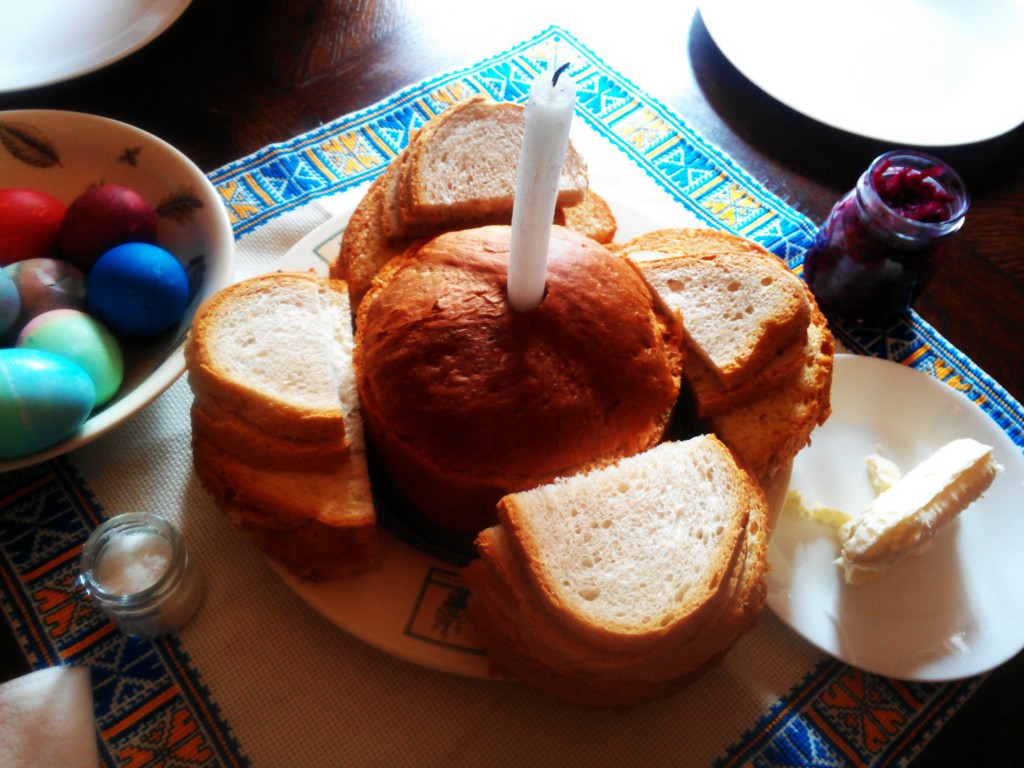
Yesterday was Ukrainian Easter (celebrated according to the Julian calendar). We began our day with the traditional breakfast of eggs, rich egg bread, beets mixed with horseradish, “lamb” butter, cheese, ham and sausage. All of it was blessed in baskets adorned with embroidery on the afternoon before in the church parking lot. I love this tradition, probably because it’s tied to food, and the sharing of meals is so important to me and my family.
I remember our first Spring in Frankfurt, Germany, in 2003. I was able to find a small Ukrainian community that had services out of a Roman Catholic church. That year we blessed our basket in the courtyard alongside Ukrainians born in Germany and those recently from Ukraine. Our baskets were nearly the same, adorned with varying styles of Ukrainian embroidery.
Looking around, that was my first experience of how important community must have been for my grandparents transplanted to Chicago from Ukraine after WWII. There is comfort is celebrating beloved traditions, even on foreign soil with people you do not know.
Food also helps us to connect–an ocean between us, on different land, we can still eat the same kind of foods, the same basic recipes, passed down from grandparents to parents to children and on and on.
Recipes are a lot like stories: they can be carried and shared; they can be written down or remembered; they vary from region to region, incorporating the influence of the land and people around them. Recipes also have the ability to transcend time and space, to connect us to those who have gone and to those who are yet to come. Like stories, they’re a little bit of magic. They provide us with opportunities to remember and reconnect.
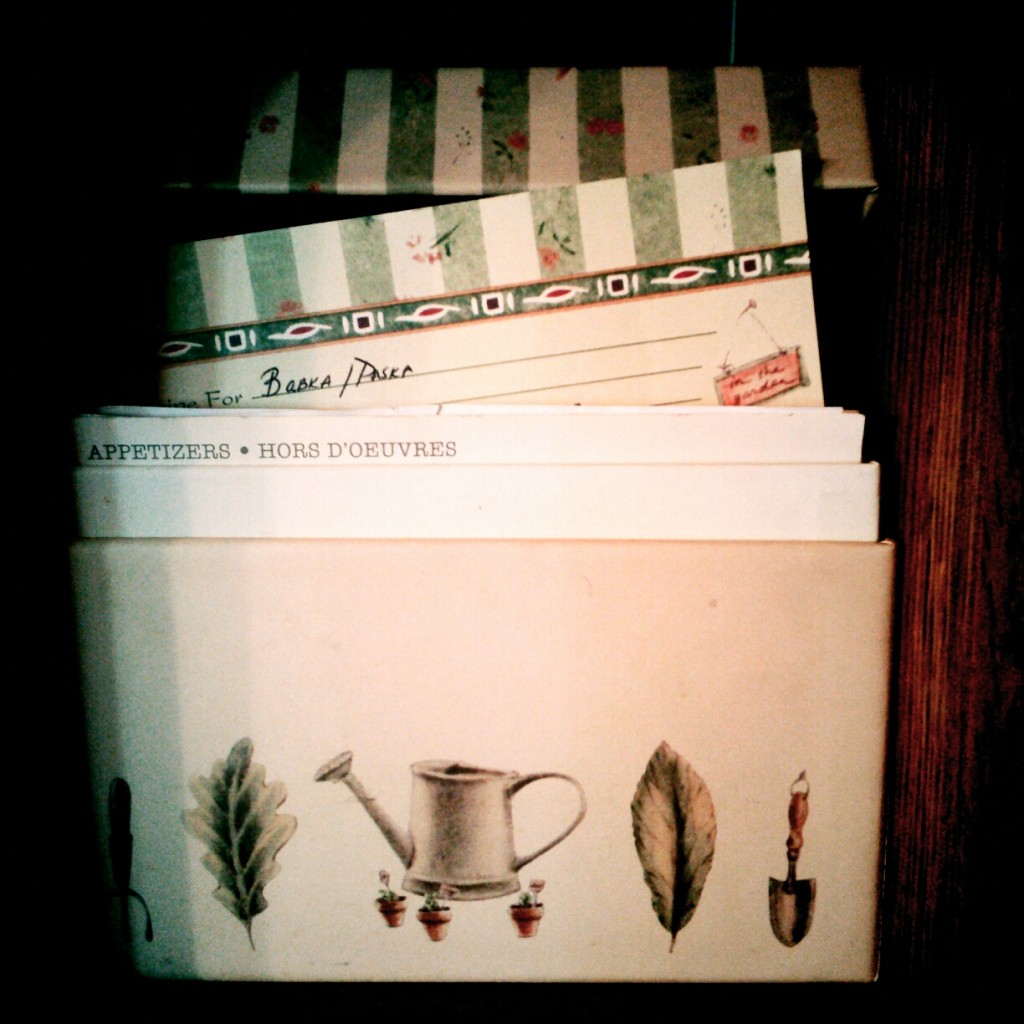
Over the last decade, I have been slowly building up my recipes. I’m not very organized and I’ve never scrapbooked, but this thing I have somehow kept up. I don’t usually print them out, choosing instead to write each recipe on a card, adding notes, crossing things out as I adapt a dish.
It’s always been important to me. My box of recipes is one of the few things that has travelled around the world with me. Maybe it’s because I see it as a sister activity to writing and storytelling? Maybe it’s because I hope that someday those recipes will provide my children and grandchildren with a window into my life–the treasured meals I have been able to share with them and other people I hold dear. Maybe it’s because writing a recipe down feels like preserving a little of the magic.
If you have ever shared a meal with me, I thank you.
If you’ve ever given me a recipe, rest assured that it is treasured.
If you’d like to share a recipe, I would be honored to add it to my collection.
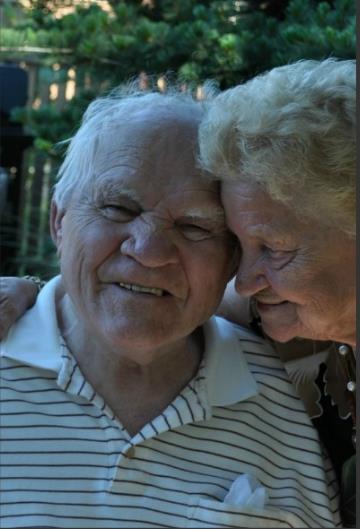
We just passed the milestone of 40 days after my Dido’s death. In Ukrainian tradition, this is the time when his spirit moves on to the afterlife, to join my Baba.
Last month, my father and his siblings had to go about the responsibility of preparing my grandparent’s house to be sold.
I’ve grown up with a rich cultural legacy and many family stories, but we never had family “treasures” like other kids I knew. My grandparents left Ukraine during WWII, and they brought very little with them from the Displaced Persons Camps. There were no antiques: no great-grandmother’s rocking chair, no ancestral bible, no great-uncle’s violin.
When my father went into politics and began to acquire a few mementos of historical or cultural significance, it was a big deal for us. These were keepsakes–a word almost reverent because it was rare and new.
My parents would say: Look, here is a photo with the President; you’ll be able to show your kids someday. Here’s a statue your father was given; it will be yours someday.
It was never about acquiring things; it was about building a legacy, something my grandparents had not been able to bring over with them.
However my grandparents, like many of their generation, made up for the lack of keepsakes with the things they themselves made and the rich oral tradition they kept shared. This group of Displaced Persons came to Chicago and built/painted/sewed/baked/engineered with their hands. They created museums, built camps, cultural centers, restaurant, shops, renovated homes, planted trees and flowers. We have a Ukrainian Village in Chicago because of their handiwork (as well as the work of those who came before and after). They got their hands dirty to make a very real foundation–they were crafting a future that connected with their roots.
My sister and I went back to visit my Baba and Dido’s house with my father a few weeks after my Dido died. When we walked in, all the signs of his hospice were gone. On the table and countertops were objects to be disposed of or given to goodwill if no one in the family wanted them. Most of the things were practical everyday objects (kitchen tools for a woman who loved to cook and bake for her friends and family, silverware and dishes from years of entertaining guests) as well as Ukrainian treasures, those things they acquired in Chicago or were given as gifts: wooden handmade vases and plates, paintings and prints, ceramic art and dishes, pysanky, and probably the most precious: those things made by my Baba’s own hands: her embroidery, her pillows and handkerchiefs, her pavuky (straw mobiles).
I felt compelled to have something my Baba used in the kitchen, something she would have used all the time that I could also use: a rolling pin, a cookie cutter, as well as a set of four wine/cordial glasses. My Dido loved to garden, and so from the garage I have a gardening hoe that he made.
It was an odd experience, going through their things in such a way. It got me thinking about what we acquire in our lives and our homes, what we will will leave behind, what we really need.
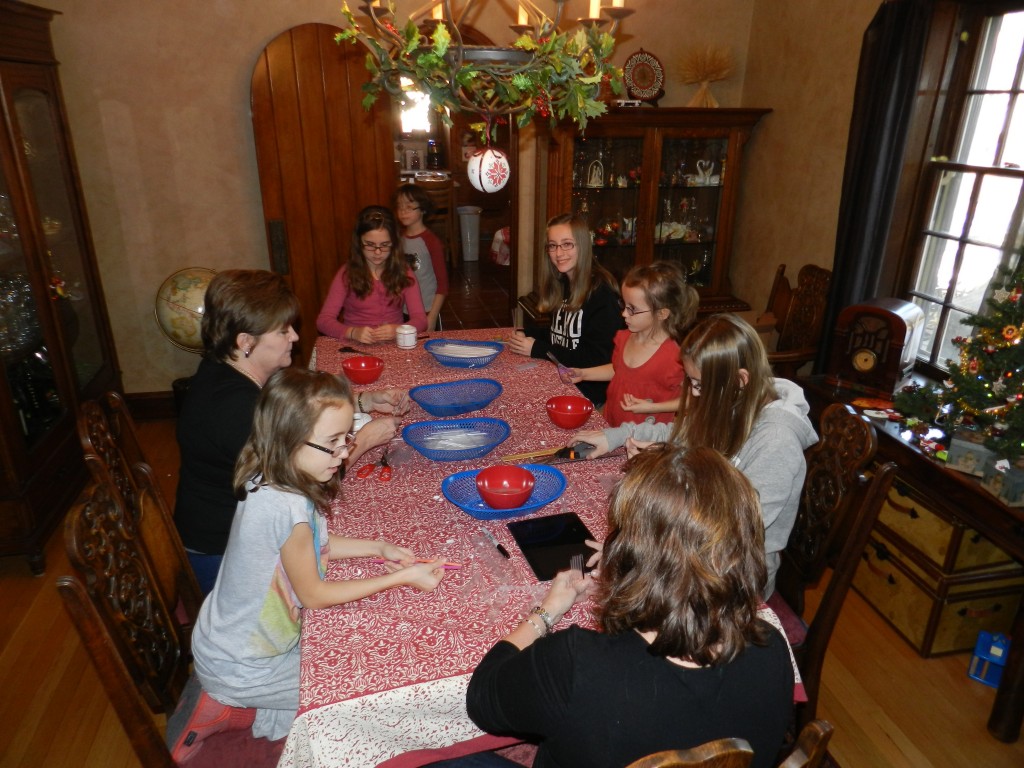
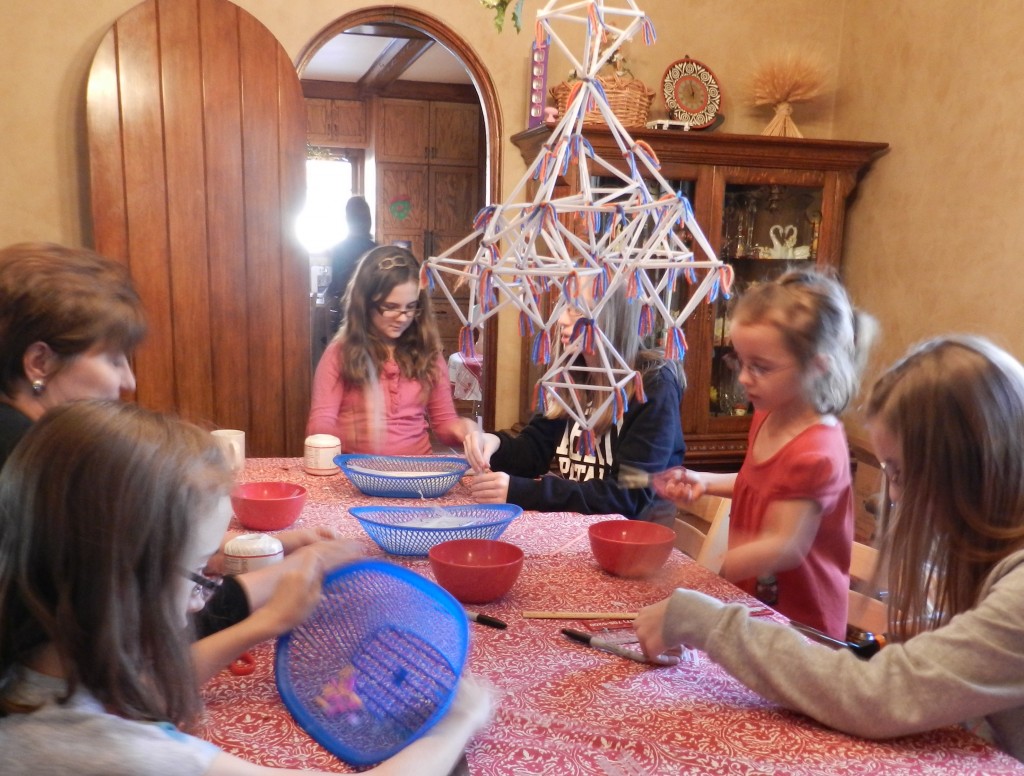
This week my aunts and cousins came over to teach me and my kids how to make a traditional Ukrainian “pavuk.” As long as I can remember, my Baba had these strange straw mobiles hanging in her home.
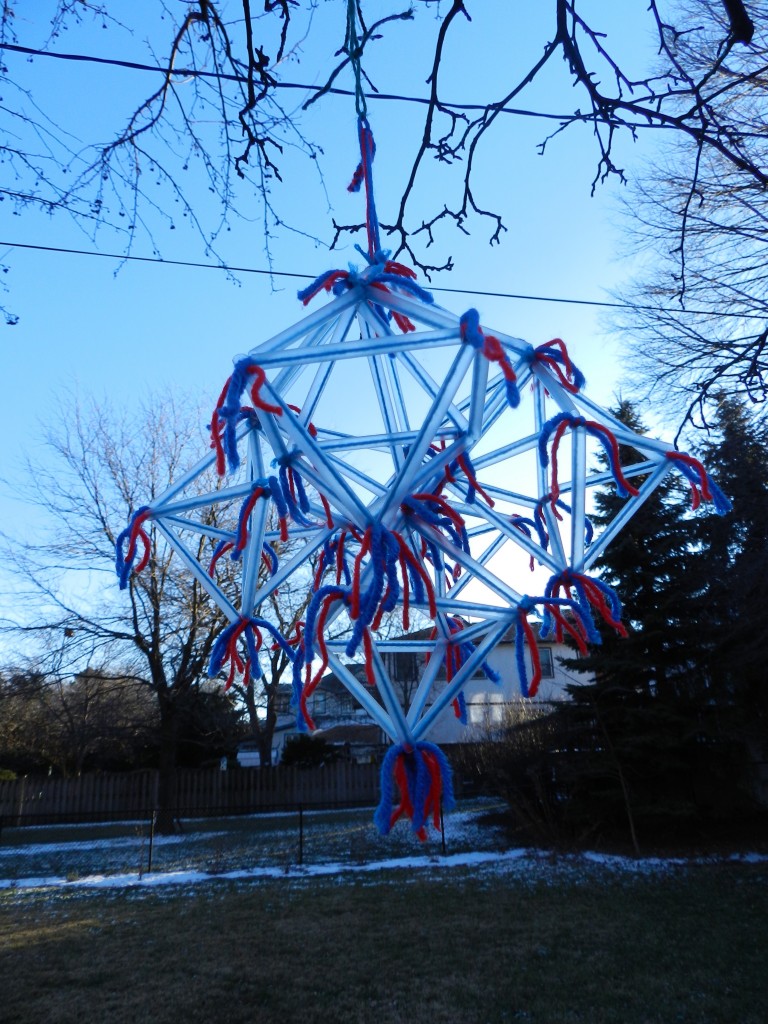
Baba’s Pavuk in the yard.
I think because they were made with drinking straws and blue and red yarn (or whatever colors she had on hand), I assumed it was a craft she came up with on her own. Then a few years ago, my aunt told me that the “pavuk” is actually an ancient Ukrainian tradition. Using drinking straws and yarn was my Baba’s spin on the traditional handicraft, because actual straw was not readily accessible in Chicago. I loved learning from them, and I was so grateful that they had learned from her.
Cutting straws for the Pavuk.
It turns out this handicraft is in danger of dying out in Ukraine. Like so many others, it’s an old ritual that’s being forgotten. Traditionally, the straw was taken from the final harvest, like the straw collected for the didukh (a bundled sheaf of wheat that embodies the spirit of the ancestors and the reminds us of Mother’s Earth’s bounty).
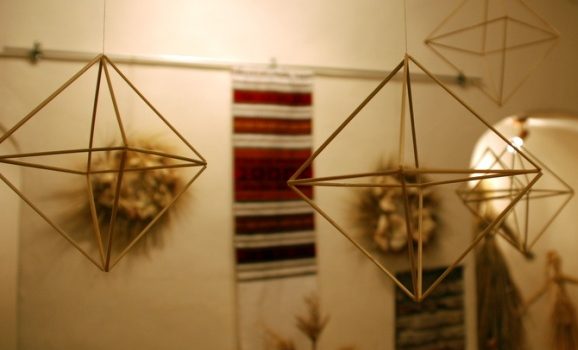
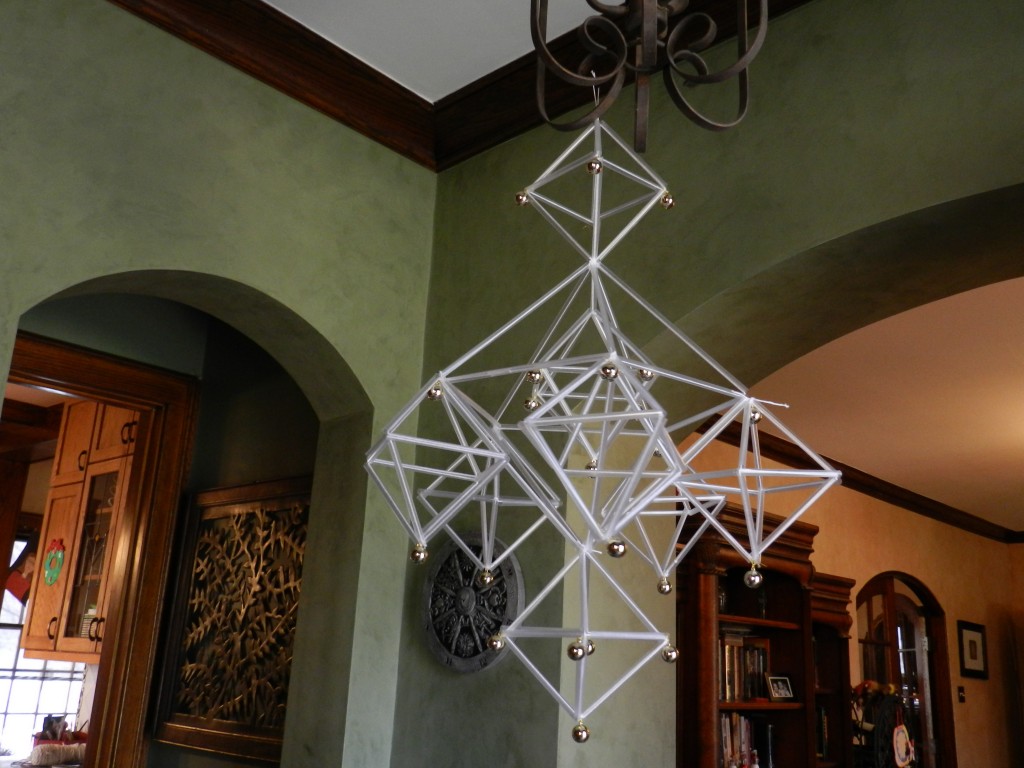
The Pavuk (“spider”) is a mobile that would also be crafted from straw. It would be hung in the home for the winter season. Out of the chaos of these random pieces of straw , they would cut and craft diamond shapes strung together to make a delicate hanging mobile. Some say the name comes from patterns like a spiderweb, others saw that the hanging mobiles themselves are like giant spiders. Either way, it’s a wonderful name and tradition, since spiders are cherished in Ukrainian culture as messengers, harbingers of good fortune.
Pavuk made from straw.
The pavuk would absorb the negative energies and then get burned on the Feast of the Epiphany. Some believed that they should be left hanging in the home to attract good luck for the family. Some moved it to the barn to bring fortune and health for the animals. Either way, the pavuk reminded the family of the bounty of the harvest through the cold winter days.
Our ancestors wanted to bring beauty into the home, and so they did so by adorning their objects (sacred or everday) with symbolic beauty: inlaid wood or carvings, embroidery, or painting. They also crafted gorgeous objects out of gifts from the natural world, like straw and wood. Objects of hope in times of darkness.
Pavuk made by the cousins, 2013.
Winter has historically been a time when people turned inward, became more contemplative. With snow on the ground, they could not toil in the fields or hunt in the woods. They were forced to remain indoors, living off all they had preserved, spending their time making things for Spring, telling stories, playing games, remembering. The land appeared dead or asleep, and starvation was a real threat. All around them were signs of how fragile life can be.
I wonder if many of us are so busy and detached from nature that we forget about how fragile life is and how natural death is?
This Winter I have been less social than usual. I’ve had a a few adventures (and I’ll write about in the next blog entry), but I’ve spent more time in the house with the kids, quiet time with family and friends rather than large parties and robust celebrations.
Hanging in the air is a feeling of solemnity rather than celebration. It’s not sadness exactly, but it’s reverence–an awareness that our lives are changing, that we are shifting into a new chapter. The matriarch and patriarch of my father’s family are now our ancestors. My father and his siblings are the heads of their respective households. The legacy is being passed down in stories and keepsakes. We say their names and share their stories to remember, we use their mug or rolling pin or favorite vase to feel closer to them.
There’s also something else, at least for me. I think with my Baba and Dido dying, I feel my own mortality a little more. It makes me think about whom and what I will leave behind, the stories yet untold, the lessons I hope to impart, the objects I will pass along, the things I make with my hands.
After this past year, death feels more intimate. I now have friends and family on the other side, and I plan to keep the connections strong. In Ukrainian we say Vichnaya Pamyat, which means Eternal Memory. What is remembered, lives on forever.
So I put up their photos, and I talk to them. My father visits the cemetery and brings flowers, blessed bread from church, a kiss. Several of us cousins carry Baba’s handkerchiefs in our pockets and purses. Our children hug their Pra-Baba’s (great grandmother’s) embroidered pillows at night and look for Baba and Dido to visit in their dreams. We share stories, and we teach each other the lessons we have learned from them.


 We just passed the milestone of 40 days after my Dido’s death. In Ukrainian tradition, this is the time when his spirit moves on to the afterlife, to join my Baba.