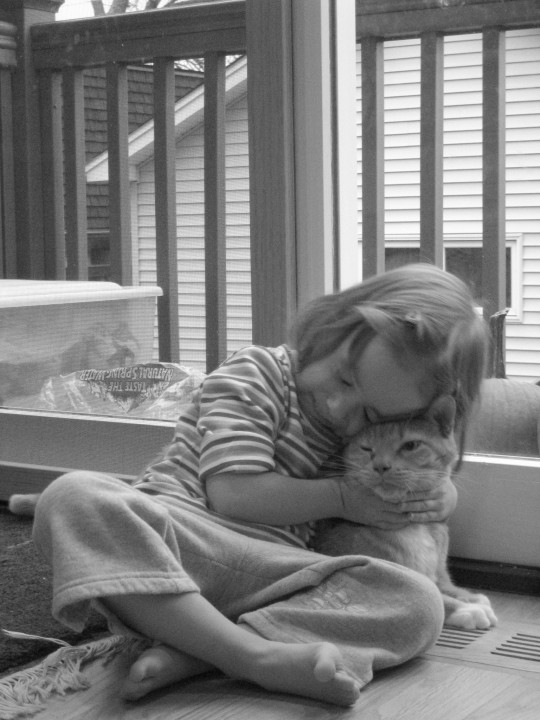
We said goodbye to our sweet Tiger today. He went gently and peacefully.
There are animals that come into our homes, our families, and our lives who carve out special places in our hearts. They become family.
Tiger was family.
For those of you who met Tiger, you know. He was a one-of-a-kind, world-traveling, head-butting, always-talking, always-purring, curmudgeonly-muttering, toilet-drinking, chicken-hunting, ever tolerant, affectionate dog-cat.
His name was one of the first words for each for our children–children who would carry Tiger around the house as soon as they were able to walk. (Since Tiger’s weight fluctuated between 14 and 18 lbs, this usually meant holding him under the arms and half-carrying, half-dragging him from place to place.)
Tiger might mutter in protest from time-to-time, but he never bit or scratched the kids. He put up with all their love: being dressed up in scarves and doll clothes, forced to sit for tea parties, and placed into the center of elaborate train track setups where he would tolerantly watch the kids play.
The kids gave him extra love last night and said goodbye this morning.
The title for this post is phrase I am borrowing from my writer-friend Brooke Bolander: heart critter.
Tiger was our heart critter. He was a part of our family for 16 years, and he will never be forgotten.
When my sister and I were young, my father was a Chicago cop. His schedule varied, but he often worked nights. Sometimes when he’d wake up and I’d come home from kindergarten, we’d go for a walk. My little sister, father, and I would meander through our neighborhood on Chicago’s northwest side. He would share stories about when he was a boy, and I would talk about school or dancing or something we saw on television.
Sometimes we would just walk quietly and watch the seasons changing: new flowers growing or leaves falling; or we’d catch clouds making shapes in the sky. If we didn’t already see her there, we would stop to call the cat who always sat in the second story story window of one particular apartment building on Patterson Street, and we would cheer when she came to the window.
We did a lot of different things with my father: he was a fun dad, eager to indulge the creative whims of his two young daughters, whether that meant allowing my sister and I to “fix” his hair or play Uno, Yahtzee, or Monopoly. But going on walks was one of my favorite things. It’s one of my fondest memories, and it’s one of the activities I treasure most with my own kids.
It may seem an odd message to get from a show about killing zombies in a post-apocalyptic America, but it’s one of my favorites in our book, Geek Parenting.
The Walking Dead doesn’t seem an obvious place to “get a lesson” about parenting, but that’s kind of the point of our book. There is certainly value in reading reference guides that give you lists and milestones for parenting. But so much of who we are is shaped by our daily interactions, by the things we read, watch, and do. So yes, we are influenced by the shows we watch, and sometimes those shows remind us of important things:
Even when we’re not dodging zombies, taking a walk removes many of the distractions competing for our attention. A family amble around the neighborhood or through the park gets us out of our heads and into the world.
Precocious toddlers and young children love the chance to ask questions while meandering. If you’re unsure how to start a conversation with a grumbly tween or a reluctant preteen, point out a car that reminds you of when you learned to drive, or a dog on a walk that looks like a former pet. Perhaps more important, ask questions of them: Who do you think lives in that house? Can you see a face in that tree? What kind of an apartment would you like to live in when you’re older?
Whatever we see, whatever we talk about, wherever we go, remember that when we set out on a stroll, we are spending time together — come what may.
One of the many things that overwhelmed me as a new mother was trying to figure out where I fell on the spectrum of parenting philosophies: Attachment parent? Tiger mom? Ferberization fan? Dr. Sears subscriber? Bringing Up Bébé believer? Not to mention a chorus of friends and family with their own sets of best practices. There were so many voices to sort through…from my mother to Mister Rogers to Super Nanny to Dr. Spock, and so many questions: Will you let your baby cry? Does she sleep in bed with you? How long do you plan to nurse? Will you do sleep training? Will you speak to her in different languages? Each question carried its own opinion and the answers seemed to place a parent in some camp or another.
I cannot speak for all new parents, but I certainly felt nervous and tentative. I was trying to do my best and secretly hoping I might find the “magic combination of rocking, swaddling, and shushing” that would help my baby (and me!) to sleep better, or overcome whatever the next challenge was to come along
I felt like I should “belong” in some camp or another, because how I identified seemed to be important in helping me to figure out what I should do. So I did what I do in most unfamiliar situations–I read everything I could get my hands on and then considered the advice of people I respected. Mark and I tried a few different strategies (some worked, most didn’t), and we eventually fumbled our way into what worked for us: trusting our intuition.
We came to realize that when you’re sleep-deprived, overwhelmed, mentally-drained, and trying to care for your family, it’s really not the time to try on new philosophies or adopt a new world view. Not only did it feel unnatural, but it didn’t stick. Sure, there were things that could be learned, and there was value in educating one’s self about developmental milestones and needs; but we came to feel quite strongly that we needed to trust our instincts–drawing from our inherent strengths, gratefully leaning on the people who offered support, and being humble enough to ask for help when it was needed.
The thing we didn’t realize at the time was that we already did belong to a group, one that was built upon decades of wisdom that we had already integrated into our core being…We were “geek parents.”
We may not have specifically called ourselves by that title at the time, but we did discuss and draw from a common frame of reference that was shaped for years by a steady stream of sci-fi’s pseudo-familial starship crews, comic book examples of courage and persistence, and beloved fantasy characters full of compassion and integrity. Everything we had read and watched and loved had become a part of us and ultimately helped us to be better parents.
Children learn from the world around them, but their first and most important teachers are their parents. They are always watching us, and we teach them with our countless mundane, everyday examples. So in many ways, the path of trying to be a good parent was a continuation of the path of trying to be a good person.
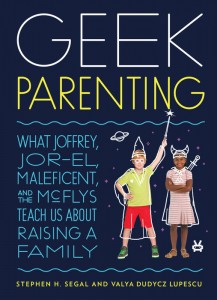
When Stephen and I started working on the book Geek Parenting (What Joffrey, Jor-El, Maleficent, and the McFlys Teach Us about Raising a Family (Quirk Books), our idea was never to create a definitive book on parenting or a revolutionary approach toward raising children. Geek Parenting does not claim that any one philosophy should be adopted when making choices about development or discipline. On our pages, there are dozens of parenting gems from a wide range of sources from a diversity of voices, because at its core, that is what it means to be a geek parent.
Every geek parent is made up of a unique patchwork of geek ideas and ideals shaped by their own particular interests and fandoms. Very few are strictly “one kind of geek.” We may have started with Superman or Star Wars, but those led to other characters, other stories, other worlds.
In his “Song of Myself,” Walt Whitman wrote some of my favorite oft-quoted lines:
“Do I contradict myself?
Very well then I contradict myself,
(I am large, I contain multitudes.)”
Of course Whitman was not talking about geeks. Of course we all contain multitudes. But geeks contain particular combinations of multitudes not often found in others: it may be fairy tales and robotics, or gothic architecture and zombies, or steampunk crafting and Slavic mythology. These highly speculative and imaginative stories show us different ways of envisioning the future, revising the past, and relating to all manner of humans, aliens, gods, creatures.
Geek Parenting celebrates those multitudes. It highlights just a fraction of the hundreds of relationships that have made an impact on geek culture and have provided geek parents with tools and examples for how to cope, how to heal, how to teach, how to forgive.
Geek Parenting is not a book that someone can read to understand the secret to being a good parent. Because there is no secret. There is no one path, no one-size-fits-all philosophy that works. Truly, it goes against the imaginative geek spirit to assert that there can only one way to do…anything.
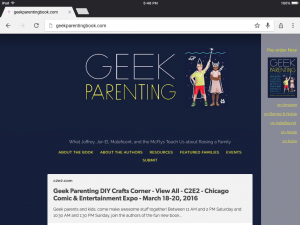
As part of the promotion for Geek Parenting, we’ve launched a website (www.geekparentingbook.com) that will feature, among other things: quote cards from the book, reblogged parenting or geek material that seems pertinent, Geek Parenting memes, and real-life geek family portraits..
This last part is the most exciting to us because it brings Geek Parenting to life. The portraits will show the beautiful diversity of geek families and the range of geek wisdom that has influenced them.
Geek parents have been outsiders and underdogs, lonely and misunderstood; geek parents have also been heroes and leaders, happy and victorious. Most of us fall somewhere in between. We are scientists, gardeners, teachers, programmers, baristas, firemen, writers, and electricians…Geeks are everywhere, and in many ways our numbers are growing. That gives me hope.
In his now famous TED talk (that has been seen by more than 37 million people), Sir Ken Robinson discusses at length his concern that the schools are educating our children out of their creativity. He argues that the future is going to need creative thinkers more than ever before. “You can’t just give someone a creativity injection,” Robinson said, “You have to create an environment for curiosity and a way to encourage people and get the best out of them.”
I would argue that geek parents are especially good at cultivating environments for curiosity. The multitudes that many of us contain are by their very nature visionary. Whether in life, on the screen, or on the pages of our beloved stories, geek parents have experienced a wide range of what is means to be human, and we have seen countless examples of different possibilities for our future.
That is what Stephen and I want to celebrate in Geek Parenting–the creativity, empathy, and innovation that seem to lie at the heart of so much geek wisdom.
If we can use those lessons to love our children and teach them to question and imagine and strive for a better future, perhaps we will give them the tools they need to make it so.
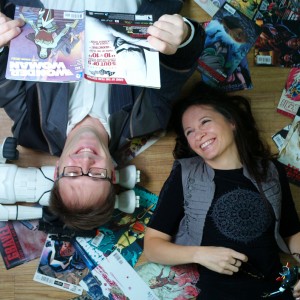
Photo by Kyle Cassidy, at Locust Moon Comics, 2016.