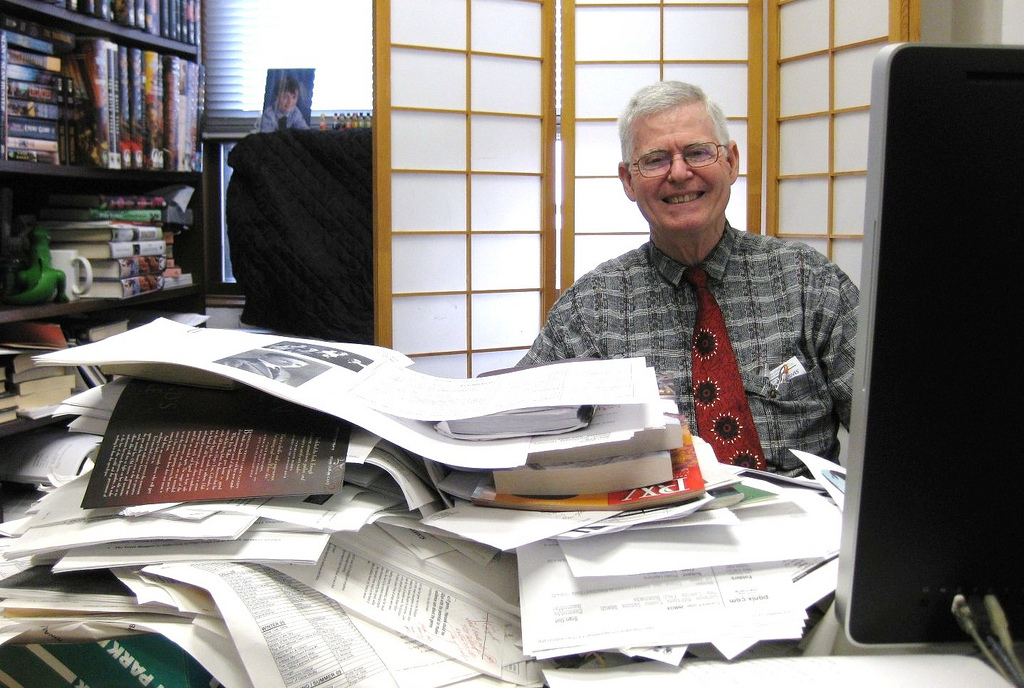
David Hartwell in his office. (Photo by Robert Hoge, 2010)
David G. Hartwell has passed away. David leaves an indelible mark on fantasy and science fiction–so many people who write and edit and read have been shaped by his vision and commitment to the genre.
I met David while planning the Fuller Award to honor Gene Wolfe in 2012, and he was so generous and kind in all his help and enthusiasm. I delighted in subsequent opportunities I had to interact with him, at ICFA and other conventions, as well as on trips to New York where our paths crossed. Everything about the way he engaged with the world, from his clothes to his kindness, made a lasting impression.
I didn’t realize until last summer when I was packing up my books to move that one of my favorite childhood anthologies had been edited by David. Published in 1988, it was one of those literary treasures that always moved with me–from childhood home to college apartment and all the places that followed. I made a mental note to bring it with me to a future ICFA (The International Conference on the Fantastic in the Arts) where I planned to show David and ask him to sign it.
Sitting in my living room and holding that collection in my hands 25+ years later, it felt like an important reminder of the many ways we are connected, of the creative continuum that we become a part of when we release work into the world, and of the ways that childhood aspirations can become reality.
Kyle Cassidy always says, “If you’re doing things right, eventually all your idols will gravitate to your living room.” Kyle calls it the gravity of art, and he’s right. I’m grateful that I had the chance to get to know David Hartwell.
So many people I care about–writers and editors and fans, are hurting from the sudden loss. My thoughts are with David’s family and friends.
Patrick Nielsen Hayden wrote in his online tribute that David “was our field’s most consequential editor since John W. Campbell.” Many people have been sharing photographs and memories.
David Hartwell’s legacy is vast. He will never be forgotten.
Like so many people, I’m moved by the passing of David Bowie. When the kids woke up, I was listening to his music and weepy. I tried to explain it to them.
“Was he your friend?” my youngest asked, knowing how many of my favorite artists are friends or acquaintances.
“He wasn’t,” I replied. “I never had the chance to meet him, but his music was important…to me and to the world.”
“You still have that,” my twelve-year-old replied sagely over her breakfast. “You can listen to it any time you want.”
She’s right, of course. His memory, his music, lives on.
One of the most important books I’ve read in the last few years is Viktor Frankl’s Man’s Search for Meaning. (It’s brilliant; you should read it.) In it he writes about surviving the Holocaust with those cherished things—no, cherished ideas—that kept him alive. He writes about the memory of his wife which largely motivated him to keep going.
While in the camps, Frankl reflected upon their time together and his love for her. He writes, “A thought crossed my mind: I didn’t even know if she were still alive. I knew only one thing—which I have learned well by now: Love goes very far beyond the physical person of the beloved. It finds its deepest meaning in his spiritual being, his inner self.”
The memory of loving her helped to give his life meaning when he was surrounded by death and despair. The power of memory—of having loved, of being moved by encountering someone or something—is a touchstone. This is true even of someone we may not know personally, like David Bowie, because their work (their music or art or words) touches us so deeply that it shapes the way we understand and experience the world. The memory of that encounter continues to resonate.
Always.
Viktor Frankl also writes:
“In the past, nothing is irretrievably lost, but rather, on the contrary, everything is irrevocably stored and treasured. To be sure, people tend to see only the stubble fields of transitoriness but overlook and forget the full granaries of the past into which they have brought the harvest of their lives: the deeds done, the loves loved, and last but not least, the sufferings they have gone through with courage and dignity. From this one may see that there is no reason to pity old people. Instead, young people should envy them. It is true that the old have no opportunities, no possibilities in the future. But they have more than that. Instead of possibilities in the future, they have realities in the past—the potentialities they have actualized, the meanings they have fulfilled, the values they have realized—and nothing and nobody can ever remove these assets from the past.”
What a beautiful way of looking at the gifts of age–all those treasures to cherish.
There is sadness and loss (my heart goes out to his friends and family), but thankfully we still have David Bowie’s music. And our memories. How beautiful and telling it is that today so much of the world is sharing both.
Here’s one from a young Bowie.
“Tell them I’m a dreaming kind of guy,
And I’m going to make my dream.
Tell them I will live my dream.
Tell them they can laugh at me,
But don’t forget your date with me,
When I live my dream.” ~David Bowie, “When I Live My Dream”
He lived his dream, and our world is better for it.
They take their mugs, then their seats, and fill the room; the empty chair holding everything they do not say. Until she speaks to raise a mug and, in remembering, cracks the silence, spills everything, and takes them back with, “I remember when” and “He always” and “I will miss” and “If only.” (“Seven,” KROnline )
I’m delighted that my new short story, “Seven” has been published by The Kenyon Review Online. The story is essentially a love letter to friends near and especially far, whom I don’t get to see often enough. It was also born out of something I was thinking a lot about at the time: What may have happened to the fairy tale heroes and heroines, victims and villains, as they eventually faced aging and death? It’s not the sexy part of the story, but I feel like there is beauty and grace to be explored there.
So much of 2015 was spent working onGeek Parenting, that I wasn’t able to write and submit a lot of short fiction and poetry. “Seven” was an exception, and I’m grateful to begin this year by having it published it in such a well-respected and widely-read journal.
Thus the wheel turns and we leave 2015 behind, having lost loved ones, having turned parts of our lives upside-down, having welcomed new relationships and projects, hopefully having created a few new treasured memories. We look ahead to 2016, beginning to write onto those blank calendar squares, planning the ways we hope the year will play itself out (although it will surely surprise us).
I have not traditionally been a fan of New Year’s Eve. Many of my best eves have been spent “writing in the new year” in a quiet house or apartment, a cup of hot coffee beside me (maybe with a splash of Kahlua). However this time it felt appropriate to celebrate the threshold between the years with something more creative and dramatic–with a Celestial Ball in three stories of a festively decorated historic New York City Romanesque Revival building filled with live music and occupied by all manner of beautifully costumed people meandering about, drinking, dancing, and laughing. It felt very much like the shimmery veils between so many fantastic worlds were lifted to allow for such a congregation of sparkly, mythic creatures.
I was swept up in all that that magic and forgot to take photos, but thankfully photographer Steven Rosen was there, and he took this beautiful portrait. (Oh, the light!)
There’s so much out of balance and broken and hurting in our world right now. I want to believe that the systems in place that continue to perpetuate hatred and injustice will finally be dismantled, that new models will spring up to reshape a future where all people are treated with dignity and respect. I have hope, and I want to do my part.
In so many cultures, the end of an old year was a time for magic, for fortunetelling and storytelling, for casting spells and making wishes. My wish for 2016 is not long: May we find our way to love in 2016–in the people, animals, activities, and ideas that nourish our authentic selves and connect us with humanity as a whole.
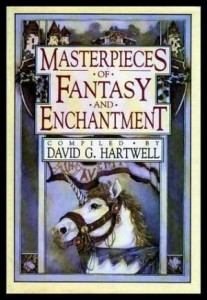 didn’t realize until last summer when I was packing up my books to move that one of my favorite childhood anthologies had been edited by David. Published in 1988, it was one of those literary treasures that always moved with me–from childhood home to college apartment and all the places that followed. I made a mental note to bring it with me to a future ICFA (The International Conference on the Fantastic in the Arts) where I planned to show David and ask him to sign it.