Writing Process Blog Tour

This post is part of a blog post relay on craft, which the wonderful Nancy Hightower invited me to join. Nancy is the author of Elementari Rising. She has a poetry collection, The Acolyte, forthcoming with Port Yonder Press, and her short story collection, Kinds of Leaving, was shortlisted for the Flann O’Brien Award for Innovative Fiction.

My take on craft:

1) What am I working on?

While my second novel, The Supper Club, is out on submission, I’m working on my third novel, Mother Christmas, a historical fantasy set in Ancient Turkey. I’m also writing the script for a graphic novel, Sticks & Bones, with artwork by the incredible Madeline C. Matz. The story follows displaced house spirits/household gods (brownies, domovyky, the tomte, etc.) who are being hunted in America.

2) How does my work differ from others of its genre?

My writing falls under the category of speculative fiction, more specifically magic realism, but I draw from an Eastern European folkloric tradition rather than a Latin American one. I enjoy looking at the mundane world through the lens of myth and fairy tale, bringing those magical stories into a contemporary context. In my work, I explore moments of revelation—epiphanies that come to light when two seemingly contradictory elements (like the magical/realistic) intersect. Those liminal spaces are my creative obsession—the places where ideas meet, where personalities collide, the crossroad moments in history.

3) Why do I write what I do?

What I write has been called “diaspora literature,” especially my first novel, The Silence of Trees. Diaspora literature is primarily concerned with the individual’s or community’s attachment to homeland. It is born from their sense of yearning for that homeland, an attachment to its traditions, religions, and languages. The diaspora writer creates from the threshold, from the border.

My grandparents came to America from Ukraine after WWII. Like many Ukrainian Americans, my sister and I were raised with one foot in each world: speaking Ukrainian at home, going to Ukrainian school, church, and dancing on the weekends; but also participating in modern American culture.  The Ukrainian language and traditions of our ancestors were being wiped out in the Soviet Union. We were taught that it was our responsibility to keep those traditions alive in America. Typical of the Diaspora experience, we were raised to retain a collective memory/vision about our ancestral homeland. I have no doubt that this is where my fascination with “the threshold” was born.

This directly ties into magical realism—with its crossing of borders that allow the writer to celebrate the myths and folklore of home, while creating tension in the story that echoes the experience of being ex-centric, out of the mainstream.

Ultimately, I think I write what I do to explore the paradox of the union of opposites.

4) How does your writing process work?

Most of what I write begins with a question, and those questions come from so many places: reading books or articles, people-watching, going for a walk. I usually write to explore the possible answers: What makes some people bury the past, while others celebrate it? When faced with cruelty, how can two people have such a dramatically different response? What happens to all those teeth? How might the ancient gods of the ocean respond to a devastating oil spill? How might house spirits communicate with one another? For me, the act of writing is the joy and magic of exploration.

As far as process, I most often write at night. I put the kids to bed, wrap up mundane tasks, and brew a pot of coffee. The nighttime has a natural air of magic and mystery, which makes it easier to leave the “real” world behind and slip into the world I am creating. The “writing witching hours” are usually 10pm to 2am. In the morning, after getting up and dropping the kids off at school, I tend to the business of writing. That’s when I do most of my editing and revision, emails, etc. Then I try to get in another four hours of writing in the late morning/early afternoon. Generally, the more I write, the happier I am. I feel like there are so many stories to tell, and I’m trying to find the time to get them all down.

* * *

Next up on the Writing Process blog tour are two fabulous writers: Brooke Bolander and Amelia Beamer! Look for their blog posts on May 19th!

Brooke Bolander‘s work has been featured in Lightspeed, Strange Horizons, and Nightmare, among other venues. She writes stories of indeterminate genre that some might classify as slipstream, although simply calling them weird would probably do just as well.

Look for Brooke’s post at: http://brookebolander.com/

Amelia Beamer is the author of The Loving Deadthe number two zombie novel of the past decade according to Barnes & Noble. She works as an independent editor and proofreader with major publishers including Shueisha English Edition, a new general imprint of popular Japanese titles translated into English. She built her publishing career working as an editor at Locus for seven years, and for three years before that as a student assistant at the Clarion Writers’ Workshop. She publishes short fiction, book reviews, poetry, and cultural criticism. Her most recent short fiction appears in Psychos: Serial Killers, Depraved Madmen, and the Criminally Insane, and Zombies vs Robots: Women on War!  

You’ll find Amelia’s post at:  http://www.ameliabeamer.com/

Spring (if only for a moment)

I know it won’t last, but at this very moment there is sunshine and warm weather in Chicago! It’s Spring!

I wrote until way too early in the morning, but I’m happy for the progress. Then I met a friend for lunch, who put up with my slightly slap-happy and sleep-deprived state.

I am feeling so grateful for this beautiful day.

sunshine

I had a wonderful time at the International Conference on the Fantastic in the Arts in Florida, and I’ll write about it soon. I have a few blog posts to finish, comic book pages to revise, and stories to send off.

Soon.

But right now, I’m enjoying the sun and warm wind on my face, and the appearance of catkins on the branches outside the house (pussy willows are always the first sign of Spring around here).

pussywillows


Spring stirs my heart and my imagination. It makes me feel like anything is possible, like all the ideas and emotions and stories that have been growing will be rewarded with a most beautiful blossoming.

Whatever may happen tomorrow, right at this moment, it is enough to make me happy.


Crossroads and Connections

Chicago has such a great theater scene, with more than 200 small, critically acclaimed theatre companies. I’ve seen Shakespeare in a former church, sketch comedy in a grungy basement, a puppet show in a smoky pub. I love all the opportunities to see provocative theater, emerging playwrights, and innovative ensembles.

When a friend called my attention to Cameron McNary’s “Of Dice and Men” being performed by Otherworld Theatre, there was no question. The play appeals to my love of theatre and my love of things geeky—I wanted to see it right away.

I met my friend Sean at The Public House Theatre for the 7:30pm show, and we settled onto the couch that forms the first row. The Pub House has two theatrical spaces, and the other play, “Bye Bye Liver,” had a later start time in the adjoining space. The stage was part castle, part basement bedroom dressed with beloved science fiction and fantasy books and D&D accoutrements.

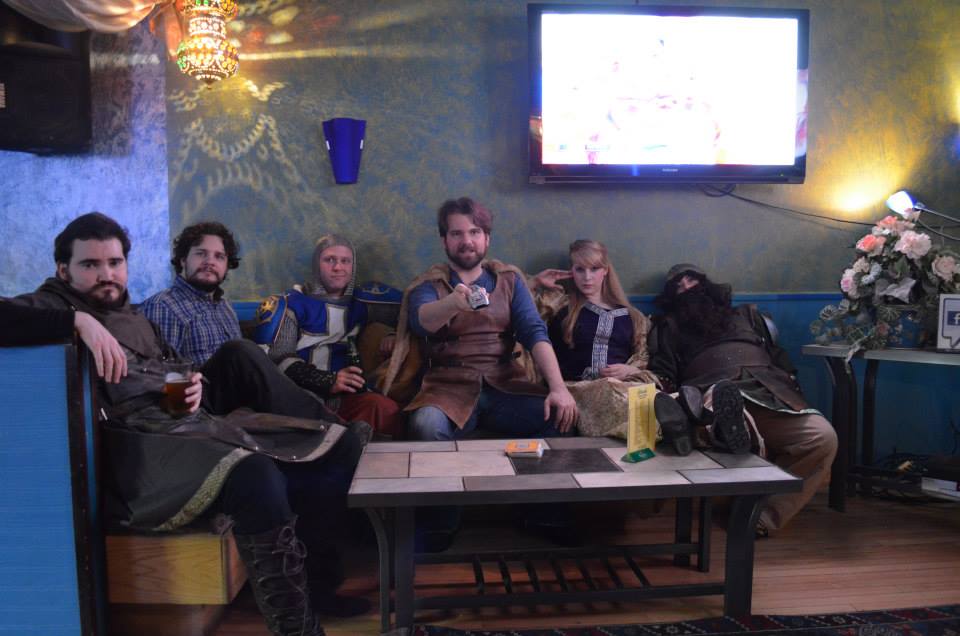
Broken down simply, “Of Dice and Men” is about a group of six friends on the edge of dramatic changes in their lives. They are Dungeons & Dragons players, and many of them have been playing together since high school, sharing life’s ups and downs while throwing the polyhedral dice. These are not caricatures of gamers/geeks, they are authentic, well-rounded characters, clearly envisioned by a writer who knows and loves that world so well.

“Of Dice and Men” opens with a familiar scene, narrator (and Dungeon Master) John Francis is taking books off his shelves and dividing them into two boxes: To Keep or To Give Away. The play follows John Francis as he prepares to move to another city and say goodbye to his friends and their weekly D&D game. Before John Francis can make his announcement, however, another of his friends reveals that he has enlisted in the Marines to go to Iraq.

1890393_698187210202278_702737976_o

The play begins at that moment on the crossroads—one of my favorite ideas to explore because it is both familiar and powerful. At certain points in our lives, each of us comes to a crossroads; and we have to make choices about the things, ideas, and people we hold onto, and those we choose to let go.

It may be Dungeons & Dragons, it may be comic books, it may be old movies or cds. We get to that place and take stock of what we’ll bring and with whom we want to move forward. It’s what you do in games, and it’s what you do in life. “Of Dice and Men” explores this beautifully, with humor, intelligence, and emotion.

I loved it.

The writing is smart, the play is well-crafted, the cast is wonderful. “Of Dice and Men” was the kind of play that had me smiling through about 80% of it, tearing up for at leat 10%, and fully engaged the entire time.

The cast has terrific on-stage chemistry and sold me on their characters’ friendship. I loved the brash John Alex, the noble Jason, and all the rest. They are authentic, endearing, and playful when they need to be (for example, when a piece of the set wall came crashing down onto John Francis and Brandon).

At one point in the play, the character of John Francis questions the stereotype of the gamer and the inherent value of gaming. It’s a question that can be applied to many of the seemingly “pointless” things we do to fill our time. “Of Dice and Men” doesn’t just ask the question, it attempts to answer it by showing us these friends inside and outside of their D&D game.

1798630_706856536002012_1119423192_n

The things we love to do with friends form the backdrop for our friendship. Yes, these activities are fun and allow us to step out of our mundane lives for a few hours. More importantly, things like gaming or watching football set aside time and space for us to connect—to talk about our lives while rolling dice or watching the screen or playing cards. Their value is in the connection.

The Otherworld Theatre Company was founded by Tiffany Keane in June 2012 “to bring a theatrical experience to the Science Fiction and Fantasy genre.” You can read about her choice to stage “Of Dice and Men” here. I wish I had known about their adaptation of Ray Bradbury’s Fahrenheit 451 last summer, but I will definitely be attending future performances.

“Of Dice and Men” is a play about friendship and the things that bring us together—whether that’s a love of D&D, golf, Doctor Who, or college sports. I urge geek and non-geek friends alike to check out the play as it runs on the weekends through the end of March. Tickets are $15.

There’s also an independent feature film version of “Of Dice and Men” set to be released later this year. I look forward to seeing that too:

OF DICE AND MEN – Official Main Trailer from Kelley Slagle on Vimeo.