Legacy of Love

My grandfather, Iwan Dudycz, died yesterday evening.

Like my grandmother, Parania, he was surrounded by his children, who kept a vigil around his bed ever since he slipped into a coma Friday morning. He was ready to join my Baba, who died on July 31st of this year. He was 93 years old and weary without her.

When I heard that he slipped into a coma, I went to see him. I knew I couldn’t speak with my Dido, that he was not conscious, but I wanted to be close to him one more time, to say goodbye. Sometimes you don’t need words.

We have different bonds with different people in our lives, different ways we show our love. With some people, it’s words; with others it’s actions or shared experiences; and with some, we show our love with affection.
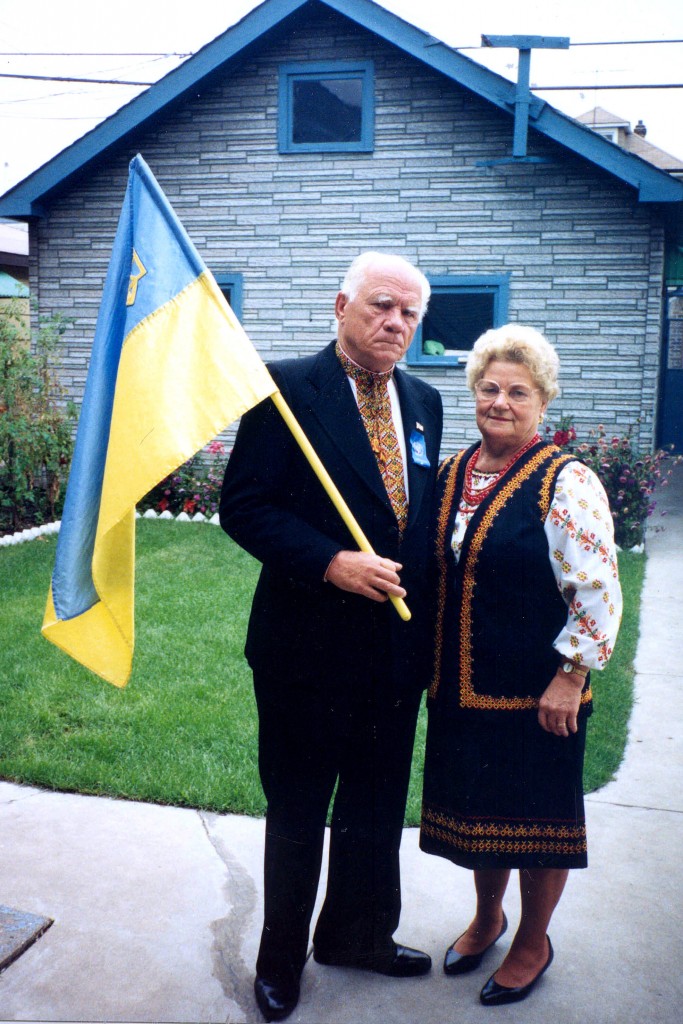
Baba & Dido 1991
Baba & Dido 1991

Dido fell into this last category. Even before he lost his hearing, Dido was more quiet than my Baba. She was the talker, sharing stories, offering advice. Dido certainly held his own, but he was also content to let Baba ramble on and on while he sat nearby, ready to clarify or contribute something to her story.

As a grandfather, Dido was affectionate and supportive. He would often use Ukrainian terms of affection when referring to my sister and I and our cousins. He would call us his “keetsya” or “zozulka” (the Ukrainian words for kittens, cuckoo, or other cute animals). He would engulf us in a large bear hug. It’s the way we hug in the Dudycz family: big and with our whole hearts. Anyone who knows me has felt the legacy of those hugs.

Valya, Oksana, and Chrystia at Baba’s and Dido’s, 1970s

The older Dido got, the more quiet and watchful he became. Where he once played the harmonica and bantered with friends, he began to spend more and more time sitting on the front stoop watching the world go by or sitting in his recliner in the living room.
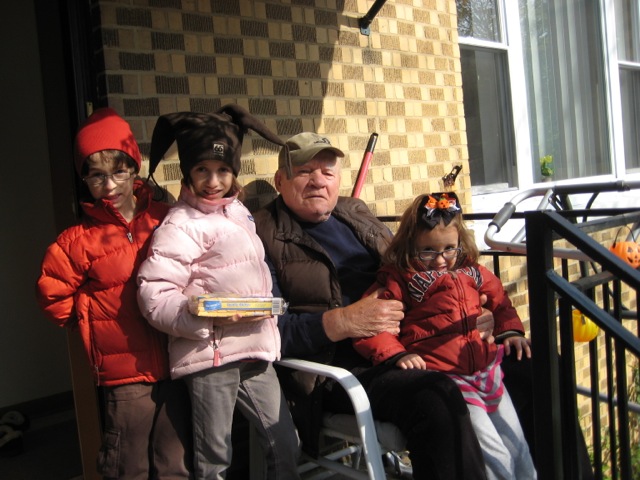
Dido with some of his great grandchildren, 2011.

I’m sure that some of it was age and the loss of his hearing, and I imagine that some of it was seeing the world change around him: friends died, neighbors moved away. His grandchildren had children and we saw each other less often as we moved into our own lives. But whenever we came together, he was happy to be with his family, proud of his children and grandchildren. His smile still had the same warmth, his blue eyes the same twinkle. His hugs may not have been as strong, but they conveyed the same big-hearted love.
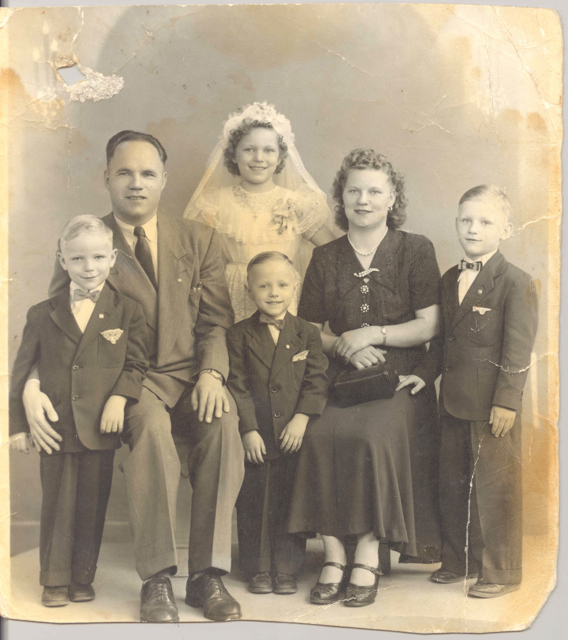
Dudyczfamily1954
Dudycz Family (Sophia’s Communion), 1954

I believe in my heart that he knew his children were there at his deathbed, that he felt the way they cared for him, massaged his arms and legs, kept a cool towel on his forehead, kissed him, held his hands, told him they loved him and shared memories. I believe that Dido knew when loved ones came, and he felt the prayers of family from afar.

When I saw him, I kissed the top of his head, hot from fever, in the same way I would always kiss him hello and goodbye. I knew that the next time I’d kiss him would be at the funeral home, and his body would be cold. Even if his spirit lingers for 40 days as per Ukrainian tradition, it would not be tied to that body. This was the last time he would be there in a physical way.

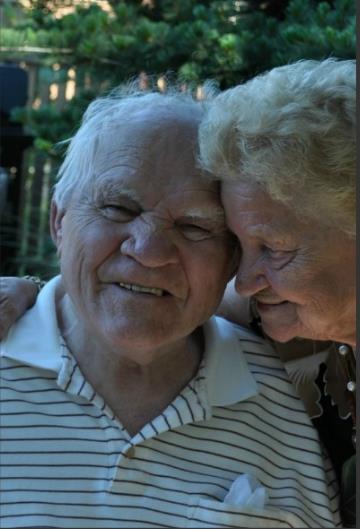
My father with his father.

I sat beside him and held his hand, looked at the age spots on his skin, the wrinkles on his face, the soft gray hairs. Dido was a strong man and there were stories in those hands—heartache in his childhood, a youth of toil and sacrifice, war, displaced persons camps, hard labor and time spent in factories, but also so much love: meeting my Baba, raising a family, creating a home, tending his garden, holding grandchildren and great-grandchildren. His hand was warm and solid, like Dido.

Dido and I at my wedding, 2001.

Ever since I could remember, my Dido would tell me that I had his nose; the Dudycz nose. It’s true. That round ball on the tip of my nose is from his genes. It connects me to him, to my father, to my roots. When I said goodbye to Dido, I touched my nose to his, Eskimo-kiss style. My Dudycz-nose to his.

It’s still amazing to me that Baba and Dido both passed surrounded by all of their children. I am blessed to have been born into the family that they created, and I see them in my father and aunts and uncles. I even catch glimpses in my cousins and our children.
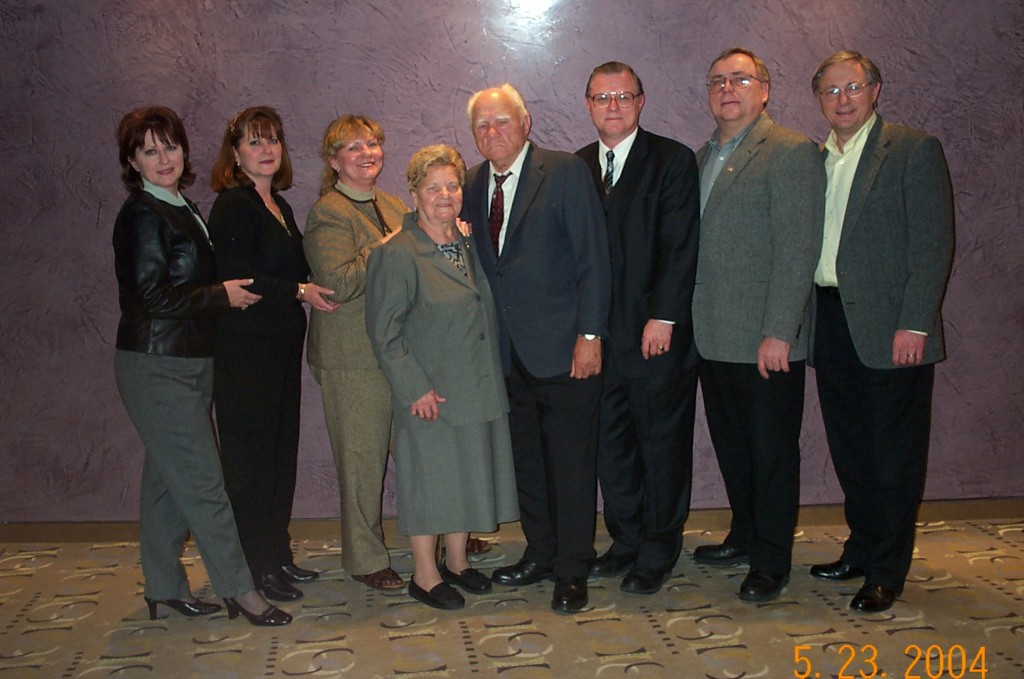
Baba and Dido will live on in us, and I look forward to the times when the extended Dudycz family will get together. I think it’s what Baba and Dido would want, for us to continue to be a family, to support one another, to be there for good times and hard times. They would want us to share their stories, to laugh and cry with their memories. Because that is also how they will live on in us. What is remembered, lives.

I love you, Dido and Baba. Vichnaya Pamyat.
For Neil

I woke up this morning and this was stuck in my head, a birthday gift for a friend who inspires me with the depths of his imagination. Happy Birthday, Neil Gaiman.

For Neil

There was once a man who caught stories in his hair.

As a boy, he took his favorite book, the one with shadows and heroes, and he climbed up to the roof of his parent’s home. He opened the book and waited for the stories to escape the prison of their pages. They did, because stories want to be shared, and the boy was happy.

While he was sitting there, listening to the words whisper their farewell as they set upon the clouds, he felt something land atop his head. It dripped down over his eyebrows and inside his ears like a cracked egg. Suddenly he had to tell someone, so he slid down the drainpipe and shared the story.

The boy began to experiment, climbing trees and mountains, sitting very still on the tallest perches until one story would catch and then another and another. When it worked, and it usually did, he was delighted. Catching stories in his hair was as much fun as setting them free. The boy found that the stories were better companions than many of the people in his world. The boy also learned that by sharing them, he found a way to feel less lonely.

Soon the boy grew into a man, and though he still enjoyed rooftop adventures, he no longer had to scale mountains. The stories would find him when he was walking in the park or eating his breakfast. In fact, so many stories settled in his hair that his hair grew longer and more wild to hold them. He had to work quickly to free them and make room for the others.

Sometimes the man needed a break, and he would cut his hair and walk among people with only a stray haiku caught behind his ear or or a tiny folktale wrapped in a curl at the base of his neck. He enjoyed it for a while, but the man missed them and his hair eventually grew.

So the man lived his life and made a living with the stories in his hair, and he often wondered about the other people he passed on the street. What did they catch in their locks?

Sitting in his favorite cafe, he watched people under the weight of his crazy hair. He drank of a pot of tea and kept pushing the novel that hung from the fringe on his forehead out of his eyes.

Until he heard music. He turned his head to see the source and discovered the music was coming from a table behind him; and not just from the table behind him, but from the hair of the woman seated at the table behind him. Her hair was moving like waves to the melody ensnared inside, and she bounced along in her seat. Their eyes met, and she stood up and walked over to join him, stopping to pat the top of his head.

They sat listening to the murmuring and the humming, and they were happy. Then the man with the hairful of stories and the woman with her dancing curls stood up and walked away to find other people who caught things in their hair.

Many people didn’t realize that they had things stuck in their braids or caught in their crewcuts. The man and the woman would gently shake them free and teach them how to pay attention. Together they wandered and watched and listened, and they discovered a world full of people with paintings, poems, and poppets in their hair.

One morning, the man woke up to find a song in his hair, and he grinned.

~Valya Dudycz Lupescu (November 10, 2012) 

The Season of Tea

I’m sad for the end of October. It’s my favorite month for so many reasons, not the least of which is a burst of productivity that usually follows as the children settle into their routine and I into mine.

But this October was busier than I would have liked. Too many other responsibilities kept me from my usual month of writing furiously. Next year, I need to protect October.

So now November, and the Season of Tea begins (for me anyway).

I love coffee. Anyone who knows me, even online, knows that I love coffee.

I love it with a mostly-uncomplicated devotion. It has been a constant in my life for over 20 years, and I love the taste, the smell, the ritual of grinding and brewing, the swirl of milk, and the first hot sip.

Certainly coffee comes in different incarnations (espresso drinks, Turkish, Thai, café au lait, etc.), but for me it is a spectrum of one similar and familiar flavor. There are some beans I love more than others, and there are definitely bad cups of coffee. But for all the subtle nuances of roast and blend, I rarely attribute a memory to a particular cup of coffee. Instead they fall under the larger category of “memories of coffee and conversation.”

Tea, on the other hand, is more distinct. I have many favorites, and each has a taste and smell that brings me back to specific times in my life:

Lipton tea with honey is a Thanksgiving memory, served in a glass teapot by my mother’s mother with our desserts at the family table.

Maté tea, strong and earthy from Argentina, reminds me of tea with my first love and his parents in their apartment in the Ukrainian Village.

Earl Grey brings to mind black cast iron kettles and tiny cast iron mugs enjoyed during college, usually at the Bourgeois Pig Cafe in Lincoln Park. I was so impressed with their wall of teas from around the world, each in its own large glass canister. I would open each, pick one that suited my mood.

Vanilla rooibus tea evokes Autumn in Frankfurt, Germany, with my friend Al. I need only to open a box, and I can be remember sitting with her, talking about the joy of travel and trials of motherhood.

Loose leaf English Breakfast steeped in a china teapot and sweetened with sugar enjoyed with my Russian friend and her daughter on cozy afternoon teas in their Gurnee kitchen.

The best Indian Chai was savored with my Indian friends in their Frankfurt apartment during our second time in Germany. Such hospitality and delicious food, such beauty in their homes and preparation. The best chai. Ever.

I’ve had a tea cabinet as long as I’ve lived on my own, and it remains well-stocked each year as friends come by for holiday celebrations and bring some new blend as a gift. So many teas, so many cherished moments. It’s nice to think that I can call them up with a pinch of aromatic leaves and boiling water, like magic. A sensual companion to photographs, they are memories accessible in tea bags and tin canisters.

So I wonder, do you have a favorite memory of tea?

November begins on the edge of so many celebrations and the icy darkness of winter. Whether tea or hearth fire or the arms of a loved one, I hope you are surrounded by warmth this upcoming season.