Speaking of hearts

I’ve had hearts on my mind.

One of the central images and metaphors of Sticks and Bones: Issue 1 (the kickstarter fairy tale comic that I’m creating with artist Madeline C. Matz)  is a heart. I don’t want to give too much away, but the first panel on the first page is a heart held in someone’s hands. You’ll have to read the comic to find out what happened and why.

Then real life caught up with my imagination. Last Tuesday, my husband Mark had a heart attack. We got to the hospital in time to discover a 100% blockage in the Left Anterior Descending Coronary Artery (aka “the Widowmaker”). This is the same artery he had a stent put in back in 2004. He had a longer, thinner stent put inside the existing stent. After a few days at the hospital, he’s now at home recovering.

The title of Issue 1 is Home Is Where the Hearth Is, a play on the idiom: Home is where the heart is. The fireplace (or hearth) was literally and symbolically the center (or heart) of the home, the place where people gathered to prepare food, share stories, keep warm. In the winter, it kept the inhabitants alive. No surprise that the spirits or guardians of the home are tied to this central, sacred spot, and they needed to be nourished, cherished, remembered.

This week I was reminded that our hearts also need to be nourished…by the way we live and by the people we love.

With everything going on, hearts have been the topic of conversation at our house. My son asked me about them, “The blood carries the love, right? That’s why I feel it here for you,” he pointed to the place where his six-year-old heart was pumping. “It starts here and spreads out.”

“It does,” I told him.

It starts here and spreads out.

Gazing at the Clouds

So much has been written, publicized, televised, shown, and sung about this day.

I wanted to share a poem by Nobel-prize winning poet Wislawa Szymborska.


The End and the Beginning

by Wislawa Szymborska

After every war
someone has to clean up.
Things won’t
straighten themselves up, after all.

Someone has to push the rubble
to the side of the road,
so the corpse-filled wagons
can pass.

Someone has to get mired
in scum and ashes,
sofa springs,
splintered glass,
and bloody rags.

Someone has to drag in a girder
to prop up a wall,
Someone has to glaze a window,
rehang a door.

Photogenic it’s not,
and takes years.
All the cameras have left
for another war.

We’ll need the bridges back,
and new railway stations.
Sleeves will go ragged
from rolling them up.

Someone, broom in hand,
still recalls the way it was.
Someone else listens
and nods with unsevered head.
But already there are those nearby
starting to mill about
who will find it dull.

From out of the bushes
sometimes someone still unearths
rusted-out arguments
and carries them to the garbage pile.

Those who knew
what was going on here
must make way for
those who know little.
And less than little.
And finally as little as nothing.

In the grass that has overgrown
causes and effects,
someone must be stretched out
blade of grass in his mouth
gazing at the clouds.

from Miracle Fair: Selected Poems of Wislawa Szymborska, 2001
W.W. Norton & Company, Inc., New York, NY

Kickstarter Comic: Sticks and Bones (Issue 1 – Home Is Where the Hearth Is)

In graduate school at the School of the Art Institute of Chicago, I took a class called the Shape and Structure of the Book with M. Evelina Galang. It was one of my favorite classes because we broke books apart to see how they worked, looking at the bits: choices of perspective, setting, chapter breaks, syntax.

I love knowing how things are put together, especially stories. Everything is a choice when you’re crafting a story: Where do you start? Who is the protagonist? How many chapters? What do you name the town? How much history do you include? What word best describes the villain? Where do you end? What will be your first sentence? What will be your last? So many choices. Some conscious, some intuitive.
If a writer is successful, readers don’t notice the machinations of the plot, characters, setting. A puppeteer doesn’t want you to think about the strings. A magician doesn’t  want you to focus on the sleight of hand. A writer doesn’t usually want you to notice a clever plot device or stop to admire the way a character’s backstory was carefully developed.

Last year, I had the idea for a story. I wrote it, and I liked it, but it didn’t feel quite right. A few months ago I realized that this was because it wasn’t meant to be a short story, but a comic. So I wrote it and revised it (thanks to some helpful comments and feedback), and I asked artist Madeline C. Matz if she’d be interested in doing the artwork for it, funding it through Kickstarter. She was, and away we went!

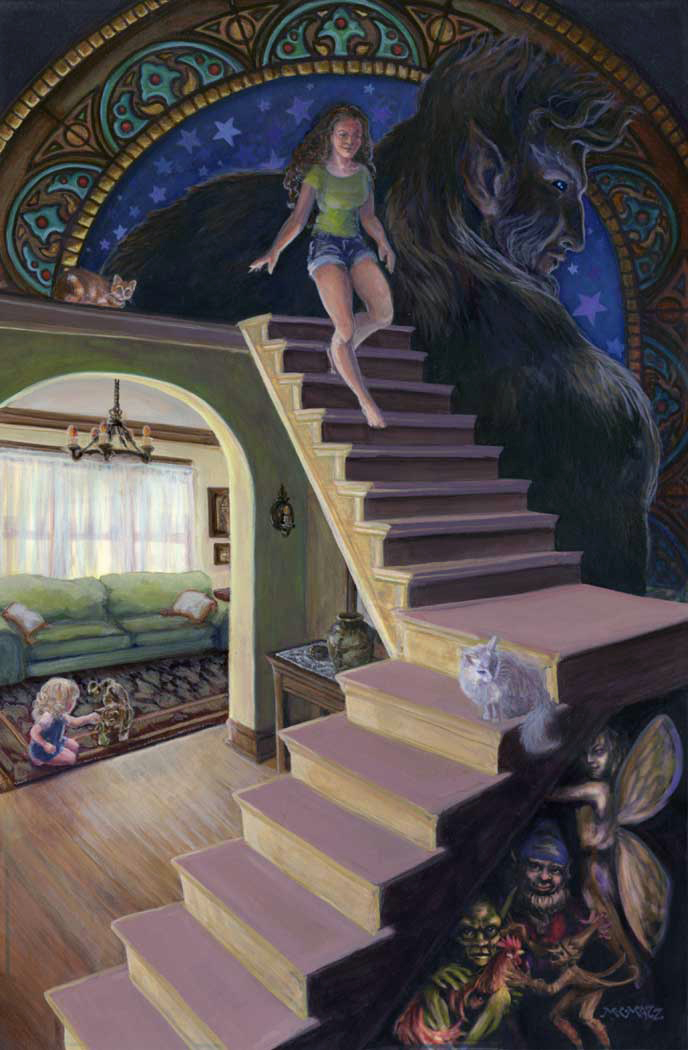
Last week we launched our first Kickstarter comic project: Sticks and Bones: Issue 1 – Home Is Where the Hearth Is.  The comic explores issues of home, roots, identity, and sacrifice on 24 fully-painted pages.

Home Is Where the Hearth Is tells the story of Yaroslav, a displaced house spirit in America looking for a new home. At its heart, this is a fairy tale about love and transformation, and the sacrifices we make to find our place in the world.

You can learn more about the comic and the incentives being offered to backers on our Kickstarter page:

http://www.kickstarter.com/projects/valya/sticks-and-bones-issue-1-home-is-where-the-hearth

We’re hoping to raise $3,500 to cover the costs of production, printing, shipping, and promotion. As is the Kickstarter policy, if we do not raise the full amount, no one gets changed and we will be unable to complete the project. If we raise beyond that around, we plan to print more copies and then begin Issue 2.

Available on the kickstarter page, here’s my attempt at an introductory video (encouraged by Kickstarter). The beautiful musical score is “The Domovyk’s Lament,” written by Rob Lambert. The photos are used with permission by 8 Eyes Photography. The shaky camera is my feeble attempt at videography. Forgive me, I usually work with words, not cameras.

Thank you for your support!