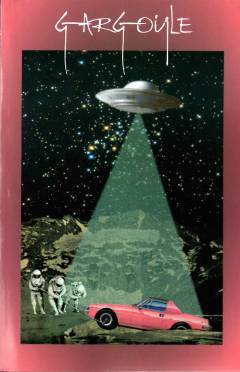
An excerpt from my new short story, “Lament” published in the 40th Anniversary Issue of Gargoyle (66):
Lament
The Steppes, 1550
I sing their souls into heaven without seeing their faces, without knowing their names. In many ways, we are invisible on the battlefield: the blind and the dead.
I stand above this one, the toe of my boot pressing against his thigh. I hear his horse exhale, stamping its hooves into the ground beside his fallen rider. I reach out to touch the animal, feel my fingertips graze its mane. The horse is hot and smells like mud, blood, and excrement.
“Your master is dead,” I whisper in Ukrainian. “I am here to attend to him, just as you have done in life.” I pat his neck. “You have served him well.”
Horses are loyal, more loyal than men. Unless wounded, most horses will remain beside their riders. The animal calms a little under my hand. I kneel and touch the dead man’s shirt to feel around for the absence of his heartbeat. There is a distant wailing from warriors still dying or mourning. The celebration of victory will come later, after the dead have been addressed.
In the darkness, grasses rustle and trees drop their leaves to shroud the fallen. They crackle on the wind, land atop corpses, stick in puddles of blood. I was eight-years-old when stricken with the smallpox that led to my blindness, but I can recall the way Fall colors would blaze, like lighting a fire before everything burns to ash.
I was considered odd even when sighted, and my parents seemed relieved when blindness gave them permission to send me away. I travelled far enough away to escape, embracing the mask of blind minstrel as excuse enough for being an outsider, for being alone, for keeping the best part of myself hidden—except from the dead.
A cold wind blows in my ear, and I hear wings flapping. The vultures circle, and soon hungry things will come crawling through the shadows. I pull my hat down to better cover my head. Northern winds are blowing, and soon there will be snow.
I hold out my hands, and my young guide, Slavko, hands me the wooden bowl we carry. It fits in my palm, because that is the way I whittled it into existence. Slavko has filled it with water we collected from a stream we passed on our way to the battlefield. When I heard the rusalky, the tragic water nymphs who were once drowned women, crying from beneath the ripples, I knew that we would find many dead.
I place the bowl onto the chest of the dead kozak. His soul will use the water to wash and prepare for its journey to the afterlife. My hands shake, betraying my age, and I pause to rub my fingers. When the ache and trembling subside, I touch the dead man’s face—his skin firm, his cheeks bare.
I have performed these secret rites for longer than this man was alive. The rituals are second nature, and death is a familiar companion on my journey; but I know Slavko is getting impatient. I can hear his thighs brushing against one another in a nervous rhythm as he paces beside me. He is nearly a child, disfigured but sighted, and not accustomed to this work. The smell of death alone is disconcerting, but he is right to rush me along. Spirits hide in the darkness, hungry things wait to steal breath, secrets, and dreams.
Something pokes against my shoulder—my instrument being pushed toward me, and I reach over to take the bandura from Slavko, carefully closing my fingers around the neck and strings.
“Patience,” I whisper.
“But there are s-s-so many,” he stutters. “S-so many dead to attend to.”
“They will be patient,” I say, smiling. “They are still realizing that they are dead, and when I sing for them, they will know we are here to help their souls to cross over. The dead only get restless if they are ignored or forgotten.”
Slavko resumes his nervous shuffling, and I turn back to the fallen kozak whose head is resting by my knee. I feel blood wetting my leg. By dawn, I will be covered in much more.
No doubt Slavko had hoped his apprenticeship as a kobzar’s assistant would bring him to church festivals and warm seats by the hearth. Those too are a part of the minstrel’s life, and I have a large repertoire of songs for all manner of joyful occasions. However, I have found that my own gifts are better suited to the dead. The dead are far less judgmental and make for better listeners.
Though I am blind, I always shut my eyes at this point in the ritual. The act of closing them helps me to focus, to feel as if I have control, to set the stage for what comes next.
My fingers fall into their familiar places and strum a few notes on the bandura. I sing a quiet lament—a duma—whose purpose is to honor the warrior’s death. The duma will free his soul from the shackles of its body.
“May God accept your prayers and deeds,
You who have sacrificed your life on this field.
You who have fought with dignity—“
As the soul stirs from the dead body below, I feel the familiar tingling in my hands, the fluttering around my heart. It is happening. Our souls connect.
“Why me? Why now?” asks the dead man, his voice breaking and full of sorrow.
Some souls are silent, but most cry out. The first words by the dead are always questions.
I say nothing. My duty is to sing, to perform the rite of passage so that this kozak who fell in battle will not join the ranks of Unquiet Dead; so that instead he can rest quietly in his grave and transition into the next world.
“Brother, your prayers will not sink to the sea
nor fly away into the clouds.
They will become like a ladder,
leading you up and away
from the shackles of this earthly body—“
* * *
To read the rest and the other wonderful stories published in the 40th Anniversary Issue, you can purchase Gargoyle 66 on their website:
http://www.gargoylemagazine.com/gargoyle/Issues/Issue66.php




Stefan O. Rak lives in New York City, because it makes sense. In the 1940s, his grandparents fled Ukraine for NYC, otherwise he may have never been born. He’s worked as an archival director, film professor, record producer, experimental music programmer, and bartender. Rak’s ADVENTURES OF BASTARD AND M.E. is a pataphysical romp through a seedy underworld of criminal comic characters