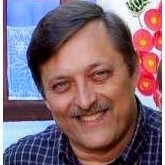
He died a week ago, on Tuesday, June 23, 2015. I haven’t been able to write about his death. I think it’s because it still doesn’t seem real. Even standing with family and friends, watching as his grave was filled with dirt, it was still so hard to believe.
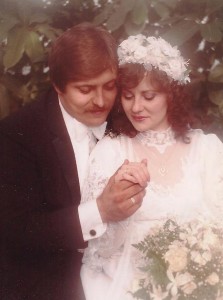
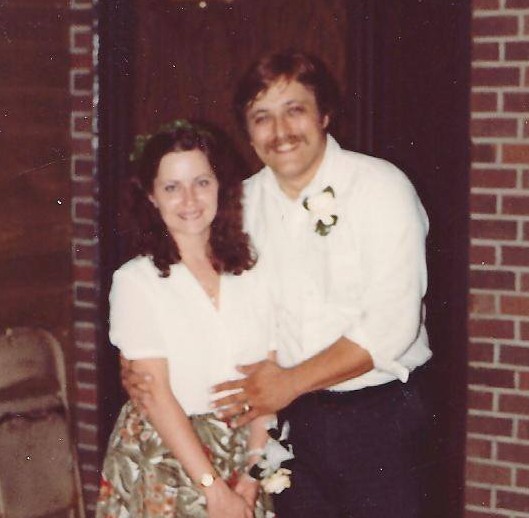
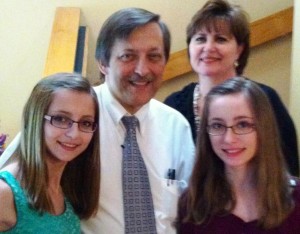
John Chychula married my aunt, Hanusia Dudycz, when I was just 8. I think that theirs was my first real example of courtship as I watched him become a part of our family. Growing up, we have those examples in films, in books, or in life, of couples who have the kind of magic we hope to someday find. I never told Hanusia or John, but for the little girl version of Valya with her head full of dreams, they were that couple for me. He serenaded her! They would dance together. They were in love. They were my fairy tale.
I was just old enough and they were just young enough, that I remember seeing them together before they got married. I loved seeing them dressed up–in costume from the Halloween Maskarada or dressed up in fancy clothes for Malanka. They always looked like they were having such fun together.
However, if I had to point to one thing though that stood out to me, to the little romantic kid watching from the corners—more than the singing or the dancing, more than the way he would put his arm around her—it was the way that John looked at Hanusia, like she was the most remarkable woman in the world. You can see it in their photos, but in life, it was even more powerful. It was magic.
For me, John and Hanusia were better than any movie prince or princess, because they were real, and he was a prince who took the time to play with us—the gaggle of little kids in the Dudycz family. I was always delighted when he was at Baba’s house, because he got down to our level. In one moment, he would be silly and do tricks with his fingers or his eyelids, making us laugh. Then in the next moment, he would ask us questions about our lives and really listen to the answers. It was easy to read on his face that he genuinely cared. Again, it was something in Uncle John’s eyes—they were so kind and gentle.
When I was older, I worked for a few summers downtown in the Department of Human Services, which was in the same building as Drivers Services where Uncle John worked. I would see him at work, and he always treated me like an adult, like an individual, not just his teenaged niece. But that’s how I saw John treat everyone. He took the time to listen to people, to really pay attention. He cared about people. That made an impression on me—the way he moved through the world with such a generosity of spirit.
My oldest daughter is only a few years younger than John and Hanusia’s twin girls. So again the wheel turned, and my relationship with them evolved as we found ourselves parents of young children around the same time. I watched the way he adored his girls, and the way he was once again a doting uncle, this time to my kids and the children of my cousins. I am so grateful that they had the opportunity to know and love him.
Some people have a way of caring about you that makes you feel accepted no matter what. It’s rare, and it’s special. Uncle John was like that—openhearted.
Openhearted.
That is the best word I can find to describe John Chychula. If you knew him, if you ever had the pleasure to spend time with him, if you were blessed to be his friend or family, you know.
Uncle John, you will never be forgotten. Вічная пам’ять.
I’ve been thinking a lot about authenticity, about what is genuine.
It’s something I look for and love about the people in my life: give me honest grumpiness over false pleasantries. I think that’s why I sometimes have a hard time with sarcasm–if I can’t tell what’s true, it makes me uneasy.
I’ve recently had a few conversations with friends about the internet and authenticity–the ways we portray ourselves and the quality of our online relationships.
Just last weekend, I was at a baby shower for a dear childhood friend, sitting at a table with my sister, my oldest friend, and others from the neighborhood. The conversation turned to the love-hate relationship many of us have with Facebook.
My sister refuses to join Facebook, while the rest of us use it to varying degrees. She teased me about some of my posts, brought to her attention by my cousin, who asked if I really do the things I post about (especially with three young kids).
The things I post about really do happen.
But it got me thinking.
When I post a photo or an anecdote about some small instance of joy, like dancing in the kitchen or enjoying coffee under canopy of trees or laughing with friends by a campfire, it’s not to point to them as examples of my everyday life.
My everyday is filled with a rather unexciting routine of kids, coffee, writing, kids, cooking, coffee, housework, relationships, writing, wine, frustration, bickering, procrastination, overcommitment, deadlines, and so on. The everyday is pretty typical. It’s messy, and I’m generally ok with that.
My dining room at this very moment–a mess of homework, Halloween, and the ever-moving piles of paperwork.
Sometimes I will post about the everyday, usually if I think it’s funny because I think it helps to know that other people are dealing with ridiculous moments of child stubbornness or homeowner frustration, but nobody wants to read about the everyday everyday.
So most of my everyday posts are about coffee or wine. Because the sharing of those seems to be a recognizable symbol for “the routine”–a shout out to everyone else, as if to say “Cheers! We’re in this together, this grind of everyday”–without having to specify the details. It’s like a nod of recognition.
Those other moments: the ones that are silly or playful or creative–they are exceptions and exceptional. They are the moments that make me stop and feel gratitude, they remind me to keep perspective, they show me what the everyday is for.
When I share them, it’s because they are outside my norm, because they are not everyday or typical. I feel like they’re a gift, so I share them.
I’ve been reflecting about why I post the things I post: on Twitter, on Facebook, on Tumblr, on the blog. Each one is different, a different tool.
This past year I’ve been trying to write as much as possible: fiction, short fiction, poetry, comic book script. Making a commitment to writing means that I spend a lot more time at home alone on my computer. When I take a break, I pop online. I read a post or some tweets. Then I go back to work.
Twitter? It’s about community for me, the larger writing/arts community, many of whom are not in Chicago. That’s where I can wave to friends who are also writing at 2am, learn about a new poem someone published, or give congratulations for an award or good review. It’s also where I get most of my news.
Tumblr? I post photos and stories that I find interesting and quotes that strike me as compelling. Much of what I post there if for myself, a sort of bookmark for the future. (I tend to use Google+ in a similar fashion).
Blog? I process the world by writing. When something is really important and I’ve been giving it a lot of thought, I often write a blog post. It’s my way of working things out and also inviting a conversation from people I don’t get to see in person.
Facebook? This one is trickier.
Facebook is good for long distance friends and family, for birthday greetings and other milestones. I periodically check-in on people, pick a few folks I’m thinking about and read their posts, skim their photos.
But what about the things I choose to post?
There are the interesting articles and links. I try to only post things I think are compelling or important.
The rest?
I think it comes down to connection.
In her TED talk on vulnerability (and also in her book), Brené Brown says, “Connection is why we’re here. It’s what gives purpose and meaning in our lives.”
I think she’s right. Of course, connection means different things for different people. For some people it’s the close friendship of a handful of trusted friends, for others it’s crowds of fans and followers. Most of us are somewhere in between.
I think at its best, Facebook can be about those little nods that tell us we’re not alone. Especially when we are alone so much of the time.
That’s how I see “likes,” as nods, not in agreement necessarily, but in acknowledgment: I see you, I hear you. In this moment, you are not alone.
Of course, we are. Alone. That’s not necessarily a bad thing. It’s what I loved so much about Louis CK’s talk on Conan.
Louis CK said:
“You need to build an ability to just be yourself and not be doing something. That’s what the phones are taking away, is the ability to just sit there. That’s being a person. Because underneath everything in your life there is that thing, that empty—forever empty. That knowledge that it’s all for nothing and that you’re alone. It’s down there.
And sometimes when things clear away, you’re not watching anything, you’re in your car, and you start going, ‘oh no, here it comes. That I’m alone.’ It’s starts to visit on you. Just this sadness. Life is tremendously sad, just by being in it…And I go, ‘oh, I’m getting sad, gotta get the phone and write “hi” to like 50 people’…then I said, ‘you know what, don’t. Just be sad. Just let the sadness, stand in the way of it, and let it hit you like a truck.’
And I let it come, and I just started to feel ‘oh my God,’and I pulled over and I just cried like a bitch. I cried so much. And it was beautiful. Sadness is poetic. You’re lucky to live sad moments. And then I had happy feelings. Because when you let yourself feel sad, your body has antibodies, it has happiness that comes rushing in to meet the sadness. So I was grateful to feel sad, and then I met it with true, profound happiness. It was such a trip.”
I think Louis CK is right. We need to be able to just stand in the way of moments without the distraction of the phone or the filter of the camera. We need to be able to feel them fully, to be present.
But after? After those moments?
After that profoundly sad moment happened, Louis CK shared it on live television, and it has been archived and passed all over the internet.
Maybe somewhere in there lies the balance?
We need to experience genuine moments–moments of joy or sadness or revelation. But after? Afterwards we can share them.
Facebook can never be a substitute for a face-to-face talk, a hug, the energy of a lively dinner conversation, but the internet does give us a starting point from which we can further connect.
I think it’s always important to remember that the virtual is only part of the whole.
When I raise my mug of coffee in the morning, know that I’m probably setting it down on a large pile of papers to be sorted. Just because I don’t mention them, doesn’t mean they’re not there.
When I’m singing to the Beatles in the kitchen, it may to be to drown out the sound of the kids complaining about homework or fighting over who gets to use the cool, sparkly pencil.
And when we’re dancing in the living room–I often close my eyes not to see the clutter –because sometimes it’s better to just be present in the moment. The rest of it can wait.
We just passed the milestone of 40 days after my Dido’s death. In Ukrainian tradition, this is the time when his spirit moves on to the afterlife, to join my Baba.
Last month, my father and his siblings had to go about the responsibility of preparing my grandparent’s house to be sold.
I’ve grown up with a rich cultural legacy and many family stories, but we never had family “treasures” like other kids I knew. My grandparents left Ukraine during WWII, and they brought very little with them from the Displaced Persons Camps. There were no antiques: no great-grandmother’s rocking chair, no ancestral bible, no great-uncle’s violin.
When my father went into politics and began to acquire a few mementos of historical or cultural significance, it was a big deal for us. These were keepsakes–a word almost reverent because it was rare and new.
My parents would say: Look, here is a photo with the President; you’ll be able to show your kids someday. Here’s a statue your father was given; it will be yours someday.
It was never about acquiring things; it was about building a legacy, something my grandparents had not been able to bring over with them.
However my grandparents, like many of their generation, made up for the lack of keepsakes with the things they themselves made and the rich oral tradition they kept shared. This group of Displaced Persons came to Chicago and built/painted/sewed/baked/engineered with their hands. They created museums, built camps, cultural centers, restaurant, shops, renovated homes, planted trees and flowers. We have a Ukrainian Village in Chicago because of their handiwork (as well as the work of those who came before and after). They got their hands dirty to make a very real foundation–they were crafting a future that connected with their roots.
My sister and I went back to visit my Baba and Dido’s house with my father a few weeks after my Dido died. When we walked in, all the signs of his hospice were gone. On the table and countertops were objects to be disposed of or given to goodwill if no one in the family wanted them. Most of the things were practical everyday objects (kitchen tools for a woman who loved to cook and bake for her friends and family, silverware and dishes from years of entertaining guests) as well as Ukrainian treasures, those things they acquired in Chicago or were given as gifts: wooden handmade vases and plates, paintings and prints, ceramic art and dishes, pysanky, and probably the most precious: those things made by my Baba’s own hands: her embroidery, her pillows and handkerchiefs, her pavuky (straw mobiles).
I felt compelled to have something my Baba used in the kitchen, something she would have used all the time that I could also use: a rolling pin, a cookie cutter, as well as a set of four wine/cordial glasses. My Dido loved to garden, and so from the garage I have a gardening hoe that he made.
It was an odd experience, going through their things in such a way. It got me thinking about what we acquire in our lives and our homes, what we will will leave behind, what we really need.
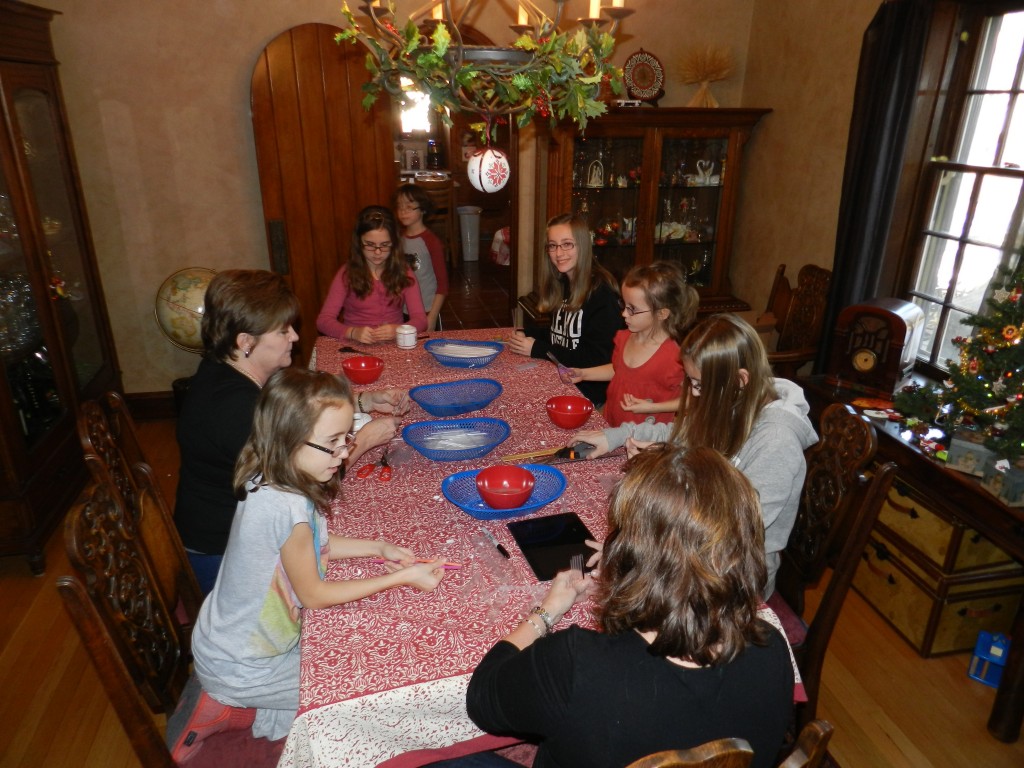
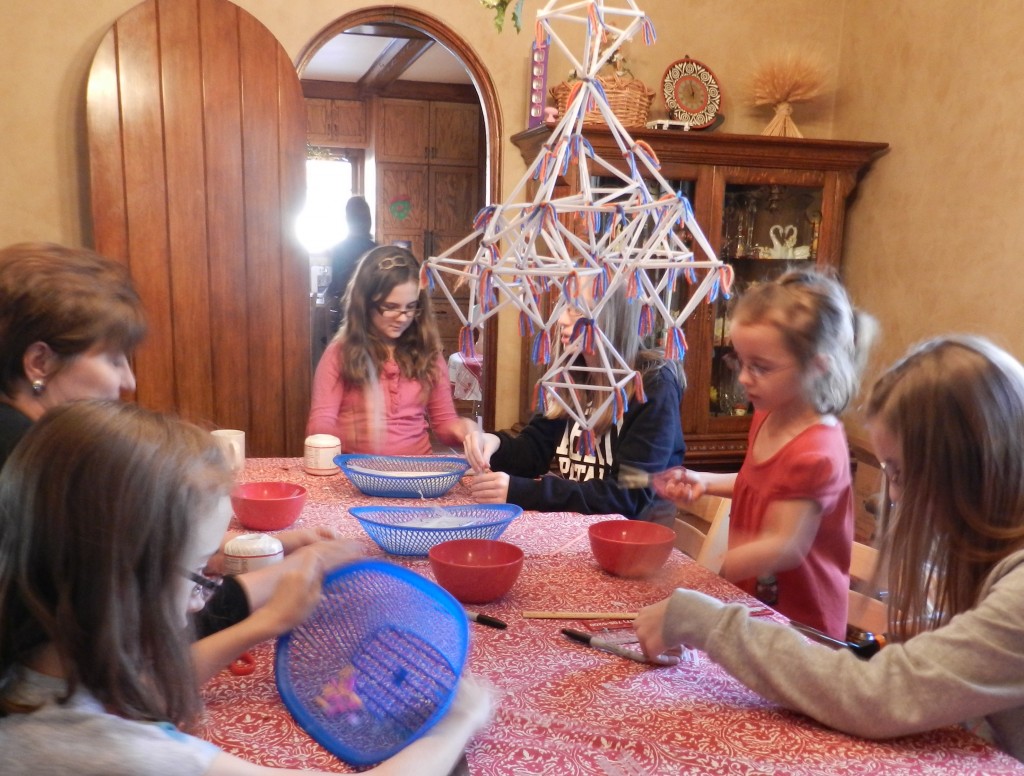
This week my aunts and cousins came over to teach me and my kids how to make a traditional Ukrainian “pavuk.” As long as I can remember, my Baba had these strange straw mobiles hanging in her home.
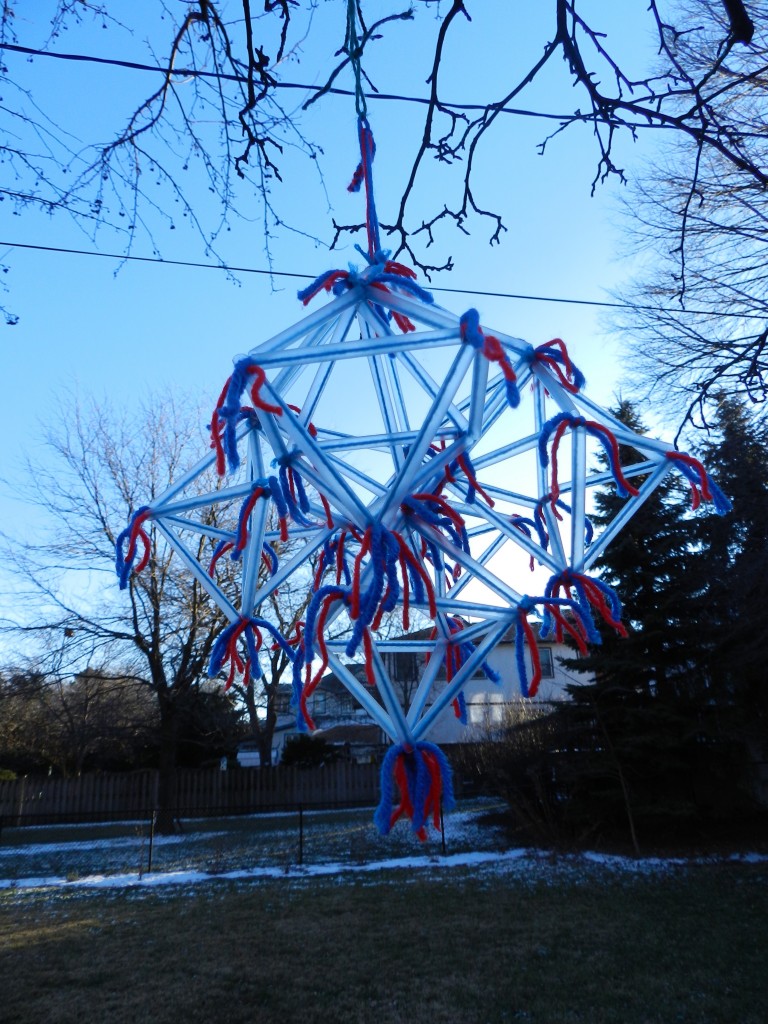
Baba’s Pavuk in the yard.
I think because they were made with drinking straws and blue and red yarn (or whatever colors she had on hand), I assumed it was a craft she came up with on her own. Then a few years ago, my aunt told me that the “pavuk” is actually an ancient Ukrainian tradition. Using drinking straws and yarn was my Baba’s spin on the traditional handicraft, because actual straw was not readily accessible in Chicago. I loved learning from them, and I was so grateful that they had learned from her.
Cutting straws for the Pavuk.
It turns out this handicraft is in danger of dying out in Ukraine. Like so many others, it’s an old ritual that’s being forgotten. Traditionally, the straw was taken from the final harvest, like the straw collected for the didukh (a bundled sheaf of wheat that embodies the spirit of the ancestors and the reminds us of Mother’s Earth’s bounty).
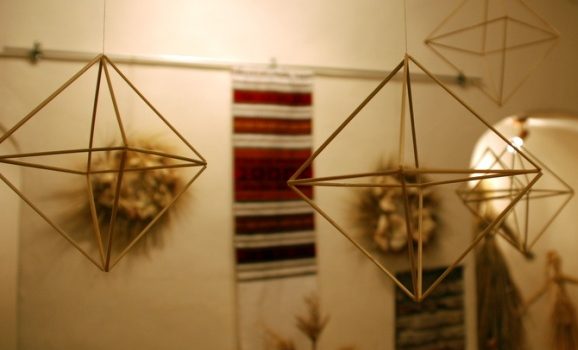
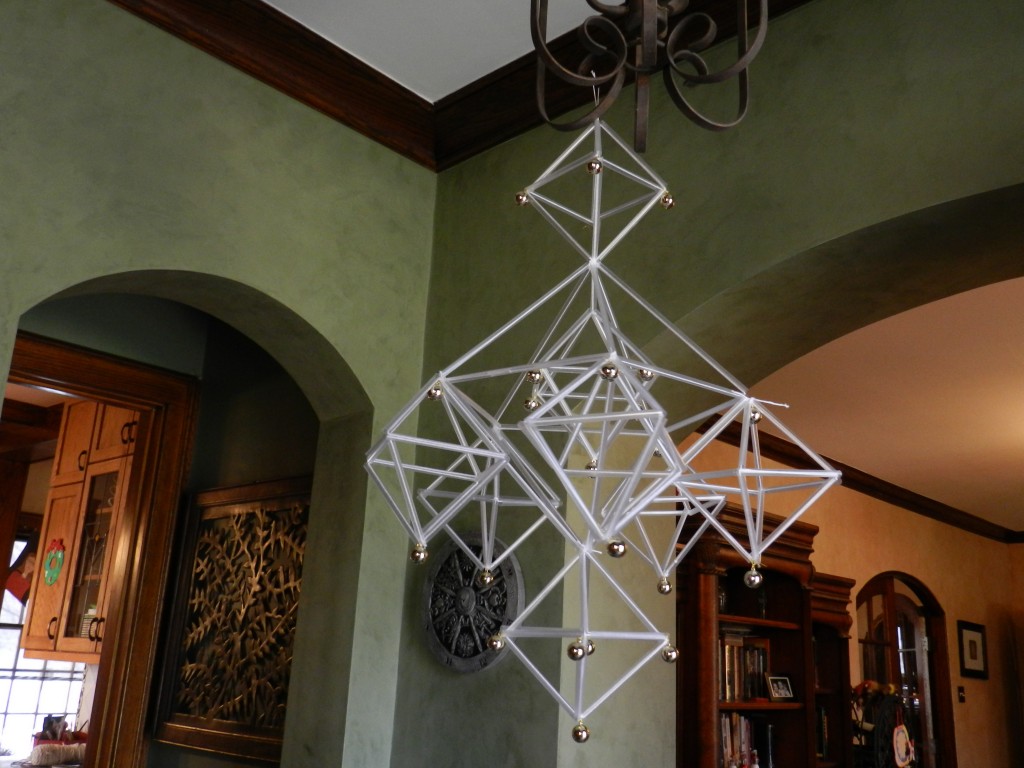
The Pavuk (“spider”) is a mobile that would also be crafted from straw. It would be hung in the home for the winter season. Out of the chaos of these random pieces of straw , they would cut and craft diamond shapes strung together to make a delicate hanging mobile. Some say the name comes from patterns like a spiderweb, others saw that the hanging mobiles themselves are like giant spiders. Either way, it’s a wonderful name and tradition, since spiders are cherished in Ukrainian culture as messengers, harbingers of good fortune.
Pavuk made from straw.
The pavuk would absorb the negative energies and then get burned on the Feast of the Epiphany. Some believed that they should be left hanging in the home to attract good luck for the family. Some moved it to the barn to bring fortune and health for the animals. Either way, the pavuk reminded the family of the bounty of the harvest through the cold winter days.
Our ancestors wanted to bring beauty into the home, and so they did so by adorning their objects (sacred or everday) with symbolic beauty: inlaid wood or carvings, embroidery, or painting. They also crafted gorgeous objects out of gifts from the natural world, like straw and wood. Objects of hope in times of darkness.
Pavuk made by the cousins, 2013.
Winter has historically been a time when people turned inward, became more contemplative. With snow on the ground, they could not toil in the fields or hunt in the woods. They were forced to remain indoors, living off all they had preserved, spending their time making things for Spring, telling stories, playing games, remembering. The land appeared dead or asleep, and starvation was a real threat. All around them were signs of how fragile life can be.
I wonder if many of us are so busy and detached from nature that we forget about how fragile life is and how natural death is?
This Winter I have been less social than usual. I’ve had a a few adventures (and I’ll write about in the next blog entry), but I’ve spent more time in the house with the kids, quiet time with family and friends rather than large parties and robust celebrations.
Hanging in the air is a feeling of solemnity rather than celebration. It’s not sadness exactly, but it’s reverence–an awareness that our lives are changing, that we are shifting into a new chapter. The matriarch and patriarch of my father’s family are now our ancestors. My father and his siblings are the heads of their respective households. The legacy is being passed down in stories and keepsakes. We say their names and share their stories to remember, we use their mug or rolling pin or favorite vase to feel closer to them.
There’s also something else, at least for me. I think with my Baba and Dido dying, I feel my own mortality a little more. It makes me think about whom and what I will leave behind, the stories yet untold, the lessons I hope to impart, the objects I will pass along, the things I make with my hands.
After this past year, death feels more intimate. I now have friends and family on the other side, and I plan to keep the connections strong. In Ukrainian we say Vichnaya Pamyat, which means Eternal Memory. What is remembered, lives on forever.
So I put up their photos, and I talk to them. My father visits the cemetery and brings flowers, blessed bread from church, a kiss. Several of us cousins carry Baba’s handkerchiefs in our pockets and purses. Our children hug their Pra-Baba’s (great grandmother’s) embroidered pillows at night and look for Baba and Dido to visit in their dreams. We share stories, and we teach each other the lessons we have learned from them.

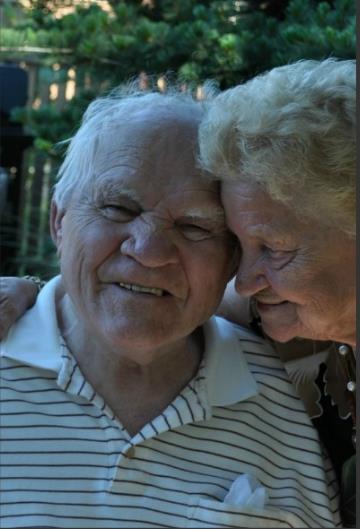 We just passed the milestone of 40 days after my Dido’s death. In Ukrainian tradition, this is the time when his spirit moves on to the afterlife, to join my Baba.