Footsteps, Connections, and Another Year

On February 1, we reach the halfway point between the winter solstice and the spring equinox—the Celts called it Imbolc, and it’s the season of renewal. The wheel turns, and today marks another year, another birthday for me. We are irrevocably tied to the movements and rhythms of this planet.

I catch glimpses of my foremothers in the mirror. I think about the gifts I’ve inherited from them, the lessons I’ve learned, the lessons I keep re-learning. The world I inhabit is so different from the one my grandmothers lived in when they were my age, and yet history repeats, the cycle continues, the more things change…

In a LIFE Magazine profile of James Baldwin (May 1963), Baldwin is quoted as saying,

“You think your pain and your heartbreak are unprecedented in the history of the world, but then you read. It was Dostoevsky and Dickens who taught me that the things that tormented me most were the very things that connected me with all the people who were alive, or who ever had been alive. Only if we face these open wounds in ourselves can we understand them in other people. An artist is a sort of emotional or spiritual historian.”

So much wisdom. We see ourselves in the footprints left on pages. We leave our own for those who come after us. I find myself thinking a lot about what this world is going to look like for my children.

This last year was one of the hardest for me, as it has been for so many. What can we do when the world seems out of control around us: wars, division, a planet being poisoned and aflame. If you believe as I do, that our purpose in this life is to love each other to the best of our ability, it’s hard to make sense of the many who fall back on fear and hatred instead.
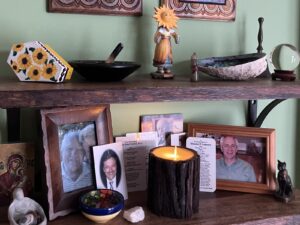
We grieve. We rage. We turn to one another. We love in spite of everything. In the maelstrom, I turn to my rituals and practices, those things that slow me down, that ground me: offering a morning toast to my beloved ancestors, baking and breaking bread, incense and candles on my altar. I call upon the those who have walked before me on this path. I look to the teachers and elders who offer wisdom and ways to work with the land, to honor this planet that is our home, to find ways to heal it and hopefully someday heal ourselves.

One of the voices that has really resonated in my heart this past year is Potawatomi botanist Robin Wall Kimmerer’s. In her book, Braiding Sweetgrass: Indigenous Wisdom, Scientific Knowledge, and the Teachings of Plants, she writes,

“Action on behalf of life transforms. Because the relationship between self and the world is reciprocal, it is not a question of first getting enlightened or saved and then acting. As we work to heal the earth, the earth heals us.”

I love that. It feels true. There is a lot of work to be done in the year(s) to come, and we all have a part to play. We are all connected.

I turn again to Nature as teacher, this time to the words of biologist Merlin Sheldrake, author of Entangled Life: How Fungi Make Our Worlds, Change Our Minds, and Shape Our Futures. Sheldrake writes about how mushrooms and mycelium challenge our ways of thinking about life. From the microbial systems inside our bodies to the broadest networks of roots that stretch across hundreds of miles, we are connected in a series of complex systems.

Sheldrake writes, “Their ability to cling on—and often flourish—through periods of catastrophic change is one of their defining characteristics. They are inventive, flexible, and collaborative.” We have much to learn from fungi, and from the rest of Nature, but that requires slowing down and paying attention, shifting our awareness and expectations.

Writing is one of the things that brings me the most joy in life, and yet this last year I have done very little active writing. That’s something I’m trying to change in the year to come, and I record it here to mark my intention. It’s not always easy to make time for those things that ultimately nourish our heart and spirit, but it is important work. Maybe that will mean more blogging, hopefully it means completing the second volume of the graphic novel and maybe wrapping up some short stories and poems in the works.

I am a believer that reading, researching, daydreaming, and living are all parts of the creative process, and those I have done. I hope that the seeds planted in my imagination take root and flower in the springtime as the world around us turns green and comes back to life. I hope that the seeds you have planted also take root and grow.

Footprints.
Records of a spiritual history.
A season of renewal.

I leave you with one more quote from Robin Wall Kimmerer. Can you imagine if we lived this way, if we treated each other and the planet with this kind of love and respect? It’s a beautiful vision and a lovely blessing:

“Know the ways of the ones who take care of you, so that you may take care of them.
Introduce yourself. Be accountable as the one who comes asking for life.
Ask permission before taking. Abide by the answer.
Never take the first. Never take the last.
Take only what you need. Take only that which is given.
Never take more than half. Leave some for others.
Harvest in a way that minimizes harm.
Use it respectfully. Never waste what you have taken. Share.
Give thanks for what you have been given.
Give a gift, in reciprocity for what you have taken.
Sustain the ones who sustain you and the earth will last forever.”
― Robin Wall Kimmerer
Braiding Sweetgrass: Indigenous Wisdom, Scientific Knowledge, and the Teachings of Plants


A Little Goncharov For Thanksgiving

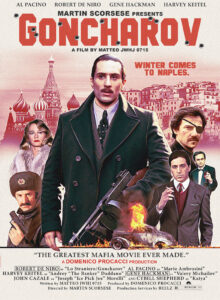
Movie poster for the fictitious film, Goncharov.
Movie poster by Alex Korotchuk, (beelzeebub.tumblr.com)

If you have not heard of the recent Tumblr phenomenon of Goncharov, you have only to google it to read a breakdown by The Guardian, Variety, and NBCnews.

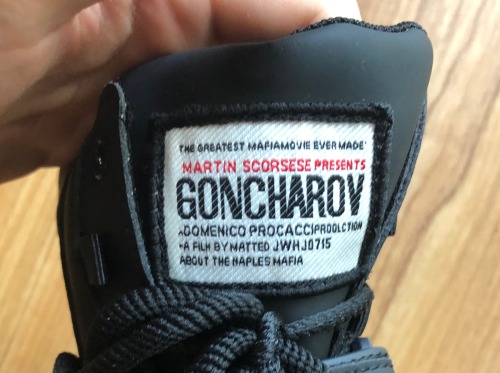
What began a few years ago on Tumblr with a photograph of a pair of boots with a label that read “The greatest mafia movie ever made. Martin Scorsese presents GONCHAROV,” evolved into an online collaborative fan community that is still working to world-build an entire film franchise that never existed. 

I learned about it the way I learn about most memes and pop culture, from my teenagers. In the days leading up to Thanksgiving, we had a group chat spring up on Discord that included two family friends who were going to be joining us for the holiday from out of town. One of the topics of conversation turned to Goncharov, the imaginary film around which an active Tumblr fan community had sprung up, as if it had been a real, little-known cult classic from 1973 made by Martin Scorsese. 

It became a fun creative exercisein the middle of the day, one of the kids would send a question about Goncharov: “What do you think about the relationship between Katya and Sofia?” or “What did you make of the clock tower imagery?” or “Goncharov… iphone or android guy?” To which someone else would playfully answer. 

This same kind of thing was happening on a massive scale on Tumblr, where artists created movie posters and promotional materials, composers posted songs and soundtracks, people posted deleted scenes and script fragments. There are reviews and academic papers, fictitious Wikipedia and IMDb listings, and A LOT of fan art.

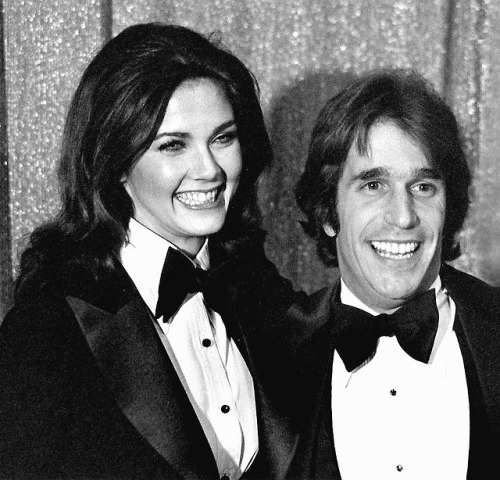
Lynda Carter posted a photo on her Tumblr with Henry Winkler that she captioned, “Me and ‘The Fonz’ at the premiere of Goncharov (1973) at Grauman’s Chinese Theatre.”

Discussions popped up about the characters and who would play them in the reboot. Posts were shared hundreds, then thousands of times. A Goncharov (1973) Lore Google Doc and Discord server were created to help keep the content organized.

Ice-Pick Joe’s Demise.

Our family’s fan-favorite character was Ice-Pick Joe, so I wrote “Musings on Ice-Pick Joe” in between chopping veggies for stuffing and waiting for the sweet potatoes to roast, complete with some AI-generated art. That was four days ago, and the post has been liked and shared more than I anticipated, and I keep thinking about why that is.

Conversations around Goncharov have continued, and I find myself wondering what it is about this moment in time and this type of activity that continues to capture so many people’s imagination and engagement? Tumblr is a hub for public fandom culture and community in a way that the other social media platforms are not. It’s where you can find discourse and fanfiction/fanart for almost anything.

Still, this is a little different and on a much larger scale. At a time when people are looking for Twitter alternatives, with the stress and joy of holidays approaching, what is drawing so many people in?

We talked about this over Thanksgiving: the way Goncharov allowed people low-stakes permission to create, to play to their particular strengths, to connect with other people, to escape reality for a moment, to build a new community. We talked about the shortcomings and challenges we saw: power dynamics, issues of race, etc.

It’s an evolving experiment, and as such, it has been shaped by the many variables involved and course-corrected each time someone notices a gap or opportunity: What would a musical look like? What if some of the actors had gone on Sesame Street or the Muppet Show? What if Gonzo played Goncharov and Miss Piggy played Katya? What would the remake look like set in 1980s NYC? What recipes might be created for the Goncharov cookbook? (I remember how much fun we had making the Forking Good cookbook.) There really is no end to what people can come up with. I’m waiting to see if Goncharov gets a Tom Gauld comic or a mention on Saturday Night Live. 

It seems relevant that role-playing games, both online and tabletop, have recently increased in popularity. Dungeons and Dragons was the cornerstone of Stranger Things, and 50,000 people attended Gen Con (tabletop game convention) in 2022. It’s not my world, although I’ve watched the joy my kids take in it. My energy goes into writing, but I can absolutely appreciate the fun of playing together. 

As a writer, I walk around with worlds in my head, but I don’t get to share them until they get published. Something like Goncharov, which was not an intellectual property “owned” by anyone, gives people permission to imagine and play.

I think it speaks to a need we have an human beings to experience connection, joy, wonder, and hope. We’ve always had those needs. People have been gathering around fires or tables, telling stories, for thousands of years.

Today, the hearth may be a computer or a phone, but the desire is not that different. My November began with the publication of Mother Christmas, my graphic novel, the secret origin of the Santa Claus story which is rooted in the ancient Muses, whose gifts inspire humanity. One of the questions my story attempts to answer is: Where does inspiration come from?

If we look at Goncharov we can see that inspiration comes from so many places. So much is possible when people given themselves permission to play, to shrug off the inner critics and outer trolls, and to imagine for a moment a different world that they have a part in creating. That is such a powerful and compelling idea.

Stories remind us that we are not alone, that we share struggles, and that we can overcome obstacles. There are so many challenges in the world right now. Maybe Goncharov is a lens through which people are seeing themselves and each other, reminding us how much fun it is to make-believe and how powerful it can be to have a shared image of the world.

The first step in creation is imagining. Exercising that muscle, allowing ourselves to play and tell stories and make art is a worthwhile one, and I think it’s one that we need to survive.  The Goncharov phenomenon gives me hope, because if we can have this many people put their energy into creating a whole world around Goncharov, just imagine what else is possible?


My Father Taught Me About Hope

It is my father, Walter Dudycz’s birthday today. These past few weeks I have been thinking about a lot about what he taught me about hope. (In Ukrainian the word is надія….also my sister’s name.) I can see how hope shaped my father’s life, and his example of hope has shaped who I am.

When I was a teenager, I thought that I was just an optimist; but the older I got, the more I realized that was not true. Optimism is not the same as hope. Optimists expect good things to happen.

I’m actually not an optimist. What I am is hopeful. I was taught by my father that hope is the belief that when the bad things happen, you can work together to overcome those things.

That idea and all its parts have shaped everything for me:
It implies awareness that bad things that have happened and will happen.
It calls out that hope requires action.
It also implies that hope can be shared. Hope in community is powerful.
And at its heart, hope is a belief. For my father and for me, belief implies the mystery of something greater than us in the Universe. That belief means that hope and prayer are interconnected.

From my father, I also learned:
We need to keep practicing hope, or we can lose it. The more we use it, the stronger it becomes.
The memory of hope can help us to rediscover it.
Hope is a tool. We take it, and we do things with it. We need hope to make changes in the world.
Sometimes those changes take a long time. Hope can come in tiny steps.
Stories and songs about hope help it to grow and spread.
When we share hope, it gets stronger.

I thought about this when I was at one of the rallies in support of Ukraine last weekend. I saw that hope in my father’s eyes, and on the faces of the people around us holding signs and chanting, as well those passersby who honked and waved.

Someone asked me why we go to rallies, what good does it do? I think I have a better answer for them now after thinking about it.

The answer is hope.

Happy Birthday, Tato

(Photo by 8 Eyes Photography)