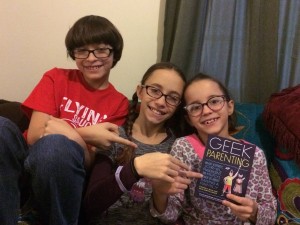
What did you watch with your parents growing up? What do you read with your kids now?
At part of our promotion for Geek Parenting, we’re looking to celebrate the spectrum of geekiness with family portraits and quotes. Dig deep into your family album or take a photo the next time you sit down to play Clue and put on your stormtrooper masks and tiaras (or maybe that’s just our house?) Follow the link and click the “Submit” tab on the Geek Parenting website to send us your picture and a bit of backstory. We’ll choose one every week to share!
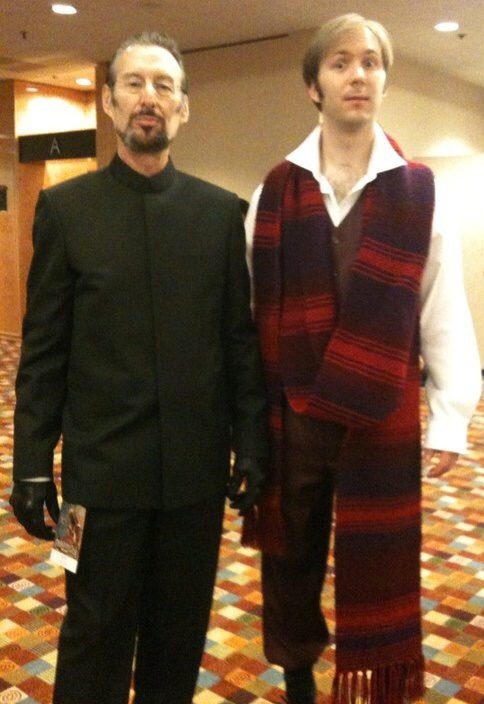
Here’s one to start us off from my coauthor, Stephen Segal and his father dressed up as the Doctor and the Master.
“Dad and I didn’t have the traditional American father-son bonding ritual of football or basketball to bring us closer together. Science fiction did that for us. We started going to Star Trek conventions when I was 12, and always had a blast together collecting T-shirts, autographs, and memories. Still, it wasn’t until more than 20 years later that I finally talked Dad into putting on a costume for DragonCon. We turned to one of those unforgettable Doctor Who moments that had been on in our living room: the Fifth Doctor waking up in the Fourth’s clothes after the Master tossed him off a 200-foot radio telescope. Sure, Dad’s version of the Master was a little more Roger Delgado than Anthony Ainley, but then, that’s my family: We’ll do it our way rather than the official way pretty much every time.” — Stephen Segal
One of the many things that overwhelmed me as a new mother was trying to figure out where I fell on the spectrum of parenting philosophies: Attachment parent? Tiger mom? Ferberization fan? Dr. Sears subscriber? Bringing Up Bébé believer? Not to mention a chorus of friends and family with their own sets of best practices. There were so many voices to sort through…from my mother to Mister Rogers to Super Nanny to Dr. Spock, and so many questions: Will you let your baby cry? Does she sleep in bed with you? How long do you plan to nurse? Will you do sleep training? Will you speak to her in different languages? Each question carried its own opinion and the answers seemed to place a parent in some camp or another.
I cannot speak for all new parents, but I certainly felt nervous and tentative. I was trying to do my best and secretly hoping I might find the “magic combination of rocking, swaddling, and shushing” that would help my baby (and me!) to sleep better, or overcome whatever the next challenge was to come along
I felt like I should “belong” in some camp or another, because how I identified seemed to be important in helping me to figure out what I should do. So I did what I do in most unfamiliar situations–I read everything I could get my hands on and then considered the advice of people I respected. Mark and I tried a few different strategies (some worked, most didn’t), and we eventually fumbled our way into what worked for us: trusting our intuition.
We came to realize that when you’re sleep-deprived, overwhelmed, mentally-drained, and trying to care for your family, it’s really not the time to try on new philosophies or adopt a new world view. Not only did it feel unnatural, but it didn’t stick. Sure, there were things that could be learned, and there was value in educating one’s self about developmental milestones and needs; but we came to feel quite strongly that we needed to trust our instincts–drawing from our inherent strengths, gratefully leaning on the people who offered support, and being humble enough to ask for help when it was needed.
The thing we didn’t realize at the time was that we already did belong to a group, one that was built upon decades of wisdom that we had already integrated into our core being…We were “geek parents.”
We may not have specifically called ourselves by that title at the time, but we did discuss and draw from a common frame of reference that was shaped for years by a steady stream of sci-fi’s pseudo-familial starship crews, comic book examples of courage and persistence, and beloved fantasy characters full of compassion and integrity. Everything we had read and watched and loved had become a part of us and ultimately helped us to be better parents.
Children learn from the world around them, but their first and most important teachers are their parents. They are always watching us, and we teach them with our countless mundane, everyday examples. So in many ways, the path of trying to be a good parent was a continuation of the path of trying to be a good person.
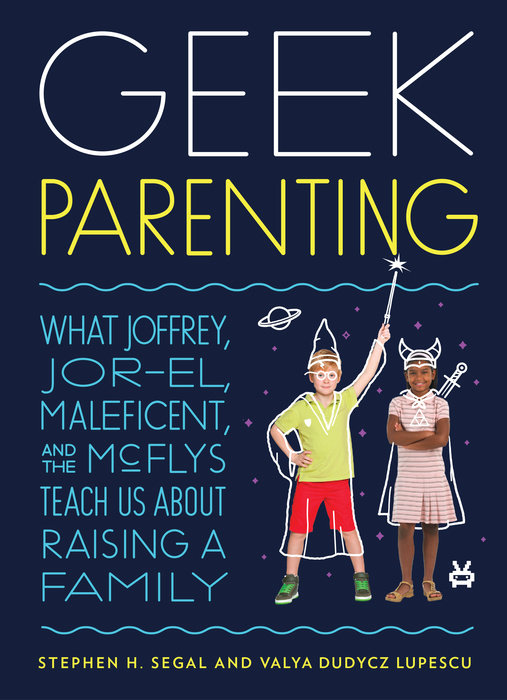
When Stephen and I started working on the book Geek Parenting (What Joffrey, Jor-El, Maleficent, and the McFlys Teach Us about Raising a Family (Quirk Books), our idea was never to create a definitive book on parenting or a revolutionary approach toward raising children. Geek Parenting does not claim that any one philosophy should be adopted when making choices about development or discipline. On our pages, there are dozens of parenting gems from a wide range of sources from a diversity of voices, because at its core, that is what it means to be a geek parent.
Every geek parent is made up of a unique patchwork of geek ideas and ideals shaped by their own particular interests and fandoms. Very few are strictly “one kind of geek.” We may have started with Superman or Star Wars, but those led to other characters, other stories, other worlds.
In his “Song of Myself,” Walt Whitman wrote some of my favorite oft-quoted lines:
“Do I contradict myself?
Very well then I contradict myself,
(I am large, I contain multitudes.)”
Of course Whitman was not talking about geeks. Of course we all contain multitudes. But geeks contain particular combinations of multitudes not often found in others: it may be fairy tales and robotics, or gothic architecture and zombies, or steampunk crafting and Slavic mythology. These highly speculative and imaginative stories show us different ways of envisioning the future, revising the past, and relating to all manner of humans, aliens, gods, creatures.
Geek Parenting celebrates those multitudes. It highlights just a fraction of the hundreds of relationships that have made an impact on geek culture and have provided geek parents with tools and examples for how to cope, how to heal, how to teach, how to forgive.
Geek Parenting is not a book that someone can read to understand the secret to being a good parent. Because there is no secret. There is no one path, no one-size-fits-all philosophy that works. Truly, it goes against the imaginative geek spirit to assert that there can only one way to do…anything.
As part of the promotion for Geek Parenting, we’ve launched a website (www.geekparentingbook.com) that will feature, among other things: quote cards from the book, reblogged parenting or geek material that seems pertinent, Geek Parenting memes, and real-life geek family portraits..
This last part is the most exciting to us because it brings Geek Parenting to life. The portraits will show the beautiful diversity of geek families and the range of geek wisdom that has influenced them.
Geek parents have been outsiders and underdogs, lonely and misunderstood; geek parents have also been heroes and leaders, happy and victorious. Most of us fall somewhere in between. We are scientists, gardeners, teachers, programmers, baristas, firemen, writers, and electricians…Geeks are everywhere, and in many ways our numbers are growing. That gives me hope.
In his now famous TED talk (that has been seen by more than 37 million people), Sir Ken Robinson discusses at length his concern that the schools are educating our children out of their creativity. He argues that the future is going to need creative thinkers more than ever before. “You can’t just give someone a creativity injection,” Robinson said, “You have to create an environment for curiosity and a way to encourage people and get the best out of them.”
I would argue that geek parents are especially good at cultivating environments for curiosity. The multitudes that many of us contain are by their very nature visionary. Whether in life, on the screen, or on the pages of our beloved stories, geek parents have experienced a wide range of what is means to be human, and we have seen countless examples of different possibilities for our future.
That is what Stephen and I want to celebrate in Geek Parenting–the creativity, empathy, and innovation that seem to lie at the heart of so much geek wisdom.
If we can use those lessons to love our children and teach them to question and imagine and strive for a better future, perhaps we will give them the tools they need to make it so.
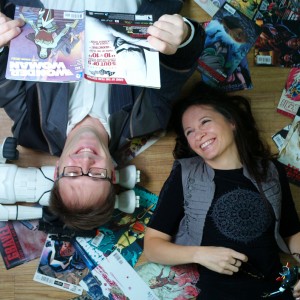
Photo by Kyle Cassidy, at Locust Moon Comics, 2016.
I spend a lot time thinking about how to reconcile being a mother and being a writer (and not just because I have a new book, Geek Parenting, coming out next month.) I’ve been reflecting upon what it means to be a parent today, compared with the way I was raised.
Valya & cousins, 1980.
I grew up with a mother who was wholly devoted to her family. Both she and my father are the children of Ukrainian immigrants who worked grueling day and night shifts in factories and cleaning office buildings. My parents made the conscious choice to always have a parent present for their daughters in a way they never had. My mom was kind and generous to the point of self-sacrifice, preparing homemade meals and cheerfully chauffeuring us from school to Ukrainian dancing, while my dad picked up odd jobs to make up the difference.
It was a life that revolved around family and community, where the needs of the group were more important than the needs of any individual. Family would be there to help in a heartbeat, and when a call went out from the Ukrainian American community, everyone rallied. Again and again, the message was that you should apply your gifts and talents for the greater good. (It’s not really the kind of environment that nurtures writers and artists and independent thinkers, unless your art is tied into a community ethos.)
After toying with the idea of law school, I ultimately decided to pursue my childhood dream to be a writer. Soonafter, I chose to become a writer who would also be a mother.
I didn’t think that those two things were in any way irreconcilable, yet I had no real-life examples of how to create a life that would allow for both. As I tend to do with many things, I dove in and assumed I’d figure it out as I went along.
Frankfurt, Germany 2004
We moved overseas to live in Frankfurt, Germany, and I gave birth to a daughter, two years later a son; and two years after that the youngest of “the Wolflings” was born. I love them, I love their precious, passionate, and wonder-filled experience of the world that enriches my life so completely. We had some grand adventures together with their father exploring ancient sites and museums, tasting new foods and meeting interesting people.
However, I also lost myself for nearly a decade.
People talk about the movies and television shows, books and internet memes of the early 2000s, as I shake my head blankly, making a joke about those “lost” years.
In trying to be a mom to three young children, I threw my perfectionist personality into giving them my everything for those first few years. I reveled in their joy, and in return, they taught me so many important lessons about being a kind, patient, compassionate human being.
But if I am completely honest, I lost touch with a large part of my authentic self in the process. Some of it was compounded by living overseas during much of that time, but not wholly. Much of it was about prioritization and juggling all the parts of a life. I didn’t talk with many friends and family for years, and I stopped writing.
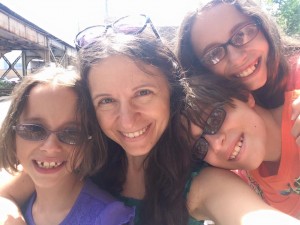
The Wolflings, Frankfurt, 2008.
I didn’t know how to carve out time for me and for my marriage while trying to be a “good mother.” I didn’t know where to look for examples and models. My parents were not a model that worked for me. So many of my creative friends chose not to have kids, and many of those with kids had different challenges. Even as I loved being a mother, I felt like an important part of me was disappearing.
Those of you who know me, know I have a love-hate relationship with technology. But the truth is, the internet saved my creative spirit.
Living in Frankfurt, I got wind of Amazon.com’s new idea to have a “breakthrough novel award” and I pulled out my manuscript for The Silence of Trees that had been sitting on the shelf since my agent and I parted ways a year prior. I made the choice to start writing again. I found online communities of writers.
In 2009, just as I was preparing to move back to the States, I found twitter, and in so many ways that was the most important creative touchstone for me over the next year. Nowhere else could I throw a rock into the waters and know that there was usually someone there to see it and sometimes respond. I met writers and artists who were also up in the wee hours of the morning working: @neilhimself, @NancyHightower, @CynthVonBuhler, @SaraJBenincasa, @Evitchka, @ayeletw, @amandapalmer, and so many others. A few were even parents and talking with them was the greatest of gifts. They became dear friends, many of whom I still see today. I started to feel less alone and more like myself than I had in a decade.
That was when I made a choice to stop seeing myself as a mother of three young kids who would sometimes write whenever I had a moment; and I became a writer, one who is committed to doing the work, who is also a mother. In many ways, it’s a matter of semantics, a small but shuttle shift in perception, but it’s an important change in the way I see myself and approach my work.
Seven years later, and I’m only now starting to truly feel like myself again.
It’s taken a lot of trial and error: a novel published, a literary journal started and then sold, countless routines started and stopped, more manuscripts written, organizations joined, prose and poetry published, more than a few loved ones lost and buried, readings performed and book clubs visited, a marriage that ended but thankfully evolved into friendship, new networks of friends formed and old ones strengthened, and the impending publication of a new book with a kind and supportive co-author.
Over the last seven years, I’ve read a lot of books by other artist parents, and I’ve talked to many working parents to try and figure out just how we can give our children what they need without losing ourselves in the process.
No one has the answer. We all just do the best we can.
I recently read a post by Amanda Palmer that accompanies her new song, Machete. Ever since she became pregnant in 2015, Amanda has been publicly blogging about her decision to have a child with her husband, Neil Gaiman. She grappled candidly with her fears in her blog (read here) and on twitter.
After their son Ash was born, Amanda retreated into that private sanctuary of motherhood that involves sleep-deprivation, doting on the baby and all his needs, and adjusting to all the changes–she was understandably quiet for a while.
Now that Ash is a few months older, Amanda has begun working and writing with greater regularity. This week she released a new song, Machete, dedicated to the memory of her beloved friend and mentor, Anthony, who died a few months before the baby was born and for whom the baby is named. She also released this beautiful image (photograph by Allan Amato):
Photo by Allan Amato, 2016.
Amanda writes on Patreon about her process of creating the song, “Machete.”
“it was at this point that i gave myself what i’d call an enforced crossroads. a fictional ultimatum.
“i was like: ok. you are going to have one of two lives. you are either going to be the person who stayed up and wrote the song, or you’re going to be the person who went to bed and didn’t write the song. you are either going to be a songwriter, or a boring fucking parent. which would you like?
“once i did that to myself, it was curtains. i stayed up and i wrote the song, just to prove to my terrified parent-self that i could. i left the baby in the suitcase, and when he croaked and cried and complained too much, i snuggled him into a wrap against my chest and kept writing. sometimes i had to stop and feed him. i stopped and fed him. then i kept writing. by four in the morning, i had a song.” (Amanda Palmer. “Machette.” Web blog post. 9 Mar. 2016.)
One line cut to my heart like nothing else Amanda has ever written, because in so many ways it paraphrases my philosophy over the last 7 years: “you are going to have one of two lives. you are either going to be the person who stayed up and wrote the song, or you’re going to be the person who went to bed and didn’t write the song.”
(Note: I feel that it’s important to mention that being a parent is not inherently boring, and for many people that is the most beautiful and fulfilling of choices. I’m quite certain that’s not what Amanda meant either. The point is that we all have things that engage our hearts and souls and imagination, and when we ignore those things, so much of the rest of life turns into sad, dull shades of grey.)
I think about those crossroads ALL THE TIME.
There are plenty of mundane things that have to get done: laundry, cooking, cleaning, bills, shopping, driving kids from place to place, papers graded, etc. I’m happiest when I’m filling the rest of the time with things I love to do, whether that’s dancing in the kitchen with the kids, spending time with loved ones, reading or watching something beautiful or provocative, listening to music…and writing.
When I face a decision, I think about whether or not it is aligned with the kind of life I wish to be living. That’s why I now rarely choose to watch television, pick my excursions carefully, and try to pull back on my time on social media–because at this moment, with all the things that require attention, there is just…so little time. I want to make it count, and I don’t want a life always fast and frantic and filled with things to do. Sometimes it means not doing the housecleaning or laundry. Sometimes it means daydreaming on a park swing or taking long walks or playing Clue with the kids. But each one is a choice.
Soon to be 9, 11, and 13, the Wolflings are approaching ages of increasing independence, and I treasure my own independence enough to not seek to deny them theirs. Because as much as I hold dear the memories of their sweet, all-encompassing childhood love, I cannot wait to meet the passionate, creative, compassionate and interesting young people I hope they will grow in to.
I truly believe that one of the best way we can teach our kids is by being their example. It’s something Stephen H. Segal and I wrote about in Geek Parenting, in the context of the show The Legend of Korra: “Be an avatar of the principles you want your child to learn.”
Whether or not we are parents, we all go through our days making choices, some big, most small. Those choices affect other people–they may perpetuate systems or challenge the status quo, they may start revolutions or comfort the quietly dying. Who we love, what we do, how we live–every choice may not rock the world, but it does have ripples. Sometimes we stay up all night and write a story or song, sometimes we hold the hand of a sick friend or comfort a child who had a nightmare.