Tonight is Ukrainian Christmas Eve, Sviat Vechir (Holy Night). Like the Greek Orthodox and many Eastern Rite Catholics, many Ukrainians families will be gathering together at their baba’s or mama’s or aunt’s houses to eat some variation of the traditional twelve dishes and sing Ukrainian carols.
 This year we will go to my mother’s house for Sviata Vecheria (Holy Supper), where we’ll eat varenyky, borshch, kutia, fish, etc. We will leave one seat open for the ancestors, those beloved Dead we remember by name and give a sampling of each meal on their special plate. Later I’ll take that food outside to the tree in my parent’s yard, the one I call the Ancestor Tree. The first Ancestor Tree was cut down, but this one is a beautiful magnolia (She’s the same one pictured in my author photo. She’s a special tree.)
I thought about sharing more of the meal with you, but then I remembered that I’ve done this before.
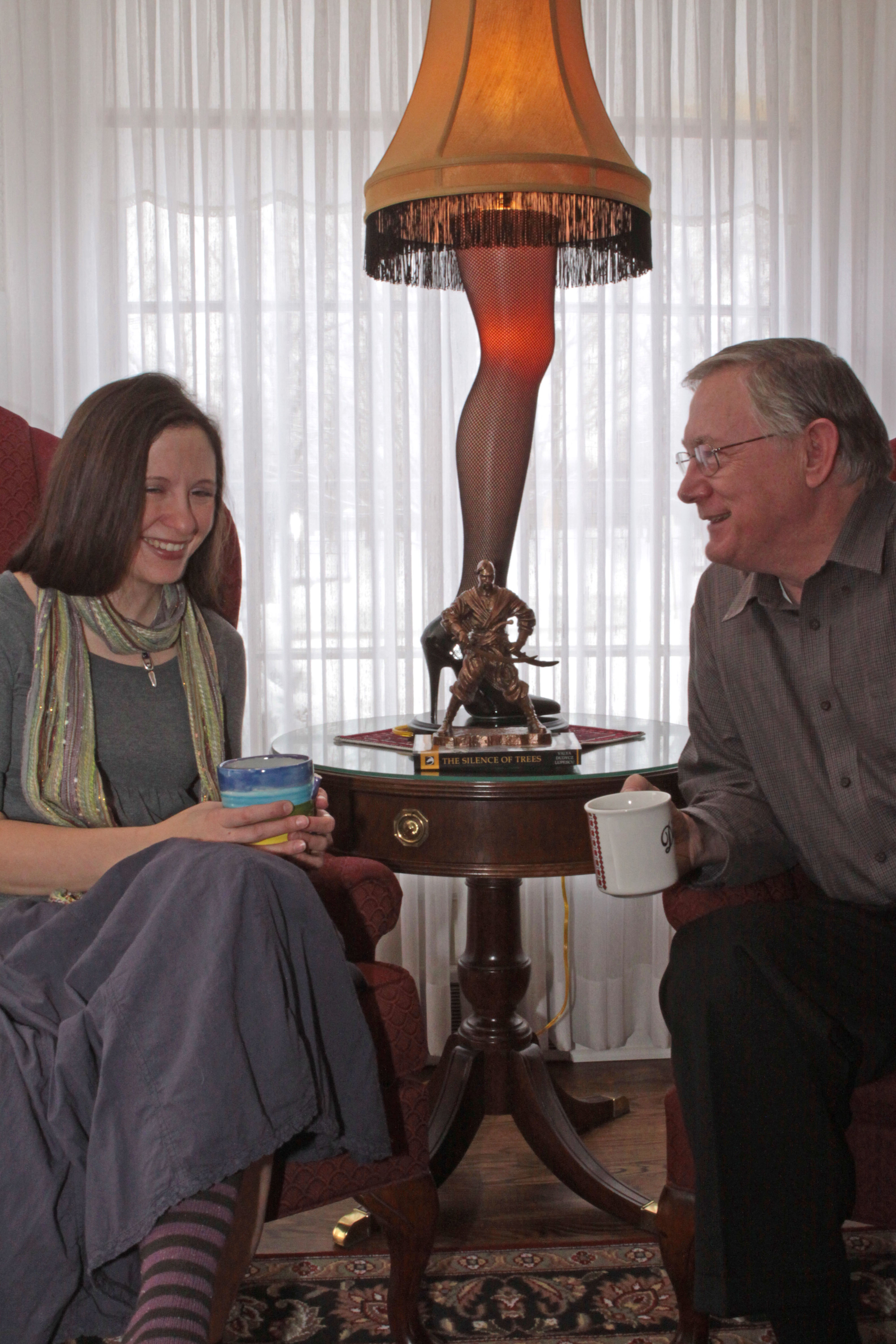
In The Silence of Trees, I give readers a taste of the kind of Sviat Vechir I remember from childhood, when dozens of us would fill my Baba’s little house in the Ukrainian Village. Our family is not that big, not yet. Maybe someday.
But even smaller in scale, the holiday is still special for me, sacred really, these traditions that have been performed by my family for generations, in the dark of winter on Ukrainian soil. It’s about connection and communion and being part of a story that stretches backward and forward in time. This is what we have done and what we continue to do. Even when so much changes in the world, even when we change, we remember. This is how we connect, and in the end, it’s the connections that really matter.
So I leave you with a scene from The Silence of Trees and wish you Veselykh Sviat (Happy Holidays):
On the way home, I stopped at a local flower shop to pick up some wheat and hay. Back home, people believed that our Ukrainian ancestors lived among the fields and crops, the trees and flowers, helping to ensure that each harvest was prosperous, that the lives of their descendants were happy. During the Feast of Obzhynky, the harvest, the best stalks of wheat were gathered into a sheaf called the didukh. On Christmas Eve, the didukh was placed in a special corner for the winter holidays. The ancestors would make their entrance into the family’s home with the arrival of the didukh.
In America, I had had to settle for store-bought wheat, and I hoped that my intention when I was fashioning the didukh would please the ancestors. This year I would be inviting many more than before into my home, and I wanted their arrival to be happy.
Once I was home, I put on a pot of coffee and lit a candle in the icon corner. I checked on the kutia, added a bit more honey, and then got to work preparing the dinner. The dishes were meatless to honor the animals that had given so much during the year. Each dish had its own special meaning. They were the same dishes my Mama used to make, and my Baba before her. Twelve ancient dishes—one for each apostle and each full moon in the year, my Baba used to say.
“These dishes have magical properties, little mouse. They were once served on the longest night of the year,” Baba said, while peeling potatoes for the varenyky. “Each one has a story, and when you make them, you should remember the story like a prayer for your family.”
“A prayer, Baba? Like the ‘Our Father’?” I asked, while playing with the hay we were going to spread under the table for dinner.
“A little bit. But these prayers are older than that. They are like the prayers of a pine tree when a bird makes a nest in her branches, or the prayers of a river when she is full of fish. These are prayers of the spirit, blessings that the mistress of the house prepares for her entire family. You must make each dish with intention. It is a special job, to be taken seriously—” Baba stooped down to tickle me. “—but also with much joy. That’s why it’s good to cook in a house filled with laughter. Some of that joy will get passed into the food and will help the meal be happy.”
So as I prepared the foods, I made my silent blessings—ancient prayers that joined me to a chain of women stretching backward and forward in time. With each sacred ingredient, I blessed my children and their children and their children, on into the future:
Kolachi: Three loaves of bread, each braided into a circle. Everything is interconnected. May they honor life in all its forms.
Kutia: Wheat sweetened by Baba’s wisdom. May they remember their roots,
Borshch: May these tart beets brighten their cheeks and bring them passion.
Baked fish: May they swim in a sea filled with love.
Pickled herring: May they find compassion in times of sorrow.
Pidpenky mushrooms: Let them remember to find beauty in all creation.
Holubtsi: As these cabbage rolls are bursting with rice, may their minds be filled with inspiration.
Varenyky: May they always be grounded, their bellies filled with good food and good sense.
Beans: May they also soar, with active imaginations and open minds.
Cabbage: When times are sour, may they turn to one another for comfort.
Beets with mushrooms: May they find a balance of desire and stability.
Fruit compote: May they not wait until the end of their lives to find the sweetness of joy.
Makivnyk: Cake swirled with poppies and sweetened with honey, like life’s spiral of joy and sadness. At the end of their days, may they have the courage to face their ghosts and dreams, their successes and disappointments.
I thought to myself, when I am gone, who will continue the traditions? Katya? She has no children of her own. Zirka has decided that Ukrainian foods are too high in calories, so she prepares bland versions of some dishes and completely avoids others. Maybe Ivanka. And Lesya, what will Lesya do with her German husband? Will they incorporate his traditions with hers?
Eager to rest my feet, I sat down at the table to fashion the didukh, which I tied with a pretty blue and yellow embroidered ribbon. It had always been Pavlo’s job to make the didukh, and the year before we did not have one.
I went outside to walk clockwise around the house three times before coming back in and placing the didukh in the eastern corner of the dining room, beside the icons, on top of an embroidered cloth. Then I arranged the leftover wheat stalks in a vase and carefully placed hay under the dining room table, hiding nuts, candy, and coins inside the hay for the children to find after the meal.
While I was arranging the treats under the table, Katya arrived at the back door. I heard her unloading things on the kitchen table.
“Are you here, Ma?” she asked.
“Under the table. Did you buy the kolach?”
“Of course.”
“Would you spread out the tablecloths and put the kolach on the table? Place a white candle in the center,”
“You forget I’ve been doing this my whole life,” she said, bending down to show me the loaf of braided bread with a candle already in its center. “And you should have waited for me to do the hay. You don’t need to be bending down under tables.”
“I’m not so old, Katya.”
I walked back to the kitchen and handed her four cloves of garlic to place under the four corners of the tablecloth, to ward off any evil spirits. Together we set out all the candles I had around the house, leaving one in the window to welcome travelers. We warmed the food on the stove and changed our clothes. Then I opened a window to cool off the kitchen, and we sat down to have some tea as we waited for the family to arrive.