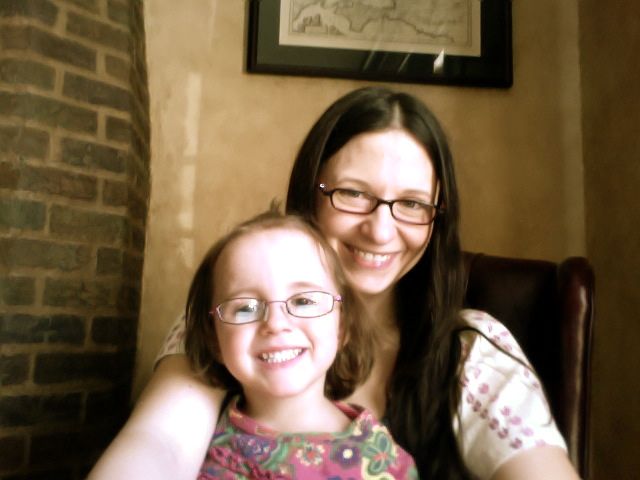
Four Eyes

As of this week, my two youngest children now have glasses. They are five and three years old. My heart hurt a little to see them in their new flexible frames at such a young age, even though I suspected they would eventually need glasses (both Mark and I wear glasses).

Going through the process with the kids, I was reminded of my own experiences getting glasses when I was seven. My parents discovered that I needed them when I stopped being able to read street signs (we played a lot of car games as kids). At the optometrist’s urging,  I started wearing contact lenses at the age of 12. Because my prescription kept getting worse, she hoped that the rigid gas permeable lenses would help to keep my eyes from changing so rapidly. It worked.

I’ll never forget that first time I was able to see myself in the mirror without glasses. Up to that point, my reflection was too fuzzy to see. I only saw myself without glasses in photographs. In school, the glasses definitely made me a bit more self-conscious and shy in school. I was already one of the “smart kids” and glasses made me look the part even more.

I can’t help but wonder how the glasses will affect my kids. So far they’ve taken to them, but I wonder how this will change as kids get older, more critical.

I usually only put them on when getting ready for bed or working at home, but I want my kids to feel confident wearing their glasses in public.

Ah, parenting and the baggage we carry with us from our own childhood.

The Sticky Subject of Kutia a.k.a. Ukrainian “Porridge”

This morning Neil Gaiman was in a NY cab and tweeted about his Ukrainian cab driver, who picked up Neil because he was a man and “if 1st fare is a woman is bad luck all day.”

I replied by explaining that this tradition is likely related to the Ukrainian superstition that a man should be the first one to enter a house (or even call a house) on New Year’s Day. I also shared the tradition of throwing kutia (porridge) onto the ceiling on Christmas Eve. If it sticks, it means good luck for the household, and the more kernels that stick, the greater the luck.

After tweeting:

What I have learned this morning: 1) Ukrainian Taxi drivers are superstitious 2) Ukrainians throw porridge at the ceiling for luck.

Neil apparently received quite a few tweets from Ukrainians in Ukraine who had not heard of this tradition. Some had not heard of the porridge.

After a few tweets redirected my way (thanks, Neil 😉 ), I decided to quickly write this post with a few highlights.

  • The Ukrainian “porridge” to which I was referring is kutia. Some people describe it is as a flummery. Neither is quite right, but they’re close.
  • Kutia is an ancient dish that was once eaten at the solstice and is now the first of the twelve dishes to be eaten on Christmas Eve dinner (called Sviata Vecheria)
  • A nice essay about the variation in Sviat Vechir traditions can be found here, by Orysia Tracz, who has written extensively about Ukrainian traditions.
  • There are several recipes online, and as many variations as there are for Irish oatmeal. Everyone has their own particular way of making it. Google “kutia recipe” for some ideas.
  • The basic recipe we use is to first sort & rinse the bulgur wheat, soak it overnight (6-8 hours), boil it for an hour or so (depends on how long you soaked it and how firm you like it), then rinse again. Add poppyseeds, raisins, crushed walnuts, and honey to taste. In my opinion, the key is in the honey. (Ukrainians have been beekeepers for generations, and Ukrainian honey was prized. Here’s a link for more information from Medyana Rosa.)
  • There is a tradition of throwing the kutia up to the ceiling on Sviat Vechir. My grandparents did this when my father was young, and it continued into my childhood. Our Ukrainian friends and family did this and exchanged stories about it.

The things that I find fascinating about this exchange is that many Ukrainians in Ukraine have not heard of the traditions, while Ukrainians in Diaspora (Canada, US, Australia, Argentina) have likely heard of it from parents or grandparents, even if they don’t still celebrate in the traditional ways.

A few weeks ago I was part of Zlukacamp, a conference with Ukrainian students studying in the US, and the subject of traditions came up. When I was growing up, I was taught (from my parents, grandparents, Ukrainian dancing and school, church) that because Ukraine was not free, it was up to us to learn the language, study the history and traditions, and keep them alive.

My grandparents came from Ukraine (via Germany and the Displaced Persons Camps) in the 1940s. The Ukraine I learned about was very much the Ukraine of the 1930s and 40s, the language of that time, the traditions of that time.

Now Ukraine is an Independent country, but some things have been lost, and other things have changed over time. Like any country and people, they have grown a great deal in the last several decades.

So I’m not really surprised that the tradition is lost, but I’m happy to have been able to share it with some people on Twitter, and I’m glad that I had the opportunity to learn about it as a child, to celebrate it as an adult, and even to write about it in my novel, The Silence of Trees (kutia and Sviat Vechir are a part of the story).

I look forward to someday seeing Ukraine of the 21st century, and I hope to be able to share with them and others some of the treasures from an older Ukraine, a Ukraine rich in folklore, fairy tales, and folk arts.

A Strange Kind of Love

On Valentine’s Day, my oldest daughter went ice skating with her second grade class (where one child bloodied his face, another broke a leg, and her teacher broke her wrist). Luckily my husband took off the day to go with her (and to tend to some things around the house that needed his attention). Each of the kids had classroom parties and returned home to spill out their bags of sweets and cards on the kitchen table to examine before picking out one treat to have before dinner.

The booty they brought home rivaled Halloween. So many children pass out goody bags of candy, pencils, erasers, stickers for Valentine’s Day, St. Patrick’s Day, Easter, Christmas, birthdays. I can’t help but think that the holidays lose some of their magic when they morph into differently colored versions of one another.

At this age, the kids still give everyone in their class a card or piece of candy. At this age, they may or may not pick out a special card for a friend or teacher. At this age, they haven’t quite gotten into the romantic part of the holiday and the potential heartache that come with it. At this age, they still like Valentine’s Day.

I know this will change.

Sooner than I like to admit, there will be wide-eyed infatuation and puppy love, as well as heartache and drama and tears. I remember it so well: the years I did not receive a card from the boy I liked or from the girl I thought was my friend, as well as the years when I walked hand-in-hand with someone for a few secret steps, or arm-in-arm with a “best friend.” The moments were fleeting, but they charged Valentine’s Day with hope and the beautiful fantasy of what it mean to be wanted, chosen, special.

I think that’s the hardest part—wanting to be special. Kids have this desire even at a young age, but they still look to their parents, teachers, or other elders to recognize them in some way. It’s when the need for approval turns to the fickle whims of their peers that even more heartache is possible—no—inevitable.

It was during the loneliest days of  Junior High, that I began to write. What had begun as classroom exercises with a wonderful seventh grade teacher who insisted on in-class essays, evolved into my earliest journal writing and poetry. The essays earned praise, while the personal writing was mostly rambling pre-teen angst that I kept to myself. The important lesson for me was that in the absence of a real-life audience or peer group, I had a place to express myself…on the page.

In her new book, The Window’s Story: A Memoir, Joyce Carol Oats writes:

There are those—a blessed lot—who can experience life without the slightest glimmer of a need to add anything to it—any sort of “creative”effort; and there are those—an accursed lot?—for whom the activities of their own brains and imaginations are paramount. The world for these individuals may be infinitely rich, rewarding and seductive—but it is not paramount. The world may be interpreted as a gift, earned only if one has created something over and above the world. (You can read an excerpt here, on Scribd.com.)

She eloquently put into words one of my fears and the conflict I experience daily as I try to balance writing and life. Does writing keep me from living? Does living keep me from writing? Yes and yes, and so I teeter from side-to-side trying to celebrate and experience both. Some days are more successful than others.

My seven-year-old received a Star Wars valentine from the boy she likes. She has recycled all her valentines but that one.

And so it begins.