Share the Magic of Mother Christmas

Thank you to everyone for your support and enthusiasm about Mother Christmas!

The cover image for Mother Christmas features a woman wearing a warm blue cloak, lined with fur at the collar. We see her only from behind. She is carrying a sack of presents filled with old fashioned toys over her right shoulder, In her left hand, she is holding a frame drum decorated with an image of the sun. She is standing in a snow filled forest, and she has glowing horns and long flowing black hair. A few people have reached out to ask how they can help spread the word about the book. Thank you so much for those offers. I really appreciate them. One of the reasons that my first book The Silence of Trees became an Amazon bestseller when it was first published was because people talked about it.

Here are a few ways you can help to share the Mother Christmas magic:

  • Share a review on  Amazon or Goodreads. Even just a sentence is a great help in making it easier for readers to discover the book. (You should be able to log in to Goodreads using your Amazon account.) 
  • Request that your local library order Mother Christmas for its collection.
  • Post a link or pictures on social media! Personal recommendations and word-of-mouth are the best publicity !
  • Share the Who’s Your Muse quiz. Hopefully it will get people curious about the graphic novel.
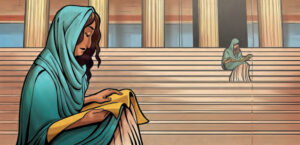
Image of a young woman in flowing dress and headscarf sitting on the steps of a temple reading.

(Thanks for this helpful list to my talented friend Stephanie Feldman, whose second novel, Saturnalia, was just released last month — and with whom I’ll be doing an online Winter Ghost Story event next month!)

I hope to have information about signings and events this week, so you can come and get your copy of Mother Christmas signed or pick up a copy.

If you have other suggestions about how to increase visibility for Mother Christmas, or if you have a bookstore or comic shop that would like to plan an event, you can contact me here.

If you’re new to Mother Christmas and want to learn more, you can read my blog post, “Why Mother Christmas?

Thank you and blessings of the Muses to you. 💜

Who’s Your Muse?

Where does inspiration come from?

We are surrounded by wonders of the human imagination: breathtaking architecture, musical masterpieces, unforgettable plays and poems, world-changing inventions. Human beings are capable of profound innovation—but what is the source of these ideas?

It’s a big question that has been considered by philosophers and theologians, artists and scientists. Answers have been offered in the form of myths and scripture, theories and studies.

One ancient answer to where the ideas come from is: the Muses. The Muses bestow their gifts on humanity, each one dedicated to a specific aspect of the imagination.

A photograph of nine women in the clothing of ancient Rome, each holding a different tool or instrument. They are representations of the nine muses.
Mosaic of the nine Muses found in the ancient Roman city of Augusta Treverorum (modern-day Trier), ca. 250 CE

The story of Mother Christmas is my answer to where does inspiration come from—and what does that magic have to do with Christmas?

The Santa Claus legend is one in a long line of stories about travelers bringing gifts in dark of winter. Around the world, many of the stories told in the cold, dark of winter have to do with finding hope in the promise of spring, and finding inspiration in the mysteries and dreams of the long nights.

What happens when you bring together a young, passionate Muse and a generous, spiritual seeker, united by a desire to inspire humanity and protect them against a growing threat of creatures that feed off fear?

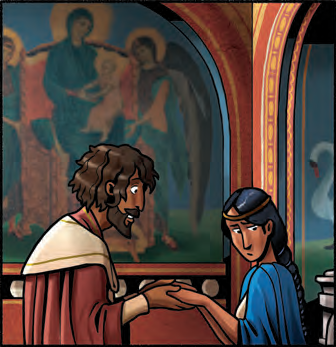
An image of a young woman holding the hands of a young man in a Byzantine church. He will eventually become Saint Nicholas and she will become Mother Christmas.
A panel from Mother Christmas, Volume 1: The Muse.

Why, you get the story of Mother Christmas!

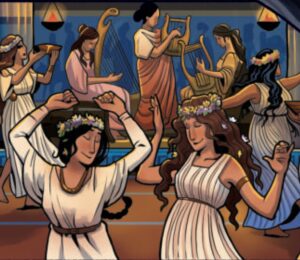
In Volume 1 of the Mother Christmas trilogy, you are introduced to the Muses and their home, the Realm of the Mousai. From ancient times, the Muses have helped to direct people toward their creative potential, each House with its own special focus: watching over them, whispering encouragement, sending dreams and cultivating their fruitful imagination.

I’d like to introduce you now to the Houses of the Mousai as they appear in Mother Christmas:

House of Terpsikhore: Muse of the Body Arts
House of Thaleia: Muse of Comedy and Theater
House of Kalliope: Muse of the Arts
House of Ourania: Muse of the Sciences and Technology
House of Melpomene: Muse of Memorials and Tragedy
House of Kleio: Muse of Leadership and Honor
House of Erato: Muse of Passion and Compassion
House of Euterpe: Muse of Music and Mathematics
House of Polyhymnia: Muse of Spirituality

And then there are those without a house: The Silent Ones, who follow Dea Tacita.

Would you like to know who your Muse is?

Take the quiz below and learn which Muse inspires you.

Words and Witchery: Some References for Slavic Mythology

A tall man in a Mother Christmas t-shirt stands beside a short woman in a Ukrainian embroidered blouse.
Stephen and Valya at Chicon8

Over Labor Day weekend, Stephen and I took the younger two teenagers to their second World Science Fiction Convention: Chicon 8 (San Jose was their first Worldcon in 2019).

Both of us were on panels (usually at the same time), and I was delighted to be on the Slavic Mythology panel with moderator Dr. Jeana Jorgensen, Alex Gurevich, and Alma Alexander. (Unfortunately Alex Shvartsman did not make it to the panel.)

We had a really wonderful and engaged audience, and at the end of our discussion, someone asked for additional references about Slavic Mythology. I agreed to post a list of resources published in English on my blog.

4 masked panelists seated at a table talking with a curtain behind them.
Slavic Mythology panel at Chicon 8.

I’ve done my best to collect them here. I will try to remember to update the post as I acquire new books, or as new media come to my attention.

A small disclaimer: Many books have been published recently about Slavic magic and Baba Yaga. I have not included anything as a nonfiction reference here that I have not personally read and reviewed. Some of the fiction and films, on the other hand, come from other panelists and audience members. I cannot speak to the accuracy of their portrayal or sources.

Nonfiction:

  • Slavic Folklore: A Handbook by Natalie Kononenko
  • Encyclopedia of Russian and Slavic Myth and Legend
    by Mike Dixon-Kennedy
  • The Bathhouse at Midnight: An Historical Survey of Magic and Divination in Russia by W. F. Ryan
  • Mother Russia: The Feminine Myth in Russian Culture by Joanna Hubbs
  • Baba Yaga: The Ambiguous Mother and Witch of the Russian Folktale by Andreas Johns
  • Fairy Tales of the Russians and Other Slavs: Sixty-Eight Stories Edited by Ace G. and Olga A. Pilkington
  • Witchcraft in Russia and Ukraine, 1000–1900: A Sourcebook (NIU Series in Slavic, East European, and Eurasian Studies) by Valerie A. Kivelson and Christine D. Worobec
  • Ukrainian Minstrels: Why the Blind Should Sing: And the Blind Shall Sing (Folklores and Folk Cultures of Eastern Europe)
    by Natalie O. Kononenko
  • The Paths of Folklore: Essays in Honor of Natalie Kononenko
    by Svitlana Kukharenko, Peter Holloway
  • The Gods and Goddesses of Old Europe: 7000 to 3500 BC myths, legends and cult images by Marija Alseikaitė Gimbutas
  • The Magical Universe: Everyday Ritual and Magic in Pre-Modern Europe by Stephen Wilson
  • Baba’s Kitchen Medicines: Folk Remedies of Ukrainian Settlers in Western Canada by Michael Mucz
  • Essential Russian Mythology by Pyotr Simonov

Folklorica: An open-access peer-reviewed journal produced by the Slavic, East European & Eurasian Folklore Association. The Slavic, East European, and Eurasian Folklore Association (SEEFA) is devoted to an exchange of knowledge among scholars interested in Slavic, East European and Eurasian folklore.

Fiction that draws from Slavic mythology:

  • Night Witches by L.J. Adlington
  • The Bear and the Nightingale by Katherine Arden
  • Shadow and Bone series and Grisha trilogy by Leigh Bardugo
  • Rusalka, Chernevog, and Yvgenie by C.J. Cherryh
  • The Age of Witches by Marina & Sergey Dyachenko
  • American Gods by Neil Gaiman
  • “Viy” by Nikolai Gogol (Mykola Hohol)
  • Shadows of Forgotten Ancestors by Mykhailo Kotsiubynsky (translated but difficult to find)
  • The Silence of Trees by Valya Dudycz Lupescu
  • Sticks & Bones: Home Is Where the Hearth Is (comic) by Valya Dudycz Lupescu & Madeline Carol Matz
  • Uprooted and Spinning Silver by Naomi Novik
  • The Secret History of Moscow by Ekaterina Sedia
  • Deathless by Catherynne M. Valente
  • The Forest Song by Lesya Ukrainka (play, translated by Percival Cundy)
  • Mesopotamia by Serhiy Zhadan

Television & Film

  • American Gods (Starz)
  • Shadow and Bone (Netflix)
  • Shadows of Forgotten Ancestors (1965 – Ukrainian: Тіні забутих предків, directed by Sergei Parajanov)
  • The Witcher (Netflix)

Articles:

A stack of books topped by a Baba Yaga figurine.